
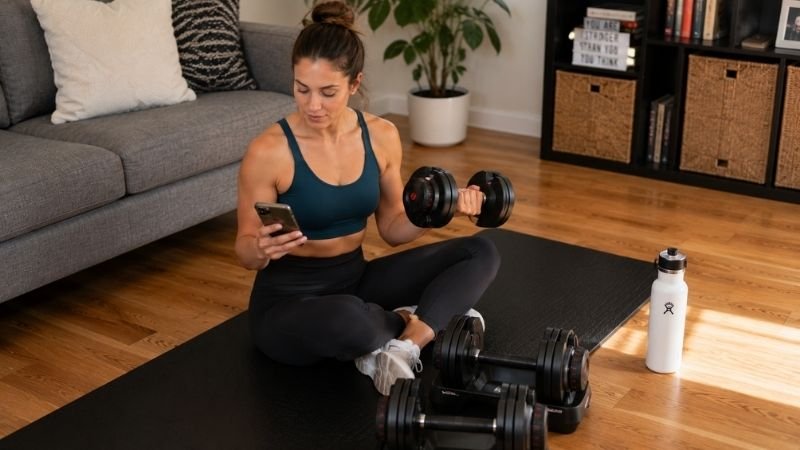
You’ve been showing up. Three, maybe four times a week. You do your squats, your push-ups, your dumbbell rows. You’re sweating, you’re sore, you’re putting in the time. And yet — three months later — you look in the mirror and something feels off. The number on the scale hasn’t changed much. Your arms don’t look different. Your workouts don’t feel any harder than they did in week one.
Here’s the uncomfortable truth that nobody in a beginner workout video ever says out loud: showing up isn’t enough. The effort alone isn’t what makes your body change. There’s a missing ingredient — and it’s not more cardio, more protein, or a fancier workout program.
It’s progressive overload. And once you understand it, everything about your training will start to make sense.
This guide will explain what progressive overload actually is (in plain language, no jargon), why it’s the single most important principle in any home workout, and exactly how to apply it with dumbbells, bodyweight, or any equipment you have at home. No gym required.
Key Takeaways
- Progressive overload means gradually increasing the challenge on your muscles over time — it’s the mechanism that forces your body to adapt and get stronger
- Without progressive overload, even consistent workouts will stop producing results after 4–8 weeks as your body fully adapts to the current demand
- There are 5 ways to apply progressive overload — adding weight is just one of them; reps, sets, tempo, and rest periods all count
- For home workouts with fixed dumbbells, adding reps before adding weight is the most practical and effective progression method
- Research published in the Journal of Strength and Conditioning Research consistently shows that progressive overload is the primary driver of muscle growth and strength gains, regardless of the training program used
- You don’t need a notebook, an app, or a complex system — the simplest tracking method is the one you’ll actually use
Why You Stop Seeing Results After a Few Months (And What’s Really Happening)
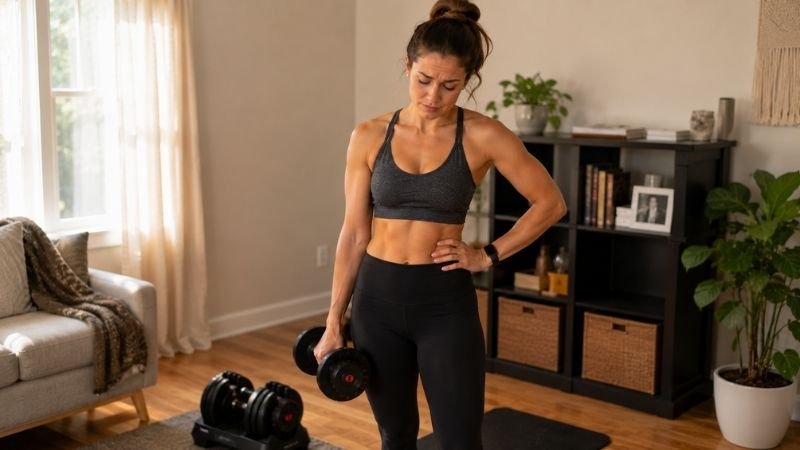
Here’s what’s happening inside your body when you start working out: your muscles encounter a new stimulus — a demand they haven’t faced before. In response, they experience tiny microscopic tears, and your body sends resources to repair those tears and build them back slightly stronger. That’s the adaptation process. That’s how you get stronger.
But your body is extraordinarily good at adapting. Within 4–8 weeks of starting a new workout routine, your muscles have largely figured it out. What was once a challenge has become comfortable. And a comfortable muscle has no reason to keep adapting.
This is the plateau. And it’s not your fault — it’s literally how human physiology works. The problem is that most beginner workout programs never tell you this, or if they do, they don’t explain what to do about it.
The solution is progressive overload: deliberately and systematically making your workouts slightly more challenging over time, so your muscles are always encountering a stimulus that requires adaptation.
Think of it like this. When you first started squatting, 10 reps felt hard. Now 10 reps at the same weight feels like a warm-up. Your body has adapted. If you keep doing the same 10 squats at the same weight forever, you’ll maintain what you have — but you won’t build anything new.
Progressive overload is what keeps the adaptation process happening.
Sportzillax editor note: The people who work out for years without visible change aren’t lazy. They show up consistently. They put in the time. But nobody ever explained this one concept to them, and without it, they’re running in place.
What Is Progressive Overload, Exactly?
Progressive overload is defined as the gradual increase of stress placed on the body during exercise training. In practical terms, it means making your workouts slightly harder over time in a way your body can adapt to — without overwhelming it.
That’s it. It’s not a specific workout program. It’s not a complex periodization system. It’s a principle that you apply to whatever you’re already doing.
The American College of Sports Medicine (ACSM) identifies progressive overload as one of the foundational principles of exercise science — the primary mechanism behind all strength and muscle gains from resistance training.
What progressive overload is not: adding 20 pounds to every exercise every week until you hurt yourself. The “progressive” part matters as much as the “overload” part. Too much too fast leads to injury. Too little produces no adaptation. The goal is the sweet spot — just enough additional challenge that your muscles have to work harder than last time.
5 Ways to Apply Progressive Overload at Home (It’s Not Just About Adding Weight)
Most people think progressive overload means one thing: add weight. And while increasing resistance is the most common method, it’s actually just one of five ways to apply this principle. This is especially important for home workouts, where you might have a limited selection of dumbbell weights.
Method 1: Increase the Weight
The most straightforward method. When your current weight feels manageable across all your sets and reps, move up to the next available weight.
Practical guideline: If you can complete all your planned sets and reps with good form and feel like you could do 2–3 more reps in each set, it’s time to increase the weight.
For home workouts with fixed dumbbells: Dumbbell weights typically jump by 5 lbs (e.g., from 15 to 20 lbs). That’s a 33% increase — sometimes too big a jump for certain exercises. This is where the other methods become essential.
Method 2: Increase the Reps
Same weight, more reps. This is often the most practical progression method for home workouts with limited weight options.
How it works: Instead of 3 sets of 10, aim for 3 sets of 12 next week. Then 3 sets of 14. When you hit 15 reps comfortably, that’s your signal to increase the weight and drop back to 10 reps.
Example progression over 6 weeks:
- Week 1: Goblet squat — 3×10 at 20 lbs
- Week 2: 3×12 at 20 lbs
- Week 3: 3×14 at 20 lbs
- Week 4: 3×15 at 20 lbs (time to increase weight)
- Week 5: 3×10 at 25 lbs (new challenge)
- Week 6: 3×12 at 25 lbs
Method 3: Increase the Sets
Same weight, same reps per set — but add another set. Going from 2 sets to 3, or from 3 sets to 4, increases the total volume of work your muscles do in a session.
When this is useful: When you’ve maxed out on reps at a given weight but the next weight up is too big a jump. Adding a set keeps progression happening without changing the weight.
Method 4: Change the Tempo (Slow It Down)
Same weight, same reps — but slow the lowering phase down to 3–4 seconds instead of 1.
This is one of the most underused progressive overload methods, and one of the most effective. The controlled eccentric phase (lowering the weight) dramatically increases muscle tension and time-under-tension, making the same weight significantly more challenging.
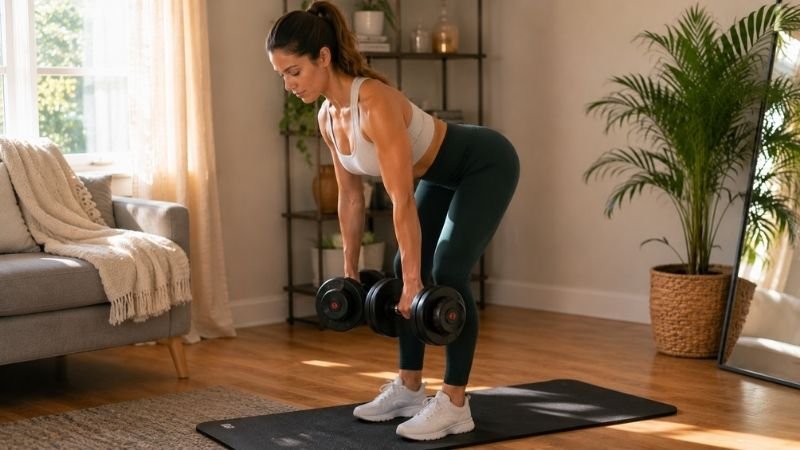
Try this: Do your usual dumbbell Romanian deadlift, but take 4 seconds to lower the weight instead of 1 second. Same weight, same reps — completely different training stimulus.
Method 5: Reduce Rest Time
Completing the same workout in less time is a form of progressive overload. If you rested 90 seconds between sets last week and this week you rest 75 seconds, you’ve increased the density of your training.
For home HIIT and circuit workouts: This is particularly relevant. Shortening rest periods while maintaining rep quality is a meaningful progression that doesn’t require any equipment changes.
How to Apply Progressive Overload With Dumbbells at Home
This is the section most guides skip — the specific, practical instructions for home users with a limited set of dumbbell weights.
The realistic home dumbbell scenario: You have a pair of 15 lb and 20 lb dumbbells. The 15s feel manageable now for most exercises. The 20s feel too heavy for some movements but fine for others.
Here’s how to navigate this:
For upper body exercises (bicep curls, lateral raises, shoulder press): The jump from 15 to 20 lbs is often too big for smaller muscle groups. Use the rep method — stay at 15 lbs and work from 10 reps up to 15–16 reps before moving to 20 lbs.
For lower body exercises (goblet squats, Romanian deadlifts, lunges): Larger muscle groups can often handle bigger weight jumps. Try the 20 lbs and see if you can maintain form for 8–10 reps. If yes, you’ve successfully progressed. If no, stay at 15 lbs and add reps.
For exercises in between: Use tempo progression — slow the lowering phase to 3–4 seconds with your current weight, which significantly increases difficulty without changing equipment.
The hybrid approach that works best: Combine rep progression and tempo progression simultaneously. Week 1: 3×10 at 15 lbs, normal tempo. Week 2: 3×12 at 15 lbs. Week 3: 3×12 at 15 lbs, 3-second lowering. Week 4: 3×14 at 15 lbs, 3-second lowering. By this point, 20 lbs may be ready to try.
Progressive Overload With Bodyweight (No Equipment Needed)
Bodyweight training can absolutely be progressively overloaded — you just need to think differently about it.
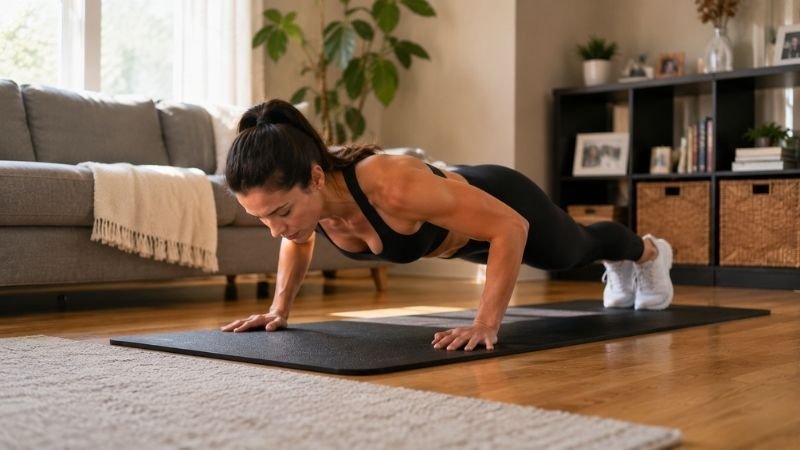
Progression for push-ups:
- Stage 1: Wall push-ups (easiest)
- Stage 2: Incline push-ups (hands on a chair or countertop)
- Stage 3: Knee push-ups
- Stage 4: Full push-ups
- Stage 5: Close-grip push-ups (harder for triceps)
- Stage 6: Decline push-ups (feet elevated — hardest)
This is an exercise getting harder without any weight being added. That’s progressive overload.
Progression for squats:
- Stage 1: Chair squat (sitting and standing from a chair)
- Stage 2: Bodyweight squat, partial depth
- Stage 3: Full depth bodyweight squat
- Stage 4: Slow bodyweight squat (4-second lower)
- Stage 5: Pause squat (2-second hold at bottom)
- Stage 6: Single-leg squat to a chair
Progression for planks:
- Stage 1: 20-second hold
- Stage 2: 30-second hold
- Stage 3: 45-second hold
- Stage 4: Full plank with 60-second hold
- Stage 5: Plank with shoulder taps
Each step is harder than the last. Your body has to adapt. That’s the principle working exactly as intended.
How to Track Progressive Overload Without Overcomplicating It
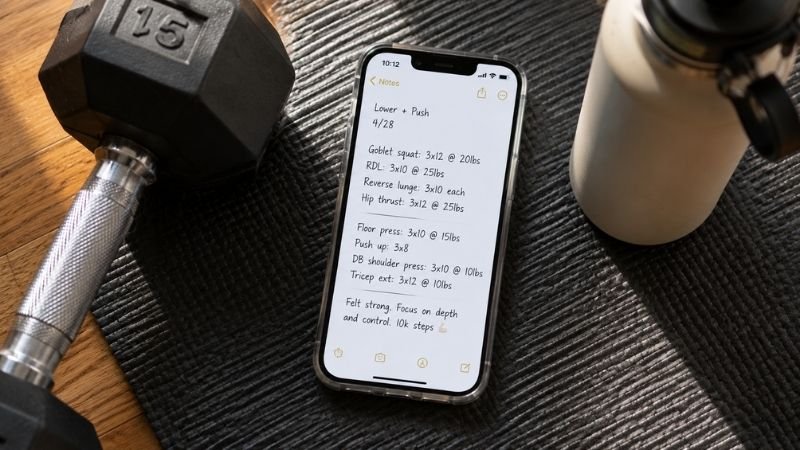
You cannot apply progressive overload consistently without tracking. Full stop. If you don’t know what you did last week, you can’t know if this week is harder.
The good news: tracking doesn’t require a fancy app or a logbook. The simplest system is the one you’ll actually use.
The phone notes method (what we recommend for beginners):
Open your phone’s notes app. After each workout, type:
[Date] - Workout Day 1
Goblet squat: 3×12 @ 20 lbs
Floor press: 3×10 @ 15 lbs
Romanian deadlift: 3×12 @ 20 lbs
Rows: 3×10 per side @ 15 lbs
That’s it. Before your next session, open that note. Your goal is to beat at least one number — one more rep on one exercise, or a slightly heavier weight somewhere. If you do, you’ve applied progressive overload.
The rule of thumb for when to progress:
- If you can complete all planned reps with good form AND feel like you could do 2+ more reps in your last set → increase reps next session
- Once you’ve hit the top of your rep range (e.g., 15 reps) consistently → increase weight
- If the weight jump is too large → use slower tempo or add a set instead
How often should you expect to progress? As a beginner, you might add reps or weight every 1–2 weeks. As you get more advanced, every 2–4 weeks is normal. Progress doesn’t have to happen every single session — and forcing it too fast leads to injury. Slow, consistent progression over months compounds into significant strength gains.
What to Do When You Stop Progressing
Sometimes you’ll hit a genuine stall. You’ve been at the same weight for three weeks and can’t seem to get that extra rep. This happens to everyone.
Before assuming something is wrong, check these first:
Sleep: Are you getting 7–8 hours consistently? Sleep is when muscle repair and strength adaptation happens. Chronic under-sleep is one of the most common reasons progression stalls.
Protein: Are you eating enough protein to support muscle repair? Aim for 0.7–1g per pound of body weight. Strength gains require adequate protein — you can’t build a house without materials.
Recovery: Are you training the same muscle groups two days in a row? Muscles need 48 hours between sessions to recover and strengthen.
Form: As weights get heavier, form often breaks down without us noticing. A form breakdown reduces how much the target muscle is actually working, which stalls progress. Consider deliberately dropping back to lighter weight and rebuilding form.
If all of the above are in check and you’ve been genuinely stuck for 4+ weeks, consider changing one variable: swap one exercise for a variation, shift your rep range, or deload for one week (reduce weight to 60% of normal for a full week of recovery).
Warning Signs That You’re Progressing Too Fast
Progressive overload is about gradual challenge, not maximum challenge. If you’re experiencing the following, you may be increasing too aggressively:
- Sharp joint pain during or after workouts (not muscle soreness — actual joint pain)
- Consistent muscle soreness that doesn’t resolve within 72 hours
- Declining performance week over week despite adequate rest
- Sleep quality dropping alongside increased training intensity
The 10% guideline is widely cited: don’t increase training volume or load by more than 10% per week. This isn’t a hard rule for every exercise, but it’s a useful guardrail when in doubt.
If you experience sharp pain, joint swelling, or symptoms that persist beyond 4–5 days, pause training and consult a healthcare provider.
Frequently Asked Questions
Do I have to increase weight every single workout? No — and trying to do so is a common mistake that leads to injury. Progressive overload happens over weeks, not every session. A realistic timeline is adding reps or weight every 1–2 weeks as a beginner. Sometimes you’ll stay at the same weight for 3 weeks and that’s completely fine, as long as it still feels challenging.
Can I do progressive overload with bodyweight exercises at home? Absolutely. Progressive overload doesn’t require weights — it requires increasing difficulty over time. For bodyweight training, this means progressing to harder exercise variations (knee push-ups → full push-ups → decline push-ups), increasing reps, slowing the tempo, or reducing rest time. All of these are legitimate progressive overload methods.
How do I progressively overload with dumbbells when the weight jump is too big? This is one of the most common home workout challenges. The answer: use rep progression and tempo progression first. Work your current weight up to 15 reps per set before moving to the next dumbbell. While working up, also try slowing the lowering phase to 3–4 seconds — this makes any weight significantly harder without changing equipment.
What’s the difference between progressive overload and just working harder? Working hard matters, but progressive overload is specific: it means the challenge is measurably higher than last time. “Working hard” is subjective. Progressive overload is tracked — you did 10 reps last week and 12 reps this week. That measurable increase is what triggers adaptation. Effort without structure often leads to the plateau most beginners experience after a few months.
How long before I see results from progressive overload? Strength adaptations begin within 2–3 weeks. Visible muscle changes take 6–12 weeks of consistent progressive overload. The people who see dramatic transformations in fitness content are typically 3–6+ months into a consistent progressive overload program — not 4 weeks. Be patient. The compound effect of small weekly improvements over six months is genuinely significant.
Your Next Step
You now understand the most important principle in all of fitness — the one thing that separates people who keep making progress from people who plateau indefinitely.
The immediate action: next time you work out, write down what you did. Weight, sets, reps. Three lines in your phone notes. Then, next session, beat one of those numbers by a small amount. That’s it. That’s progressive overload in action.
Once you have this principle working, apply it to a structured plan:
If you have dumbbells and want a full plan built around progressive overload: → Full Body Dumbbell Workout at Home: The Complete Beginner’s 3-Day Plan
If you want to understand how progressive overload connects to fat loss and muscle preservation: → How to Lose Fat Without Losing Muscle: The Complete Home Guide
If you’re still working out consistently but not seeing the results you expected: → Why You’re Working Out But Not Losing Weight (7 Real Reasons)
References
- American College of Sports Medicine (ACSM). Progression Models in Resistance Training for Healthy Adults. Medicine & Science in Sports & Exercise, 2009.
- Schoenfeld, B.J., et al. (2017). Dose-response relationship between weekly resistance training volume and increases in muscle mass: A systematic review and meta-analysis. Journal of Sports Sciences.
- Kraemer, W.J., & Ratamess, N.A. (2004). Fundamentals of Resistance Training: Progression and Exercise Prescription. Medicine & Science in Sports & Exercise.
- Healthline. Progressive Overload: What It Is and How to Do It. https://www.healthline.com/health/progressive-overload