
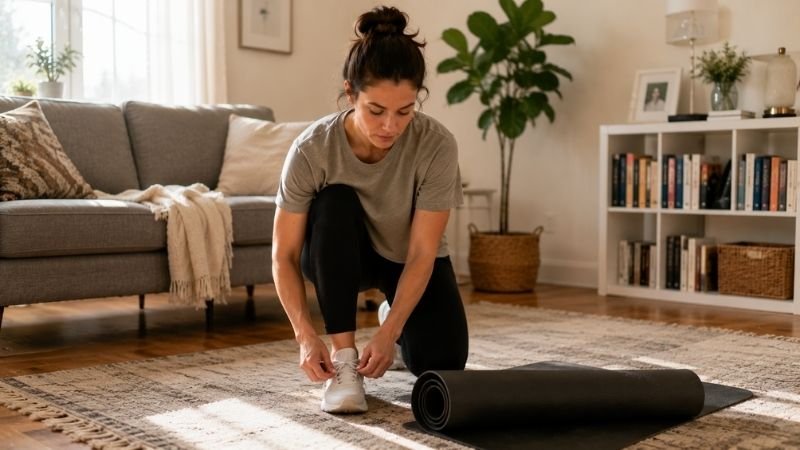
Maybe it’s been six months. Maybe it’s been three years. Maybe it’s been so long that you’ve stopped counting, because counting started to feel like evidence of failure rather than just time passing.
You used to work out. You had a routine — or at least you had something that resembled one. And then life did what life does: a new job, a baby, a move, a season of stress that had no end date, a week off that became a month off that quietly became a year off. It wasn’t a decision exactly. It just… happened.
And now you’re here, thinking about starting again. That impulse — the fact that you’re even thinking about it — is worth something. It means part of you hasn’t given up. It means the person who wants to feel strong and healthy is still in there, just waiting for the right conditions to come back.
This guide will show you exactly how to start working out again after a long break — at home, without a gym, without shame, and without destroying yourself in the first week trying to make up for lost time. We’re going to do this the right way.
Key Takeaways
- Fitness loss after a break is real but reversible — research shows that muscle memory allows people returning to exercise to regain lost fitness significantly faster than beginners building it for the first time
- The most common reason people quit again after restarting is starting too hard, too fast — the first week back should feel almost too easy
- The CDC recommends working up to 150 minutes of moderate activity per week — but for returning exercisers, even 60 minutes in week one is a meaningful and sufficient starting point
- Identity matters more than motivation — research on habit formation shows that people who see themselves as “someone who exercises” are significantly more likely to maintain a routine than those who rely on willpower alone
- The single most effective thing you can do in the first week is not do a great workout — it’s show up consistently, even if the workout itself is modest
First, Let’s Talk About the Thing Nobody Talks About

There’s a feeling that comes with restarting after a long break that fitness content almost never addresses directly. It’s not quite motivation. It’s not quite laziness. It’s something closer to shame — the quiet voice that says you’ve let yourself down, that you should have never stopped, that you’ve wasted all the progress you made, that starting over is somehow embarrassing.
That voice is lying to you. And it’s worth saying that clearly before we get into any practical advice.
Your body did not fail you during the break. Life got complicated. Priorities shifted. The capacity you had for self-care narrowed because something else — a new baby, a difficult season at work, your mental health, grief, survival — required that space. Taking a break from working out is not a character flaw. It is an extremely human response to an extremely human life.
And here’s the practical reality: the fitness you built before is not gone. Your muscles have memory. Your cardiovascular system remembers. Research consistently shows that people returning to exercise after a break regain their previous fitness significantly faster than true beginners — because the neural pathways and muscle adaptations from your previous training don’t fully disappear. They just need to be reactivated.
You’re not starting from zero. You’re starting from experience.
Sportzillax editor note: If you’re carrying guilt about the break, try replacing “I fell off” with “I paused.” Pausing is something you do with something you intend to come back to. That framing is more accurate — and more kind.
Why Most People Fail When Getting Back Into Working Out
Before we talk about what to do, it’s worth understanding why the first attempt often doesn’t stick — because most people make the same predictable mistake.
They come back motivated. They feel the energy of a fresh start. And then they train like they used to train — or like they think they should be training — right from day one. The first session is crushing. The second day brings soreness they’d forgotten was possible. The third day, they can barely walk down stairs. By day five, the whole thing feels like punishment rather than improvement, and the couch starts looking very reasonable again.
This is the all-or-nothing trap. It’s one of the most consistent patterns in returning exercisers, and it’s entirely avoidable.
The solution isn’t less commitment. It’s less intensity, for longer. Research published in the Journal of Strength and Conditioning Research found that starting returning exercisers at 50% of their previous training volume in week one, scaling to 75% in week two, and returning to full intensity by week three produced significantly better adherence and fewer injury-related dropouts compared to groups that jumped back to full intensity immediately.
The first week back should feel almost too easy. That’s not weakness — that’s strategy.
How to Ease Back Into Working Out: Your First Two Weeks
Here’s a practical framework for the first two weeks back. This is designed for home workouts — no gym needed, minimal equipment required.

Week One — Reconnect
Goal: Show up. Move your body. Remind yourself that this is something you do.
Frequency: 3 sessions this week, with at least one rest day between each.
What to do: Each session should take 20–25 minutes and feel manageable — not crushing.
Session structure:
- 5 minutes: walking in place, arm circles, hip rotations (warm-up)
- 15 minutes: 3 rounds of the following circuit:
- 8 bodyweight squats (slow, controlled)
- 6 modified push-ups (on knees is completely fine)
- 10 glute bridges
- 20-second plank hold (on knees if needed)
- 5 minutes: gentle stretching (forward fold, standing quad stretch, chest opener)
The rule for week one: If it feels too easy, that’s correct. You are not training to your limit — you are reintroducing your body to movement. Next week will be harder. Let this week be easy.
Week Two — Build
Goal: Add a little more. Notice what’s getting easier.
Frequency: 3–4 sessions this week.
What to do: Same structure, slightly increased challenge.
- Squats: increase to 10–12 reps
- Push-ups: try 2–3 full push-ups before dropping to knees
- Glute bridges: add a 2-second hold at the top
- Plank: try 25–30 seconds
- Add one new element: 10 reverse lunges (alternating legs)
Check in with yourself: What feels different from last week? Are the squats easier? Is your breathing more controlled? These are real, measurable signs of progress — even when they don’t show up on a scale.
How to Get Back Into Working Out Without Burning Out
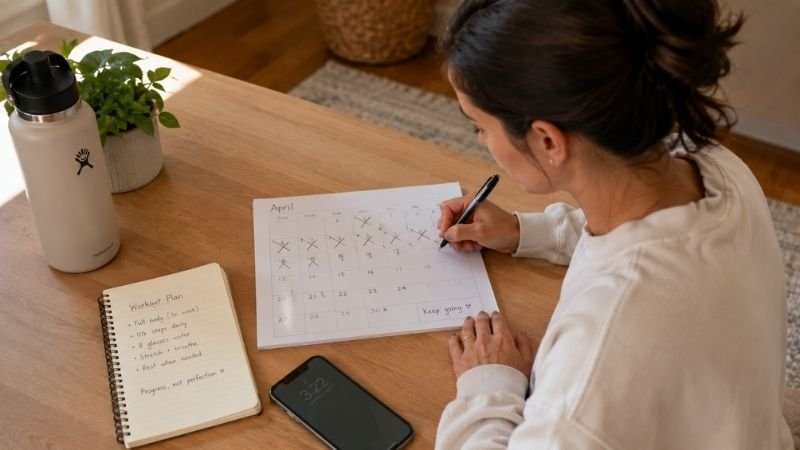
This is the question underneath most searches for “how to start working out again.” The fear isn’t really starting — it’s starting and then stopping again. Quitting for the second time feels worse than quitting for the first.
Here’s what actually works for long-term consistency, based on behavior research and what experienced coaches consistently observe:
Start with frequency, not intensity. Three 20-minute sessions per week is infinitely more valuable than one intense 90-minute session. Frequency builds the habit. Intensity builds the fitness. But you can’t build the fitness until the habit is established. Get the habit first.
Design for your worst day, not your best day. Most workout plans are built for a motivated, rested, everything-going-right version of you. Build your starting routine for the version of you that had a hard day, didn’t sleep well, and the kids are being difficult. If that version of you can still do the workout, the workout will actually happen consistently.
Replace the word “motivation” with “identity.” Motivation is a feeling, and feelings fluctuate. Identity is a story you tell yourself. Research by James Clear and others on habit formation shows that people who see themselves as “someone who exercises” — rather than someone “trying to exercise” — have dramatically higher adherence over time. Start small enough that you can tell yourself truthfully: “I am someone who exercises three times a week.” Then protect that identity.
Make it boring on purpose. Variety is exciting but inconsistency is the enemy of habit. Use the same workout, the same time slot, and roughly the same structure for the first four weeks. Once the habit is established, add variety. Novelty comes after consistency.
What to Do When You Only Have 10 Minutes
Life doesn’t always cooperate with a full 20-minute session. Some days it’s 10 minutes or nothing. Choose 10 minutes every time.
Here’s a 10-minute session for days when that’s all you have:
- 2 minutes: march in place (get the blood moving)
- 3 sets of the following (no rest between exercises, 30 seconds rest between rounds):
- 10 squats
- 8 push-ups (modified is fine)
- 10 glute bridges
- 1 minute: forward fold stretch
Done. It counts. It keeps the habit alive. It deposits into the identity. Tomorrow you’ll have more time, and you’ll show up again because yesterday you showed up.
How to Start Working Out Again at Home: Equipment You Need (Hint: Not Much)

One of the genuine advantages of restarting at home rather than at a gym is that the barrier to entry is almost zero. You don’t need a lot:
Truly nothing: Bodyweight workouts are complete and effective. The first four weeks of this guide require zero equipment.
Yoga mat ($20–$40): Makes floor exercises significantly more comfortable. Worth having, but not essential to start.
A pair of light dumbbells ($30–$60): Once you’ve completed 3–4 weeks of bodyweight work, a pair of 10–15 lb dumbbells for women or 15–25 lb for men opens up a much wider range of exercises and allows progressive overload.
Resistance bands ($15–$25): Versatile, space-saving, and excellent for adding challenge to bodyweight movements without heavy weights.
Don’t let equipment be the reason you wait to start. Start today with what you have. Buy equipment when you’ve proven to yourself that you’ll use it.
The Hardest Part of Getting Back Into Exercise: The Gap Between Who You Were and Who You Are Now
This deserves its own section, because it’s the thing that stops more people than any physical limitation.
You remember who you were at peak fitness — the weights you could lift, the miles you could run, the workouts you could crush. And now you’re back at the beginning, doing modified push-ups and getting winded on stairs. The gap between those two versions of yourself can feel humiliating.
Here’s what that gap actually is: it’s evidence that you’ve done it before. You built real fitness once. That means you have the capacity to build it again. The person who’s never trained in their life doesn’t have that reference point. You do.
The gap is not a punishment. It’s a starting point with a map.
Cleveland Clinic athletic trainer Jason Cruickshank puts it simply: “Don’t dwell on what you used to do. Focus on making incremental improvements as you work back into your routine. Looking forward is more productive than looking back.”
The first few weeks will involve a lot of noticing how different things feel from before. That’s okay. Keep going anyway.
When to Check With a Doctor Before Restarting
For most generally healthy adults, easing back into exercise with low-intensity movement doesn’t require medical clearance. But check with your doctor before restarting if:
- You’ve been completely sedentary for more than two years
- You’re managing a chronic health condition (heart disease, diabetes, hypertension, joint issues)
- You experienced an injury during your break that hasn’t fully healed
- You’re postpartum and within 12 weeks of delivery (see our postpartum guide for specific guidance)
- You experience chest pain, dizziness, or unusual shortness of breath during light activity
These aren’t reasons not to restart — they’re reasons to restart with professional guidance so you do it safely and sustainably.
Frequently Asked Questions
How long does it take to get back into shape after a long break? Faster than you think — and slower than you want. Most returning exercisers notice meaningful improvements in endurance and strength within 3–4 weeks. Visible body composition changes typically take 8–12 weeks. The good news: muscle memory is real, and research consistently shows that people returning to exercise after a break regain fitness significantly faster than those building it for the first time.
How do I start working out again without getting too sore? Start at 50% of what you think you can handle in week one. Serious soreness in the first week is almost always a sign of going too hard too fast — and it’s one of the most common reasons people quit before the habit forms. Mild soreness (feeling it in the muscles you worked, resolving within 48 hours) is normal. Soreness that makes daily movement difficult means you overdid it.
Is it okay to work out every day when getting back into exercise? Not recommended for the first few weeks. Your muscles, joints, and connective tissue need time to adapt to the new demand. Three sessions per week with rest days between is the optimal starting frequency for returning exercisers. Daily low-intensity walking is fine and beneficial — but structured workouts every day without recovery time typically leads to injury or burnout within 2–3 weeks.
How do I stay motivated to work out again after failing multiple times? Replace motivation with identity and systems. Motivation is a feeling — it comes and goes. Build a routine that doesn’t depend on feeling motivated: same time, same structure, same simple workout. Lower the bar enough that even a difficult day can clear it. Three 15-minute sessions per week is a sustainable starting bar. Once the habit is established (typically 4–6 weeks), motivation often follows naturally — it’s easier to feel motivated about something you’re already doing.
What if I start again and then stop again? Then you start again. There is no version of this where a pause becomes permanent unless you decide it does. The people who eventually build lasting fitness habits are not the people who never stopped — they’re the people who started again one more time than they stopped. The restart counts, even if it’s your third or fourth or fifth one.
You Already Did the Hardest Part
The decision to start again — that moment of “okay, I’m doing this” — is genuinely the hardest part of the whole process. Everything after it gets easier, because each session you complete is evidence that you’re someone who shows up.
You don’t need to make up for the time you missed. You don’t owe yourself punishment for the break. You just need to start from exactly where you are right now, do something small today, and do it again in a couple of days.
That’s the whole secret. It’s embarrassingly simple. The difficulty is just in the doing — and you’ve already decided to do it.
When you’re ready to build on this foundation:
→ Beginner HIIT Workout at Home: 20 Minutes, No Equipment, Real Results
→ Full Body Dumbbell Workout at Home: The Complete Beginner’s 3-Day Plan
→ What Is Progressive Overload? The Simple Rule That Makes Home Workouts Actually Work
References
- Centers for Disease Control and Prevention (CDC). How Much Physical Activity Do Adults Need? https://www.cdc.gov/physicalactivity/basics/adults/index.htm
- Kraemer, W.J., et al. (2002). American College of Sports Medicine position stand. Progression models in resistance training for healthy adults. Medicine & Science in Sports & Exercise.
- Clear, J. (2018). Atomic Habits: An Easy & Proven Way to Build Good Habits & Break Bad Ones. Avery Publishing.
- Cleveland Clinic. How to Get Back Into Working Out After a Long Break. https://health.clevelandclinic.org/how-to-get-back-to-exercising-after-a-long-break
- Ogasawara, R., et al. (2013). The time course for strength adaptations after detraining. Journal of Strength and Conditioning Research.