

You set your alarm for 6am. You did the workout. You skipped the office donuts. You drank your water. You did everything “right” — and then you stepped on the scale on Friday morning and it hadn’t moved a single pound.
That moment? That quiet, deflating oh feeling? That’s exactly why you’re here. And honestly, you deserve a real answer — not another list of vague tips that sound helpful but leave you more confused than before.
Here’s the thing nobody tells you upfront: working out but not losing weight is one of the most common experiences in fitness. It doesn’t mean you’re lazy. It doesn’t mean your body is broken. It almost always means one (or a few) of these seven specific things — and every single one of them is fixable.
Let’s go through them together.
Key Takeaways
- A realistic, sustainable fat loss rate is 0.5–1 lb (0.25–0.5 kg) per week — not the 5 lbs/week sold by crash diets
- Exercise alone accounts for roughly 20–30% of your total daily calorie burn — diet does the heavy lifting
- Muscle weighs more than fat by volume, so the scale can stay flat even when your body is genuinely changing
- Sleep deprivation increases hunger hormones (ghrelin) by up to 24%, making it biologically harder to eat less
- You can break most plateaus with two adjustments: tracking more accurately and adding strength training
First, Let’s Get One Thing Straight
Exercise is not broken. You are not broken. The problem is usually a mismatch between what you’re doing and what fat loss actually requires — and those are two very different things.
Most people start working out with the mindset of “burn it off.” Run for 30 minutes, earn back the pizza. Do 100 crunches, flatten the stomach. It feels logical, but that’s not how your body actually works. Fat loss is mostly driven by what happens in your kitchen, not your living room. Exercise is important — genuinely, deeply important — but for different reasons than most people think.
Once you understand that, everything else clicks into place.
Reason #1: You’re Eating More Than You Realize (And It’s Not Your Fault)
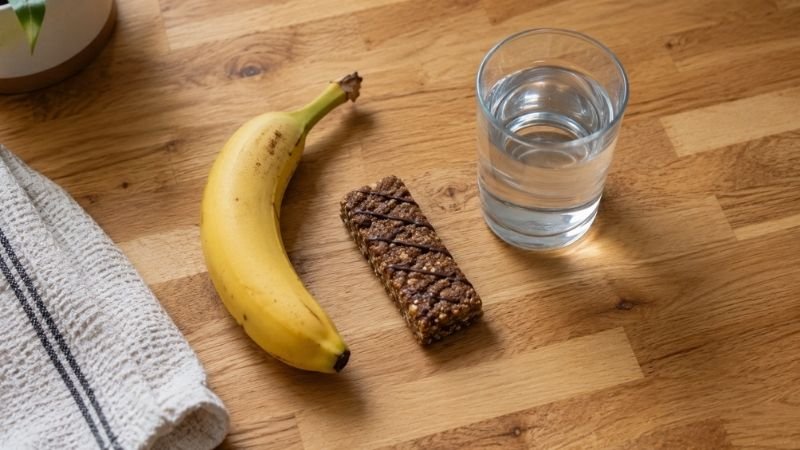
Sound familiar? You start a new workout routine, feel proud of yourself, and then — almost without noticing — your appetite creeps up. You deserve that extra handful of crackers. You earned that bigger portion. You’ve been working hard, after all.
This is called compensatory eating, and research consistently shows it’s one of the primary reasons people who exercise don’t lose weight. A 2012 study in the Journal of Sports Medicine and Physical Fitness found that people routinely overestimate how many calories they burn during exercise and underestimate how many they eat afterward.
Here’s a rough reality check: a 30-minute home workout at moderate intensity burns around 150–250 calories for most people. A “post-workout snack” of a banana and a protein bar can easily run 300+ calories. The math isn’t working in your favor.
The fix — try this tonight: You don’t need to obsess over every calorie. But for one week, try logging what you eat using a free app like MyFitnessPal. Most people are genuinely shocked. You’re not eating badly — you’re just not seeing the full picture.
Sportzillax editor note: We’re not fans of food obsession here. Track for awareness, not punishment.
Reason #2: You’re Only Doing Cardio (And Skipping the Thing That Actually Burns Fat Long-Term)

If your home workout routine looks like: walk, jog, bike, repeat — you’re building a great cardiovascular base. But if fat loss is your goal, cardio alone is leaving a massive opportunity on the table.
Here’s why strength training changes everything: muscle tissue burns more calories at rest than fat tissue does. When you add even a small amount of muscle — even through bodyweight exercises at home — your resting metabolic rate goes up. You burn more calories while sitting on the couch. That’s the long game.
The CDC recommends that adults incorporate muscle-strengthening activities at least two days per week alongside aerobic exercise for optimal health and weight management. Most home exercisers skip this entirely.
The fix — start with just this: Three times a week, after your cardio, add 10 minutes of bodyweight strength work. Squats, push-ups, glute bridges, and reverse lunges. No equipment needed. Do 3 sets of 10-12 reps each. That’s it to start. Your body will respond.
Reason #3: Your Workouts Aren’t Actually Challenging Enough
This one might sting a little, but it comes from a place of complete respect: doing the same workout, at the same intensity, for the same duration every single week will stop producing results. Your body is remarkably good at adapting.
Think of it like this — the first time you carried heavy grocery bags up the stairs, it was hard. Now? You barely notice. Your muscles have adapted. The same thing happens with exercise.
This concept is called progressive overload — the gradual increase of stress placed on your body during training. You don’t need to go harder every single session, but every few weeks, something needs to change. More reps, slightly heavier weights, shorter rest periods, a more challenging variation of the same movement.
The fix: If you’ve been doing the same routine for more than 3-4 weeks and it no longer feels challenging, it’s time to level up. Add 2 more reps per set. Slow your squats down to a 3-second lower. Try a resistance band for your push-ups. Small changes, real results.
Reason #4: You’re Not Sleeping Enough (Seriously, This One Is Big)

You might be doing everything right in the gym and the kitchen — and still not losing weight because of what happens at 11pm when you’re scrolling your phone.
Sleep deprivation directly disrupts the hormones that control hunger and fat storage. Specifically, it raises ghrelin (the hunger hormone) and lowers leptin (the fullness hormone). A study published in the Annals of Internal Medicine found that even a few nights of insufficient sleep caused study participants to eat significantly more and lose significantly less fat — even on a calorie-controlled diet.
For busy moms and working parents especially, this one hits hard. We know you’re not skipping sleep by choice. But even moving from 5 hours to 6.5 hours can make a measurable difference in how your body responds to exercise and food.
The fix: Before you add another workout, look at your bedtime. Can you get to sleep 30 minutes earlier tonight? That’s step one. Phones off, lights dim, 30 minutes earlier. Try it for a week and pay attention to how your hunger feels the next day.
Reason #5: You’re Stressed Out — And Your Body Is Holding On Because of It
Chronic stress is a fat loss killer, and it doesn’t get nearly enough attention in fitness content.
When you’re consistently stressed — work deadlines, a crying baby at 3am, financial pressure, the general chaos of modern life — your body releases cortisol. Cortisol is your stress hormone, and in small doses it’s useful. But chronically elevated cortisol tells your body to hold onto fat, particularly around your midsection, and can increase cravings for high-calorie foods.
If you’re working out regularly but living in a state of constant stress, you may actually be working against your fat loss goals. More intense exercise without adequate recovery can even raise cortisol further.
The fix: This doesn’t mean stop exercising. It means consider what type of exercise you’re doing. If you’re exhausted and stressed, a crushing HIIT session might not be what your body needs today. A 20-minute walk, a gentle yoga session, or a lighter strength workout can be just as valuable — and gives your nervous system a chance to recover.
Reason #6: You’re Measuring Progress the Wrong Way
The scale is a useful tool, but it is a terrible boss. And if you’re only measuring success by the number on the scale, you’re setting yourself up for frustration — even when things are genuinely working.
Here’s what the scale doesn’t tell you:
- Whether you’ve gained muscle while losing fat (body recomposition — this is good)
- That your clothes fit differently
- That your resting heart rate has dropped
- That you have more energy at 3pm
- That you can do 5 push-ups when you couldn’t do one six weeks ago
Water retention alone can cause your weight to fluctuate by 2-4 lbs in a single day — especially around menstrual cycles for women. If you weigh yourself after a salty dinner, after a long flight, or during your period, you will see a higher number that has absolutely nothing to do with fat.
The fix: Keep weighing yourself if you want to — but add other metrics. Measure your waist, hips, and thighs once a month. Take progress photos every 3-4 weeks. Pay attention to how your clothes fit. These tell a much truer story than the scale alone.
Reason #7: You Haven’t Given It Enough Time
Nobody wants to hear this one. But it matters, and we’d rather be honest with you than tell you what you want to hear.
Sustainable, healthy fat loss is 0.5–1 lb per week — sometimes less, and that’s fine. After two weeks, that’s 1-2 lbs. After a month, 2-4 lbs. After three months, 6-12 lbs. Those numbers feel small at the start, but they compound. They stick. Unlike the 10-lbs-in-10-days approach that leads you straight back to square one by next month.
Most people give up right before results become visible. The body often needs 4-6 weeks of consistent effort before the scale starts moving consistently — but visible changes in energy, strength, and how clothes fit can come much sooner.
The fix: Commit to 6 weeks before you evaluate. Not 2 weeks. Not 10 days. Six weeks of consistent effort, then reassess. Take photos on week one and week six. You’ll likely be surprised.
What If You Only Have 10 Minutes?

Life gets in the way. Kids, meetings, exhaustion — we get it. Ten minutes is not nothing. Ten minutes, done consistently, is dramatically better than a perfect workout that never happens.
When you only have 10 minutes at home, try this:
- 2 minutes: warm up with marching in place and arm circles
- 3 minutes: 3 rounds of 10 squats + 5 push-ups (on knees is fine)
- 3 minutes: 3 rounds of 10 glute bridges + 30-second plank hold
- 2 minutes: walk it out and breathe
No equipment. Any living room. Done.
The goal isn’t to torch 500 calories in 10 minutes. The goal is to keep your body in motion, maintain the habit, and show up again tomorrow.
When the Scale Isn’t Moving — And You’re Starting to Lose Hope
This part is for the person who has been doing everything right and is starting to wonder if their body just doesn’t respond the way other people’s do.
You are not an exception to the rules of physiology. If you are genuinely in a calorie deficit and resistance training consistently, your body will change. The timeline might be different than you expected. The way it shows up might be different — more energy, better mood, stronger muscles — before the scale catches up.
But if you’re feeling truly stuck after 6-8 weeks of honest effort, these are worth examining:
- Are you tracking your food accurately? (Measuring vs. estimating makes a big difference)
- Are you actually in a calorie deficit, or just eating “healthy”? (Healthy food can still be too much food)
- Is your sleep consistently under 7 hours?
- Are your stress levels extreme and ongoing?
Try adjusting one variable at a time. One week more accurate tracking. One week earlier bedtime. One week adding two strength sessions. Give each change a week to register before layering in another.
When to Talk to a Doctor
Most of the time, the reasons above explain why you’re working out but not losing weight. But occasionally, there’s something else going on.
Talk to your doctor if:
- You’ve been in a genuine calorie deficit and exercising consistently for 3+ months with absolutely no change
- You’re experiencing unusual fatigue, hair loss, or feeling cold all the time (possible thyroid issues)
- You have significant unexplained weight gain despite no change in habits
- You’re postpartum and struggling with unusual symptoms alongside weight resistance
Medical conditions like hypothyroidism and PCOS can make fat loss genuinely harder — not impossible, but harder, and worth addressing with professional support.
Frequently Asked Questions
Why am I working out every day but not losing weight? Daily exercise without adequate recovery can actually elevate cortisol and stall progress. Rest days aren’t optional — they’re when your body rebuilds. Try 4-5 days of structured exercise with 2-3 days of light activity or rest.
Can you be working out but gaining weight instead of losing? Yes — and it’s often a good sign early on. If you’re adding strength training, you may be building muscle while losing fat. The scale might stay flat or rise slightly while your body composition genuinely improves. Measure your waist and how your clothes fit, not just the scale.
I’m exercising but not losing weight — could it be hormonal? Possibly. Hormonal fluctuations — including those from the menstrual cycle, perimenopause, stress, or thyroid conditions — can affect both water retention and fat loss rate. If you suspect a hormonal issue, a conversation with your doctor is worthwhile.
How long does it take to see weight loss results from working out? Most people begin to notice physical changes — more muscle tone, clothes fitting differently, improved energy — within 4-6 weeks. Scale changes often follow at 6-8 weeks. Give it time before adjusting your approach.
Is it better to do cardio or strength training to lose weight at home? Both — but if you have to choose, strength training wins for long-term fat loss. It builds muscle that burns more calories at rest. The ideal home workout combines 2-3 days of strength training with 2-3 days of moderate cardio like walking, cycling, or a beginner HIIT routine.
Why am I working out but not losing weight female-specific tips? Women’s hormonal cycles can cause significant water retention throughout the month — sometimes 3-5 lbs of fluctuation. Weigh yourself at the same time each month (ideally a few days after your period ends) for the most accurate comparison. Don’t judge weekly progress by the scale alone.
What should I eat after a home workout to support fat loss? A meal or snack with protein and carbohydrates within 1-2 hours of your workout helps your muscles recover without undoing your calorie deficit. Examples: Greek yogurt with fruit, eggs on toast, or a protein shake with a banana. Keep it moderate — a good recovery meal is around 300-400 calories.
What to Do Next
If you’re working out but not losing weight, you now have seven real reasons — and seven real fixes. Start with the one that sounds most like you.
Is it the food tracking? Start logging for one week. Is it sleep? Set a bedtime alarm tonight. Is it only doing cardio? Add 10 minutes of bodyweight strength work to your next session.
You don’t need to fix everything at once. Pick one, work it for two weeks, then layer in the next. That’s not the slow road — that’s actually the fastest path to results that last.
And remember: the scale is not the whole story. Keep showing up.
References
- Centers for Disease Control and Prevention (CDC). Physical Activity for a Healthy Weight. https://www.cdc.gov/healthyweight/physical_activity/index.html
- Nedeltcheva, A.V., et al. (2010). Insufficient Sleep Undermines Dietary Efforts to Reduce Adiposity. Annals of Internal Medicine. https://www.acpjournals.org/doi/10.7326/0003-4819-153-7-201010050-00006
- Thomas, D.M., et al. (2012). Why Do Individuals Not Lose More Weight from an Exercise Intervention at a Defined Dose? Journal of Sports Medicine and Physical Fitness.
- British Heart Foundation. Why am I not losing weight? https://www.bhf.org.uk/informationsupport/heart-matters-magazine/nutrition/why-am-i-not-losing-weight
Ready to take the next step? Check out our [Beginner Home Workout Plan] — a week-by-week guide designed for real people with real lives.