
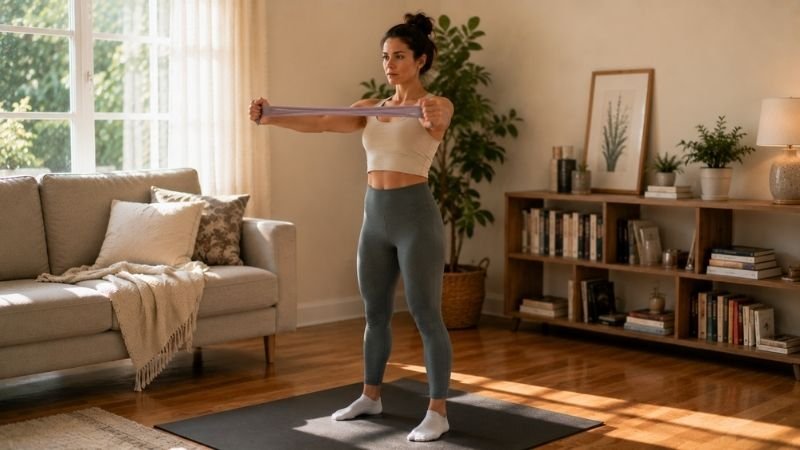
There’s a good chance you have a set of resistance bands sitting somewhere in your home right now — still in the packaging, or shoved in a drawer after a few half-hearted attempts. You bought them because they seemed like a smart, affordable way to work out at home. And then you weren’t entirely sure what to do with them.
That’s not a you problem. Most beginner content on resistance bands gives you a list of exercises with no context — no explanation of how to put them together into a real workout, no guidance on which band to actually use, and no honest answer to the question you’re really asking: can these cheap little bands actually get me results?
The honest answer is yes — more than most people expect. Research published in the Journal of Human Kinetics found that resistance band training produces similar strength and muscle gains compared to free weight training, with the added benefit of lower joint stress. For home workouts especially, a good set of resistance bands can replace a lot of expensive equipment.
This guide gives you 12 of the best resistance band exercises for beginners, organized by muscle group, plus a complete workout plan you can start today. We’ll also cover how to choose the right band, what resistance bands can realistically do for fat loss, and when you might want to add dumbbells to the mix.
Key Takeaways
- Research consistently shows resistance band training produces comparable strength and muscle gains to free weights for beginners and intermediate exercisers
- A complete resistance band set typically costs $15–$35 and replaces hundreds of dollars of gym equipment for most home workout needs
- Resistance bands are particularly effective for glute, shoulder, and back exercises — muscle groups that are often undertrained with bodyweight alone
- For fat loss, resistance bands work best when combined with a slight calorie deficit — they build muscle that raises your resting metabolic rate over time
- Beginners should start with light to medium resistance (typically the yellow or green bands in most sets) and progress to heavier bands over 3–4 weeks
- The CDC recommends 2 days of muscle-strengthening activity per week — a resistance band workout 2–3x per week meets this guideline completely
What Can You Actually Achieve With Resistance Band Exercises?
Let’s set realistic expectations — because “resistance bands build as much muscle as weights” gets taken out of context a lot.
Here’s what the research actually says: for beginners and intermediate exercisers, resistance band training produces meaningful strength and muscle gains — comparable to machine and free weight training in most studies. The mechanism is the same: your muscles are working against resistance, experiencing micro-tears, and rebuilding stronger. The tool delivering that resistance (band vs. dumbbell vs. machine) matters less than the fact that your muscles are genuinely challenged.
What resistance bands do particularly well:
- Shoulder and back exercises — the pull pattern works beautifully with bands, and the constant tension throughout the range of motion is actually an advantage over free weights for exercises like rows and pull-aparts
- Glute and hip work — banded squats, hip abduction, and glute bridges with bands are among the most effective glute exercises available, period
- Low-impact movement — the elastic resistance is gentler on joints than free weights, making bands excellent for people returning from injury or with joint sensitivities
What resistance bands do less well:
- Very heavy compound lifts — heavy deadlifts, heavy bench press, and movements where you need 200+ lbs of resistance require barbells or heavy dumbbells; bands max out around 80–100 lbs of resistance for the heaviest sets
- Exercises requiring a fixed, stable resistance — bands get easier at the start and harder at the peak of movement (variable resistance), which some exercisers find uncomfortable for certain movements
For beginners doing home workouts? Resistance bands are an excellent primary tool. For intermediate-to-advanced lifters? They’re best used as a complement to dumbbells and barbells.
Sportzillax editor note: Don’t let “not as heavy as barbells” discourage you. A set of resistance bands at home, used consistently 3x per week, will produce visible results within 6–8 weeks for most beginners. That’s not a small thing.
Resistance Bands vs Weights — Which One Should You Use?
This is one of the most searched questions around home fitness, so let’s answer it directly.
Choose resistance bands if:
- You’re a beginner — bands are more forgiving on form and joints
- You’re working with a small budget (a complete band set costs less than a single dumbbell pair)
- You travel or have very limited space
- You want to focus on glutes, shoulders, and back (bands excel here)
- You’re postpartum or returning from injury
Choose dumbbells if:
- You want to do heavy lower body compound movements (goblet squats, Romanian deadlifts)
- You want to build significant upper body mass over time
- You find bands uncomfortable or the variable resistance distracting
- You’re past the beginner stage and need heavier loads
The best answer for most home exercisers: both. A set of resistance bands ($20–$35) plus a pair of light dumbbells ($30–$60) gives you everything you need for a complete home workout program at minimal cost. Start with bands, add dumbbells when you’re ready.
How to Choose the Right Resistance Band
Before the exercises — a quick guide to not buying the wrong thing.
Two main types:
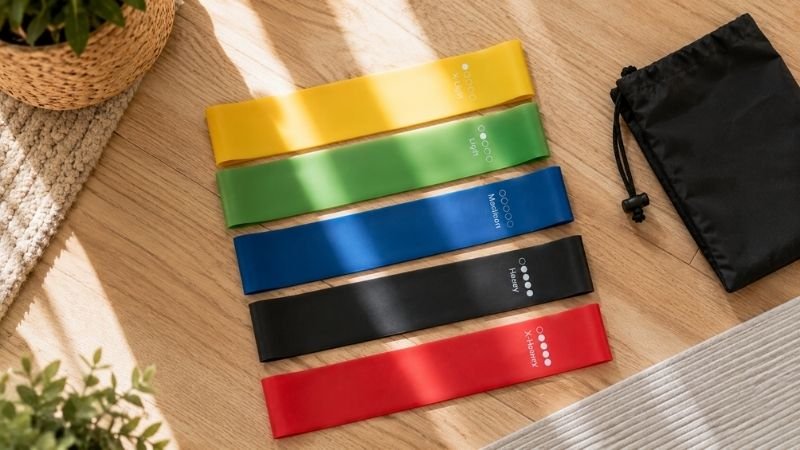
Loop bands (mini bands): Flat circular bands, typically placed around your knees or ankles for lower body work. Excellent for glutes, hip abduction, and banded squats. Usually come in sets of 3–5 resistance levels.
Long resistance bands (tube bands with handles): Longer bands with handles, used for rows, presses, bicep curls, and upper body work. More versatile for full-body training.
For most beginners, a set of loop bands is the best starting point. You’ll get immediate use out of them for glute and lower body work, and they’re the most straightforward to use without any learning curve.
Resistance levels by color (standard across most brands):
| Color | Resistance | Best for |
|---|---|---|
| Yellow | Light (5–15 lbs) | Warm-up, shoulder work, beginners |
| Green | Medium (15–25 lbs) | Most upper body exercises for beginners |
| Blue | Heavy (25–40 lbs) | Lower body work, intermediate upper body |
| Black | Extra heavy (40–60 lbs) | Advanced lower body, heavy rows |
| Red | Variable | Varies by brand — check the specs |
Beginner recommendation: Start with the light (yellow) and medium (green) bands for upper body, and medium (green) to heavy (blue) for lower body exercises. If you’re only buying one band to start, medium resistance is the most versatile.
Best Resistance Bands for Beginners
For most home workout users, a loop band set in the $20–$35 range covers everything in this guide. Look for:
- At least 3 resistance levels in the set
- TPE or fabric construction (fabric bands are more comfortable for skin contact; TPE rubber is more durable for door anchoring)
- A carrying pouch (makes storage and travel easy)
See our full Best Adjustable Dumbbells for Home Workouts guide if you’re also considering adding dumbbells to your setup.
The 12 Best Resistance Band Exercises for Beginners at Home
For each exercise: sets, reps, and a form cue that makes the difference between going through the motions and actually training effectively.
Upper Body (4 Exercises)
Exercise 1: Banded Pull-Apart Muscles: Upper back, rear shoulders, posture muscles
Hold a resistance band in both hands at chest height, arms extended forward. Keeping your arms straight, pull the band apart by moving both hands out to the sides until the band touches your chest. Slowly return to start.
- Sets/Reps: 3×12–15
- Form cue: “Pull from your shoulder blades, not your hands. Think about squeezing a pencil between your shoulder blades at the end of each rep.”
- Why it matters: Most people have weak upper back muscles from hours of sitting. This directly counteracts that, improves posture, and reduces shoulder tension.
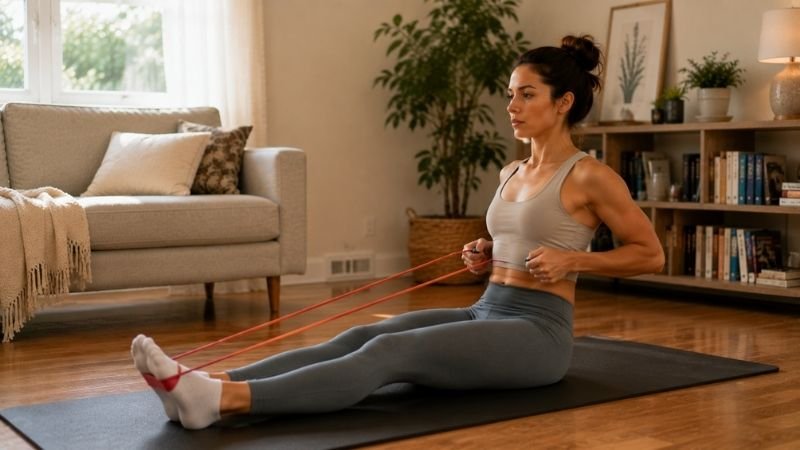
Exercise 2: Banded Row Muscles: Mid-back, biceps, rear shoulders
Sit on the floor with legs extended, loop the band around your feet, and hold both ends. Hinge slightly forward at the hips, then drive your elbows back, pulling the band toward your lower ribcage. Squeeze your shoulder blades together at the end. Return slowly.
- Sets/Reps: 3×10–12
- Form cue: “Keep your chest tall throughout. If you’re rounding your back to pull, the band is too heavy.”
- Why it matters: One of the most important exercises for long-term shoulder and back health — and one that bands do particularly well.
Exercise 3: Banded Bicep Curl Muscles: Biceps, forearms
Stand on the center of a resistance band, holding one end in each hand with palms facing forward. Keeping your elbows pinned at your sides, curl both hands up toward your shoulders. Lower slowly.
- Sets/Reps: 3×12–15
- Form cue: “The slow lowering phase (3 seconds down) produces more muscle stimulus than the curl up. Don’t rush the descent.”
Exercise 4: Banded Overhead Press Muscles: Shoulders, triceps
Stand on the band, feet hip-width apart. Hold each end at shoulder height, palms facing forward. Press both hands overhead until arms are fully extended, then lower back to shoulders.
- Sets/Reps: 3×10–12
- Form cue: “Brace your core before each press. Don’t let your lower back arch as you push overhead.”
Lower Body (4 Exercises)
Exercise 5: Banded Squat Muscles: Quads, glutes, hamstrings
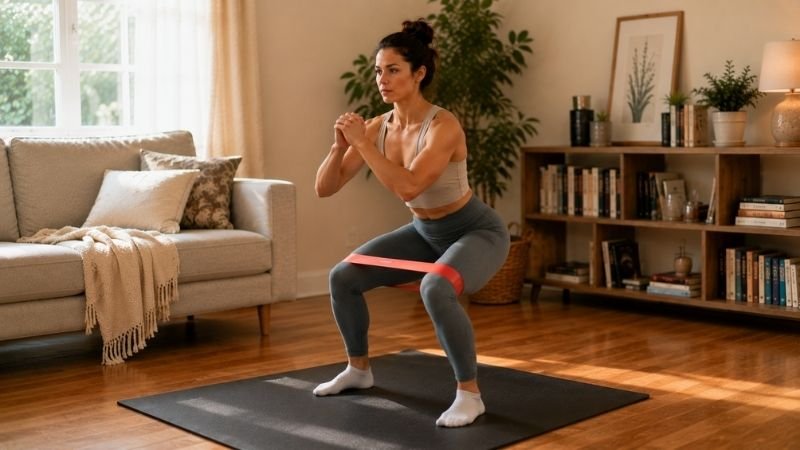
Place a loop band just above your knees. Stand with feet shoulder-width apart. Push your knees slightly outward against the band as you lower into a squat, then drive through your heels to stand.
- Sets/Reps: 3×12–15
- Form cue: “The band is there to remind your knees to stay out — don’t let them cave inward. Actively pressing against the band throughout the movement activates your glutes significantly more than squatting without it.”
- Why it matters: The banded squat is consistently one of the most effective glute-activation exercises available.
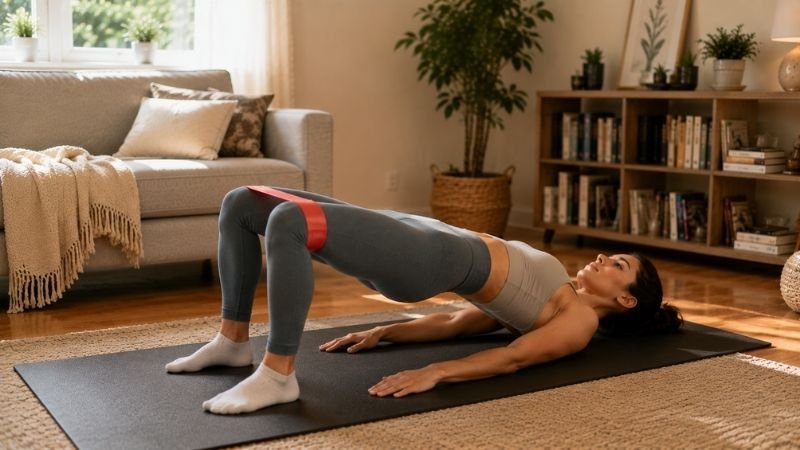
Exercise 6: Banded Glute Bridge Muscles: Glutes, hamstrings, lower back
Lie on your back with knees bent, feet flat, loop band just above your knees. Drive your hips up toward the ceiling, pressing your knees outward against the band. Hold 1–2 seconds at the top, squeezing your glutes. Lower slowly.
- Sets/Reps: 3×15
- Form cue: “At the top, your knees, hips, and shoulders should form a straight line. If your lower back is taking over, lower your hips slightly and focus on pushing through your heels.”
Exercise 7: Banded Hip Abduction (Clamshell) Muscles: Glute medius, hip external rotators
Lie on your side, loop band just above your knees. Stack your hips, bend your knees to 45 degrees. Keeping your feet together, rotate your top knee upward as far as possible without rotating your hips. Lower slowly.
- Sets/Reps: 3×15 per side
- Form cue: “Move slowly and deliberately. This exercise is easy to rush and cheat — the slower you go, the more you’ll feel it in the side of your glute.”
- Why it matters: The glute medius is one of the most undertrained muscles in sedentary adults, and strengthening it significantly improves hip stability and knee health.
Exercise 8: Banded Reverse Lunge Muscles: Quads, glutes, hamstrings
Place a loop band just above your knees. Stand tall. Step one foot back, lower your back knee toward the floor, then step back to standing. The band adds lateral resistance to the movement, increasing glute activation.
- Sets/Reps: 3×10 per leg
- Form cue: “Keep your front knee tracking over your front foot. The band will want to pull your knees together — resist that actively.”
Core (2 Exercises)
Exercise 9: Banded Dead Bug Muscles: Deep core, transverse abdominis
Lie on your back, loop a band around your hands. Extend both arms toward the ceiling, perpendicular to the floor, creating tension in the band. Bring your knees to 90 degrees (tabletop position). Slowly lower your right arm overhead and left leg toward the floor simultaneously, then return. Alternate sides.
- Sets/Reps: 3×8 per side
- Form cue: “Your lower back should stay in contact with the floor throughout. If it arches up, you’ve gone too far.”
Exercise 10: Banded Pallof Press Muscles: Core anti-rotation, obliques
Anchor a band at chest height (in a door). Stand sideways to the anchor point, hold the band at your chest with both hands. Press both hands straight out in front of you, hold 2 seconds, then pull back to chest. Complete all reps on one side before switching.
- Sets/Reps: 3×10 per side
- Form cue: “The goal is to resist rotating toward the band. The harder you resist, the more your core is working. Stand tall, don’t lean.”
Full Body (2 Exercises)
Exercise 11: Banded Romanian Deadlift Muscles: Hamstrings, glutes, lower back, core
Stand on the center of a long band, holding one end in each hand. Hinge at your hips, pushing them back as you lower the band down your legs. Keep your back flat and the band close to your legs. Drive your hips forward to return to standing, squeezing your glutes at the top.
- Sets/Reps: 3×12
- Form cue: “Think ‘hips back, not down.’ This is a hinge, not a squat. You should feel a deep pull in the back of your thighs.”
Exercise 12: Banded Lateral Walk Muscles: Glute medius, outer thighs, hip stabilizers
Place a loop band just above your knees or around your ankles. Bend knees slightly into a mini squat. Step sideways with your right foot, then follow with your left. Take 10–15 steps to the right, then 10–15 back to the left. Keep tension in the band throughout.
- Sets/Reps: 3×10–15 steps each direction
- Form cue: “Don’t let your feet come together completely between steps — maintain band tension the whole time. Small steps are more effective than large ones here.”
Your Complete Resistance Band Workout Plan
Don’t just do random exercises — here’s how to put them together into an actual training session.
Beginner Plan (3 Days Per Week)
Day 1 — Full Body (30 minutes)
- Banded Pull-Apart — 3×15
- Banded Squat — 3×12
- Banded Row — 3×10
- Banded Glute Bridge — 3×15
- Banded Dead Bug — 3×8 per side
Day 2 — Rest or light walk
Day 3 — Lower Body + Core (25 minutes)
- Banded Hip Abduction (Clamshell) — 3×15
- Banded Reverse Lunge — 3×10 per leg
- Banded Lateral Walk — 3×12 steps each direction
- Banded Romanian Deadlift — 3×12
- Banded Pallof Press — 3×10 per side
Day 4 — Rest
Day 5 — Upper Body + Full Body (25 minutes)
- Banded Bicep Curl — 3×15
- Banded Overhead Press — 3×12
- Banded Row — 3×12
- Banded Romanian Deadlift — 3×10
- Banded Pull-Apart — 3×15
Days 6–7: Rest or walking
How to progress: After 2–3 weeks, increase reps by 2 per set. Once you hit 15–16 reps comfortably, move to the next resistance band level.
The 10-Minute Resistance Band Workout (For Busy Days)
When time is short, this circuit takes 10 minutes and hits your whole body:
Do each exercise for 45 seconds with 15 seconds rest between movements. Complete 2 rounds.
- Banded Squat
- Banded Pull-Apart
- Banded Glute Bridge
- Banded Row (seated)
- Banded Lateral Walk
That’s it. Two rounds, 10 minutes, done.
Resistance Bands for Weight Loss — What to Actually Expect
Resistance bands can absolutely support fat loss — but understanding how matters.
Bands don’t burn massive calories during a session (a 30-minute resistance band workout burns approximately 100–200 calories). What they do is build muscle, and muscle tissue burns more calories at rest than fat tissue does. Over weeks and months of consistent training, this increases your resting metabolic rate — meaning you’re burning slightly more calories even when you’re not working out.
Combined with a moderate calorie deficit and adequate protein, resistance band training is an effective component of a fat loss program. For women especially, the glute and hip work that bands excel at produces the body composition changes most people associate with “getting toned” — more muscle, less fat, more definition.
The realistic timeline: 6–8 weeks of consistent resistance band training (3x per week) will produce noticeable improvements in muscle tone and strength. Scale changes, if fat loss is your goal, depend more on your nutrition than your workout — but the combination works.
Frequently Asked Questions
Can resistance bands build muscle the same way weights do? For beginners and intermediate exercisers — yes, with some nuance. Research shows resistance bands produce comparable muscle and strength gains to free weights for most exercises. The mechanism is identical: muscles working against resistance, experiencing adaptation, rebuilding stronger. Bands become less effective as you advance to very heavy loads, but for the majority of home workout users, they’re completely sufficient.
What resistance bands should a beginner buy? A loop band set with 3–5 resistance levels, in the $20–$35 range, covers everything in this guide. Look for TPE rubber (durable) or fabric (more comfortable for leg work). Start with light and medium resistance and work up. Avoid very cheap single-band sets that only offer one resistance level.
Are resistance bands good for weight loss? Yes, as part of a complete approach. Resistance band training builds muscle that raises your resting metabolic rate, making fat loss more sustainable long-term than cardio alone. Combined with a moderate calorie deficit and adequate protein, resistance bands are an effective fat loss tool. They won’t burn massive calories during the workout itself — the real benefit is the metabolic effect of building muscle over time.
Can I use resistance bands instead of going to the gym? For most people’s fitness goals — building functional strength, improving body composition, increasing energy — yes. A complete resistance band workout program done consistently 3x per week will produce meaningful results without a gym. Where bands fall short is in heavy barbell compound lifting and very advanced strength training, but these aren’t goals most home workout users have.
How do I know if my resistance band is the right difficulty? The right resistance level feels challenging by rep 10–12 of each set, but you can maintain good form throughout. If you finish 15 reps feeling like you could do 10 more, the band is too light. If you can’t complete 8 reps with good form, the band is too heavy. Most people underestimate resistance bands and start too light — if in doubt, go one level heavier than you think you need for lower body work.
Your Next Step
You now have 12 exercises, a complete workout plan, and a clear picture of what resistance bands can realistically do for you. The only thing left is to actually start.
Pull out that band set. Do the Day 1 workout. Five exercises, three sets each, 30 minutes. That’s it for today.
When you’re ready to add dumbbells to your home workout setup: → Best Adjustable Dumbbells for Home Workouts (2026): Honest Reviews for Every Budget
To understand how resistance training fits into a fat loss plan: → How to Lose Fat Without Losing Muscle: The Complete Home Guide
For a complete dumbbell-based plan to pair with your band work: → Full Body Dumbbell Workout at Home: The Complete Beginner’s 3-Day Plan
References
- Lopes, J.S.S., et al. (2019). Effects of training with elastic resistance versus conventional resistance on muscular strength: A systematic review and meta-analysis. SAGE Open Medicine.
- Calatayud, J., et al. (2015). Muscle activation during push-ups with different suspension training systems. Journal of Human Kinetics.
- Centers for Disease Control and Prevention (CDC). How Much Physical Activity Do Adults Need? https://www.cdc.gov/physicalactivity/basics/adults/index.htm
- American College of Sports Medicine (ACSM). Resistance Training for Health and Fitness. https://www.acsm.org
- Hinge Health. 13 Resistance Band Exercises for Seniors. https://www.hingehealth.com/resources/articles/resistance-band-exercises-for-seniors/