
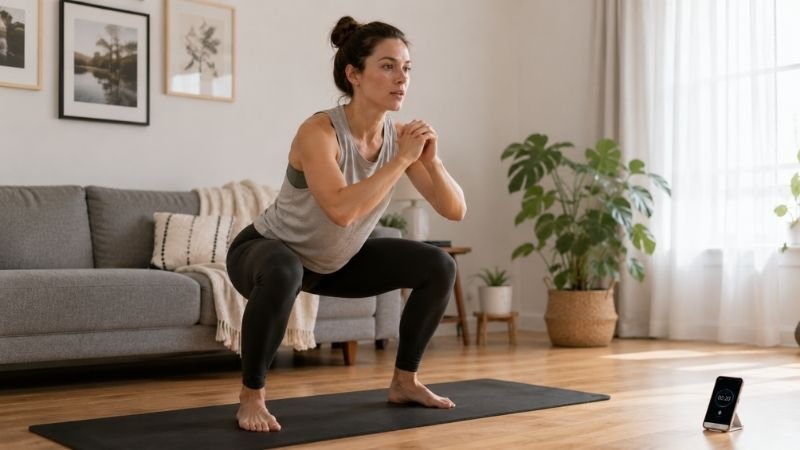
Let’s be honest — the first time you googled “HIIT workout,” you probably felt a mix of intrigue and low-key panic. Those videos of people flying through burpees and box jumps at full speed don’t exactly scream “beginner-friendly.” It looks intense. It looks exhausting. And it looks like something you’d need to already be fit to do.
Here’s what nobody tells you upfront: HIIT is actually one of the best formats for beginners — when it’s done right. The whole point is working at your high intensity, not someone else’s. Your hard is hard enough. You don’t need to jump. You don’t need equipment. You don’t need more than 20 minutes and a patch of floor.
This guide will give you a complete beginner HIIT workout you can do at home today — with a full 20-minute plan, a 10-minute version for time-crunched days, honest guidance on what results to actually expect, and every common mistake flagged before you make it.
No gym required. No experience needed. Just you, your living room, and 20 minutes you didn’t think were enough to matter.
Key Takeaways
- HIIT stands for High-Intensity Interval Training — alternating short bursts of effort with rest periods; beginners typically start with a 20 seconds work / 40 seconds rest ratio
- A 2017 study in the Journal of Diabetes Research found that HIIT is significantly more effective than steady-state cardio for reducing body fat in the same amount of time
- The CDC recommends 150 minutes of moderate aerobic activity per week — three 20-minute HIIT sessions covers this entirely
- Beginners should start with 2–3 sessions per week, with at least one full rest day between sessions
- Results from consistent HIIT training typically become noticeable within 4–6 weeks — not 2 weeks, not overnight
What Is HIIT and Why Does It Actually Work?
HIIT — High-Intensity Interval Training — is a training method built around one simple idea: work hard for a short burst, rest, then repeat. That’s it. No complicated equipment, no special facility, no fitness background required.
What makes it effective isn’t magic — it’s a phenomenon called EPOC (Excess Post-Exercise Oxygen Consumption), which is just a technical way of saying your body keeps burning calories at an elevated rate for hours after a HIIT session ends. Steady-state cardio like jogging at a comfortable pace doesn’t produce this same afterburn effect to the same degree.
For beginners specifically, HIIT is valuable because it’s scalable. Every exercise can be done at lower impact. Every rest period can be longer. The structure does the work, not your current fitness level. The goal isn’t to match anyone else’s intensity — it’s to push yourself relative to where you are right now.
Sportzillax editor note: “High intensity” is relative. If marching in place at a brisk pace is your high intensity right now, that’s a legitimate HIIT workout. Don’t let anyone tell you otherwise.
The Honest Truth About HIIT and Fat Loss
Before we get into the workout, let’s have the conversation most fitness content avoids.
Yes, HIIT burns fat. The research on this is solid — a meta-analysis published in the British Journal of Sports Medicine found that HIIT produces significantly greater reductions in total body fat than moderate-intensity continuous training, in less time. That’s a real, meaningful finding.
But here’s what the Instagram transformation posts don’t mention: HIIT alone won’t outrun a consistently poor diet. You cannot do three 20-minute HIIT sessions a week and eat 500 calories over maintenance and expect dramatic results. The afterburn effect from a 20-minute HIIT session might burn an extra 50–150 calories post-workout — meaningful, but not magical.
What HIIT genuinely does for beginners:
- Significantly improves cardiovascular fitness within 2–4 weeks
- Increases metabolic rate both during and after exercise
- Preserves muscle mass better than steady-state cardio alone
- Produces visible changes in body composition within 4–6 weeks of consistent training
Realistic expectation: 4–6 weeks of 3x weekly HIIT, combined with reasonable nutrition, can produce 1–2 lbs of fat loss per week. Slower than the internet promises, faster than doing nothing.
Your 20-Minute Beginner HIIT Workout at Home (No Equipment)
This is the main event. Everything you need to complete this workout: a yoga mat or soft surface, water, and a timer app on your phone.
The format: 20 seconds work / 40 seconds rest — this 1:2 ratio is ideal for beginners. It gives you enough recovery to actually push during the work intervals, which is the whole point. As you get fitter over weeks, you’ll naturally shift toward 30/30 or even 40/20.
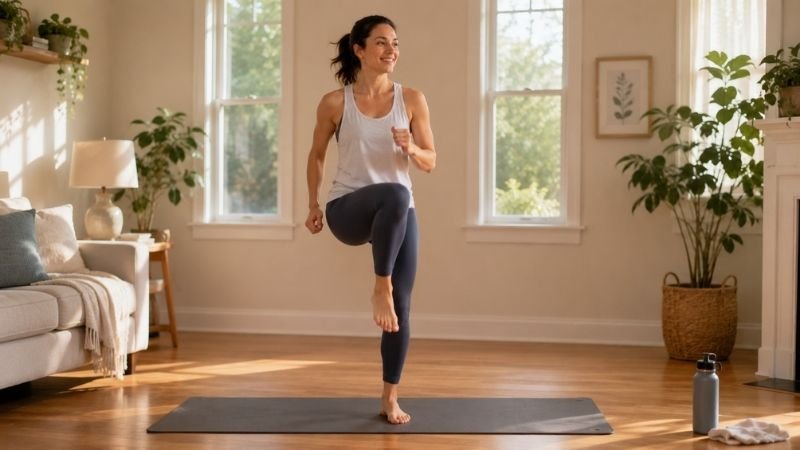
Warm-Up (5 Minutes)
Never skip this. Cold muscles and sudden high-intensity movement is how injuries happen. Do each movement for 45 seconds:
March in place — lift your knees to hip height, swing your arms. This isn’t slow — move with purpose.
Arm circles — 20 seconds forward, 25 seconds backward. Loosen those shoulder joints.
Hip circles — hands on hips, make big slow circles. Both directions.
Bodyweight squats (slow) — 5 slow squats, focusing on sinking low and keeping your chest tall. This primes your legs for what’s coming.
Inchworms — stand tall, hinge forward and walk your hands out to a plank position, hold 1 second, walk back up. Do 4 reps. If your hamstrings are very tight, bend your knees as much as needed.
The Main Circuit (12 Minutes — 6 Exercises × 2 Rounds)
Complete all 6 exercises back to back with 20 seconds of work and 40 seconds of rest between each. Rest 90 seconds between Round 1 and Round 2.
Exercise 1: Squat to Stand Stand with feet shoulder-width apart. Lower into a squat, hold for 1 second at the bottom, then drive through your heels to stand. That’s one rep. Aim for 8–10 reps in 20 seconds. Lower impact option: Sit down onto a chair and stand back up. This controls the range of motion and reduces joint stress.
Exercise 2: Modified Push-Up Start on your hands and knees. Lower your chest toward the floor, keeping your core tight. Push back up. Aim for 6–8 reps in 20 seconds. Progress option: When this feels easy, lift your knees off the floor for a full push-up.
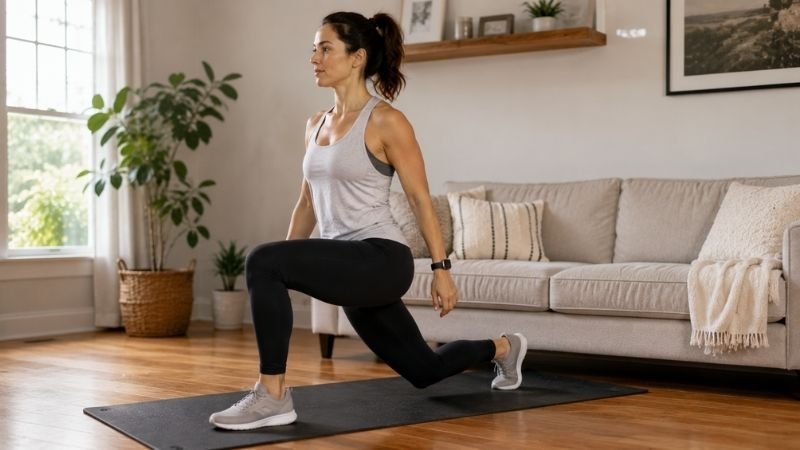
Exercise 3: Reverse Lunge Stand tall. Step one foot back, lower your back knee toward (not touching) the floor, then step back to standing. Alternate legs. Aim for 6 reps per side. Lower impact option: Hold onto a wall or chair for balance. There’s no shame in this — it still works your glutes and quads fully.
Exercise 4: Mountain Climbers (Slow) Start in a plank position — hands under shoulders, body in a straight line. Drive one knee toward your chest, return, then the other. Keep this controlled — we’re not racing. Aim for 8 reps per side. Lower impact option: Step rather than drive. Step one foot forward, return, then the other. Same muscles, less jarring.
Exercise 5: Glute Bridge Pulse Lie on your back, knees bent, feet flat. Lift your hips into a bridge position and hold. From there, do small pulses — lower an inch, lift an inch. Keep your glutes squeezed. Aim for 15 pulses in 20 seconds. This one is low-impact by design — great for postpartum moms and anyone with knee sensitivities.
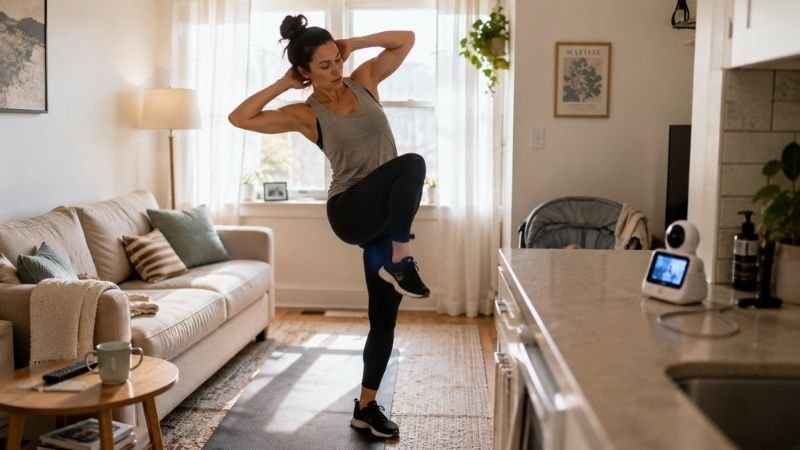
Exercise 6: Standing Oblique Crunch Stand with feet hip-width apart. Lift one knee and bring the opposite elbow to meet it. Alternate sides. Aim for 8 reps per side in 20 seconds. Lower impact option: Just lift the knee without the crunch if you feel any neck tension.
Cool Down (3 Minutes)
This matters more than most people think. Going from high heart rate to complete stillness too quickly can cause dizziness.
- March in place slowly for 60 seconds (bring heart rate down gradually)
- Standing quad stretch — hold each leg for 20 seconds
- Standing chest opener — clasp hands behind your back, squeeze shoulder blades together, hold 20 seconds
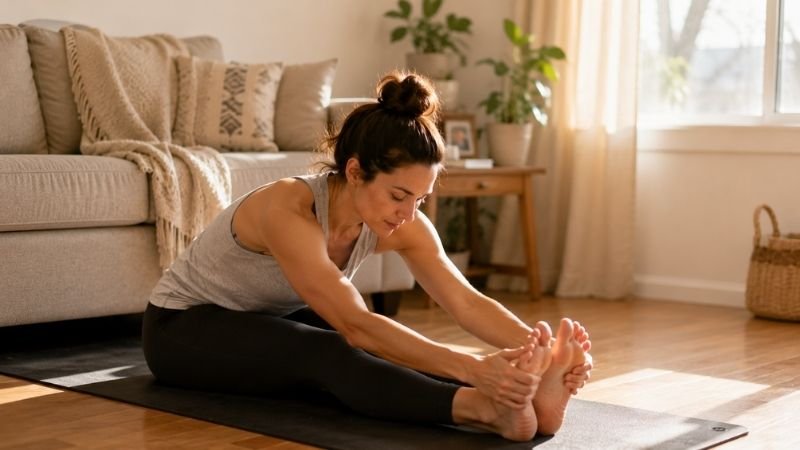
- Seated forward fold — sit on the floor, legs extended, reach toward your toes, hold 30 seconds
- Child’s pose — kneel, sit back on your heels, arms extended forward, hold 30 seconds
The 10-Minute HIIT Version (For When Life Gets in the Way)
Some days the baby wakes up early. Some days work runs long. Some days you have exactly 10 minutes and the choice is either to use them or skip entirely.
Use them.
Pick any 3 exercises from the main circuit above. Do 2 rounds of each: 20 seconds work, 40 seconds rest. Add a 2-minute warm-up (march + arm circles) and a 1-minute cool-down (forward fold). That’s 10 minutes. It counts. It absolutely counts.
The research on exercise frequency consistently shows that short, consistent sessions outperform occasional long ones. Three 10-minute sessions a week beats one 30-minute session every two weeks by a significant margin. Consistency beats perfection every single time.
How Many Times a Week Should Beginners Do HIIT?
The answer most people don’t want to hear: 2–3 times per week, maximum, especially in your first month.
HIIT is demanding on your nervous system, not just your muscles. Unlike walking, which you can do daily without issue, HIIT requires genuine recovery time between sessions. Going hard 5 days a week as a beginner is one of the fastest ways to burn out, get injured, or end up too sore to continue.
The sweet spot for beginners:
- Week 1–2: 2 sessions per week, full rest day between each
- Week 3–4: 2–3 sessions per week once your body adapts
- Week 5+: 3 sessions per week if feeling strong; consider adding one strength training session on an alternate day
On your off days, gentle walking, stretching, or light yoga is ideal. Complete rest is also fine — rest is not lost progress.
Common HIIT Mistakes Beginners Make (And How to Avoid Them)
Skipping the warm-up. We’ve said it once, we’ll say it again. Cold muscles tear. The 5-minute warm-up above takes 5 minutes and could save you 5 weeks of recovery from a pulled muscle.
Going all-out in round one. The biggest beginner HIIT mistake. If you’re completely exhausted by exercise two, you went too hard. Aim for about 7/10 effort in round one — hard but controlled. You should be able to finish all 6 exercises.
Doing HIIT every day because it feels productive. More is not better when it comes to HIIT. Your body needs 48 hours to recover from an intense session. Training on top of unrecovered muscles doesn’t accelerate progress — it stalls it.
Expecting to feel comfortable. HIIT is meant to challenge you. You will be breathing hard. Your legs will feel heavy by exercise four. That discomfort is the point — it’s what produces the adaptation. If it feels easy, you’re not working at your high intensity.
Comparing your workout to videos online. The person doing full burpees on YouTube has been training for years. You are on day one, week one. Your modified squat-to-stand is doing exactly what it should be doing for your body right now.
What to Expect in Your First Month of HIIT
Week 1: Hard. Probably harder than you expected. You’ll be breathing heavily and your legs will feel it the next day. This is completely normal — your body is adapting. Soreness in the 24–48 hours after is expected. Sharp pain during the workout is not — stop if anything hurts.
Week 2: Still hard, but slightly less devastating. You’ll notice you can get through more reps in the 20 seconds. Recovery between rounds starts to feel a little more manageable.
Week 3: The shift. Most people notice a meaningful improvement in their cardio capacity around week 3. The workout that felt impossible in week 1 starts to feel like something you can actually do.
Week 4: Building momentum. Energy levels outside of workouts often improve. Sleep tends to improve. You might start to notice small changes in how your clothes fit — not dramatic, but real.
Be patient with the scale. Physical fitness changes happen before visible body composition changes. Trust the process.
When HIIT Might Not Be Right for You Right Now
HIIT is excellent for most healthy adults, but there are situations where it’s genuinely not the right starting point.
Talk to your doctor before starting HIIT if you:
- Are postpartum and less than 12 weeks out from delivery (especially after C-section)
- Have a current joint injury — knees, hips, ankles, or lower back
- Have been completely sedentary for more than a year
- Have a diagnosed heart condition or high blood pressure
- Experience dizziness, chest pain, or severe shortness of breath during light activity
This isn’t about gatekeeping fitness. It’s about making sure the tool matches where your body actually is. If HIIT isn’t right for you yet, a 30-minute daily walk is genuinely one of the most effective things you can do for your health and weight — and there’s no shame in starting there.
Frequently Asked Questions
Is HIIT good for complete beginners with no fitness background? Yes — when modified appropriately. Every exercise in a HIIT workout can be scaled to a lower impact version. The key is working at your high intensity, not matching someone else’s. Start with the 2:1 rest-to-work ratio (20 seconds on, 40 seconds off) and use the low-impact modifications listed above.
How long before I see results from beginner HIIT? Most beginners notice improved stamina and energy within 2–3 weeks. Visible body composition changes typically take 4–6 weeks of consistent training (3 sessions per week) combined with reasonable nutrition. The scale may not move dramatically — muscle gain can offset fat loss — but how your clothes fit is often a better early indicator.
Can I do a HIIT workout at home without any equipment? Absolutely. The 20-minute workout in this guide requires zero equipment. A yoga mat makes floor exercises more comfortable, but it’s not essential. Good athletic shoes are recommended if you’re doing any higher-impact versions of the movements.
Is HIIT better than running for fat loss? Research suggests HIIT produces comparable or superior fat loss results to steady-state running, in significantly less time. A 2017 meta-analysis found HIIT reduced body fat percentage by 28.5% more than moderate-intensity continuous exercise. For busy beginners who don’t enjoy long runs, HIIT is an excellent alternative.
How many calories does a 20-minute beginner HIIT workout burn? This varies significantly by body weight, intensity, and fitness level — but a reasonable estimate for a 150lb person doing moderate-intensity HIIT is 150–250 calories during the session, plus an additional 50–150 calories in the post-workout afterburn period. Don’t chase calorie numbers obsessively — focus on consistency instead.
Can I do HIIT if I have bad knees? Potentially yes, with modifications. The low-impact options listed in this workout (sitting to standing, stepping instead of jumping, holding a wall for lunges) significantly reduce knee stress. That said, if you have an active knee injury or have been advised by a doctor to avoid impact exercise, consult them before starting. Walking HIIT — alternating brisk walking intervals with slower recovery walks — is also an excellent knee-friendly alternative.
Your Next Step
You have everything you need to start today. Seriously — close this tab, push the coffee table aside, set a timer, and do the warm-up. That’s all it takes to begin.
Once you’ve completed this workout 2–3 times and you’re feeling more confident with the format, the natural next step is adding one strength training session per week alongside your HIIT sessions. Combining HIIT and strength training produces significantly better body composition results than either alone — and it’s simpler to set up at home than most people think.
Check out our [Beginner Strength Training at Home Guide] for a simple, no-gym strength routine designed to complement this HIIT plan perfectly.
And if you’re wondering what equipment could make your home workouts more effective without breaking the bank, our [Best Resistance Bands for Beginners] guide covers everything you need for under $30.
References
- Batacan, R.B., et al. (2017). Effects of high-intensity interval training on cardiometabolic health: a systematic review and meta-analysis of intervention studies. British Journal of Sports Medicine.
- Wewege, M., et al. (2017). The effects of high-intensity interval training vs. moderate-intensity continuous training on body composition in overweight and obese adults: a systematic review and meta-analysis. Journal of Obesity.
- Centers for Disease Control and Prevention (CDC). How much physical activity do adults need? https://www.cdc.gov/physicalactivity/basics/adults/index.htm
- Gillen, J.B., & Gibala, M.J. (2014). Is high-intensity interval training a time-efficient exercise strategy to improve health and fitness? Applied Physiology, Nutrition, and Metabolism.