
Here’s a belief that’s holding a lot of people back: that building real muscle requires a gym. A proper weight rack. A barbell. Multiple machines. A trainer watching your form.
None of that is true — and the research is clear on this point.
Your muscles don’t know whether the resistance they’re working against comes from a barbell, a dumbbell, a resistance band, or your own bodyweight. What they know is whether they’re being challenged. Whether the stimulus is sufficient to trigger adaptation. Whether you’re making them work harder than they’re used to working.
That’s the entire mechanism of muscle building. And it works just as well in a living room as in a commercial gym, when you understand the principles and apply them consistently.
This guide explains how to build muscle at home — the actual science behind it, the most effective exercises for each muscle group, two complete training options (with and without weights), and an honest timeline for what to expect. No gym required. No expensive equipment necessary.
Key Takeaways
- Research published in the Journal of Human Kinetics confirms that bodyweight training produces comparable muscle and strength gains to free weight training for beginners — the tool matters less than the stimulus
- The primary driver of muscle growth is progressive overload — consistently making your muscles work harder over time, whether through more reps, more sets, slower tempo, or greater resistance
- Protein intake is essential: to build muscle, most active adults need 0.7–1g of protein per pound of body weight daily — without adequate protein, training stimulus cannot produce muscle growth
- Visible muscle changes take 6–8 weeks of consistent training; meaningful strength gains begin within 2–3 weeks as your nervous system adapts
- Recovery is when muscle growth actually happens — training 3 days per week with adequate rest between sessions produces better muscle growth than training daily
The Science of Building Muscle at Home (Simplified)
You don’t need to understand exercise physiology to build muscle. But understanding the basic mechanism makes the entire process more logical — and makes it easier to know whether you’re doing the right things.
Here’s how muscle growth works:
When you perform resistance exercise — pushing, pulling, squatting, pressing — you create microscopic damage in your muscle fibers. Your body responds to this damage by repairing the fibers and building them back slightly thicker and stronger. This process, called muscle protein synthesis, requires adequate protein from your diet and adequate recovery time.
For this process to continue producing results, the stimulus needs to increase over time. If you do the same 10 push-ups at the same difficulty level every week, your muscles adapt fully within a few weeks and stop needing to rebuild bigger. This is why progressive overload — gradually increasing the difficulty — is the non-negotiable principle of long-term muscle building.
At home, progressive overload looks like:
- Increasing reps from 10 to 12 to 15 over consecutive weeks
- Slowing the tempo from 1 second down to 3 seconds down
- Moving from a two-legged exercise to a single-leg variation
- Adding weight via dumbbells or resistance bands when bodyweight becomes insufficient
None of this requires a gym. It requires consistency and a willingness to increase the challenge over time.
Sportzillax editor note: The biggest mistake home trainers make is not the exercises they choose — it’s doing the same workout at the same difficulty for months and wondering why nothing is changing. Progressive overload is the entire game.
How to Build Muscle Without a Gym: The 5 Principles
Before the exercises, understand these five principles. They apply whether you’re using bodyweight, resistance bands, or dumbbells.
1. Train each muscle group 2–3 times per week. Research consistently shows that training frequency matters for muscle growth. Full-body workouts 3 days per week hit each muscle group frequently enough to produce consistent adaptation.
2. Train close to failure. The most important variable for muscle growth is training intensity — specifically, how close you get to muscle failure (the point where you can’t do another rep with good form). For most sets, aim to stop 1–2 reps before failure. If you can easily do 3–4 more reps, the exercise is too easy.
3. Use the full range of motion. Partial reps — half squats, quarter push-ups — produce less muscle growth than full range movements. Go all the way down in your squats. Lower your chest to the floor in push-ups. This produces greater muscle stretch and contraction, which drives more adaptation.
4. Eat enough protein. Training without adequate protein is like building a house without materials. Aim for 0.7–1g of protein per pound of body weight daily. This doesn’t require protein shakes — chicken, eggs, Greek yogurt, cottage cheese, and legumes all provide substantial protein.
5. Sleep 7–9 hours. Growth hormone — the primary hormonal driver of muscle repair and growth — is released primarily during deep sleep. Consistently sleeping fewer than 7 hours significantly impairs muscle building, regardless of how well you train and eat.
The Best Muscle-Building Exercises You Can Do at Home
Organized by muscle group, with both bodyweight and weighted variations.
Chest
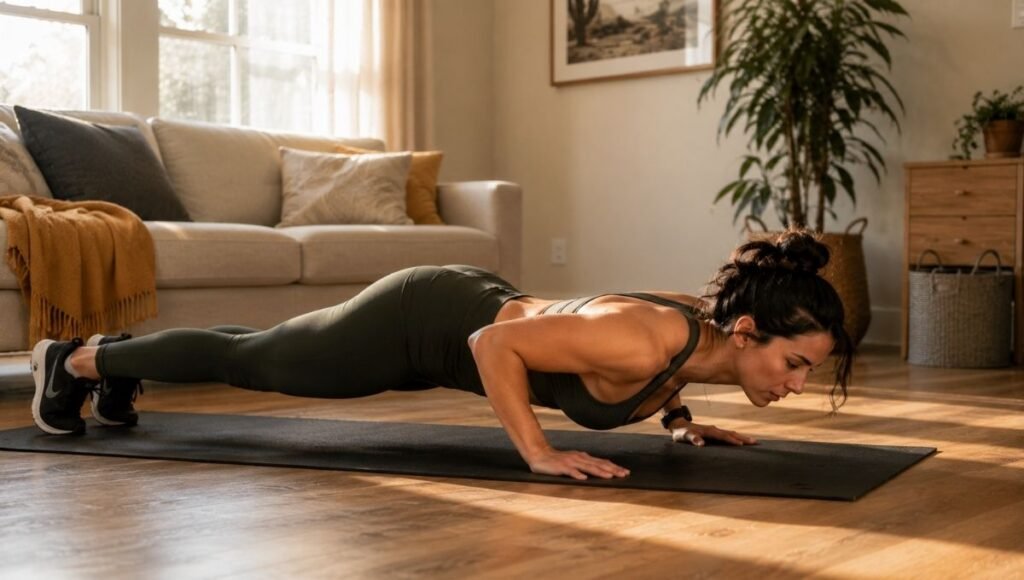
Bodyweight: Push-Up Progression
- Beginner: Modified push-up (knees)
- Intermediate: Full push-up
- Advanced: Decline push-up (feet on chair), archer push-up, slow-tempo push-up (3 seconds down)
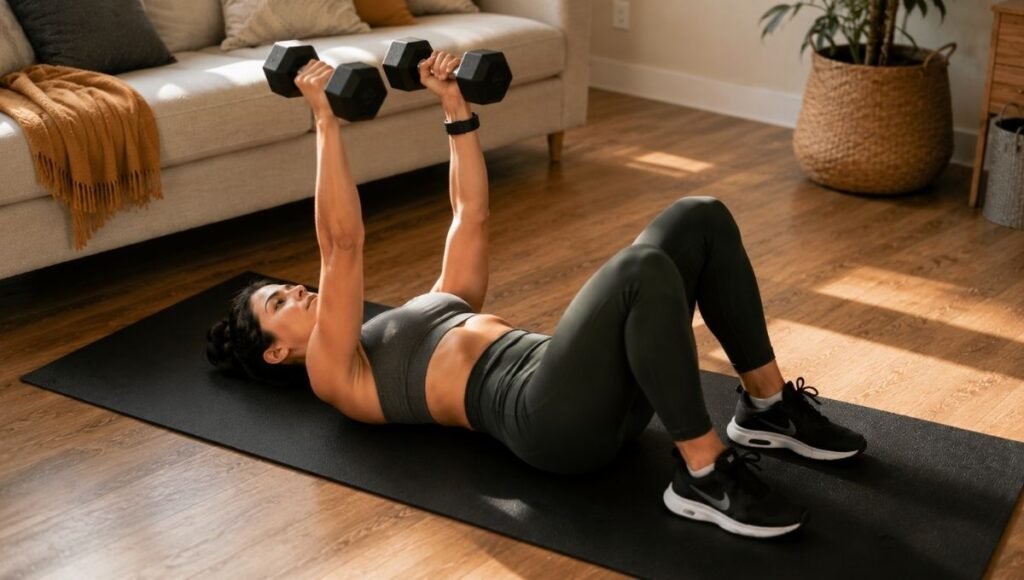
Weighted: Dumbbell Floor Press Lie on your back, dumbbells at chest, press up, lower slowly. Same movement pattern as bench press — no bench required.
Sets/Reps for muscle growth: 3–4 sets of 8–15 reps, 60–90 seconds rest.
Back
Bodyweight: Inverted Row (using a table) Lie under a sturdy table, grip the edge, keep your body straight, pull your chest up to the table. This is an underrated home back exercise that works as well as a gym row for most beginners.
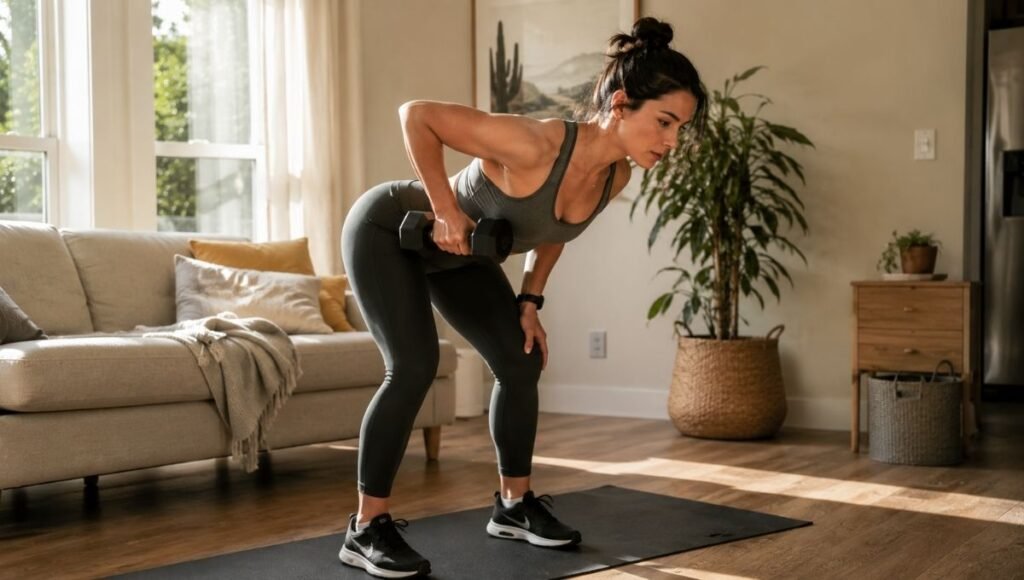
Weighted: Dumbbell Bent-Over Row Hinge forward at hips, dumbbells hanging, pull to hips with elbows back. Works mid-back, rear shoulders, biceps.
Alternative: Resistance Band Row Anchor a band at waist height, pull toward your torso. Full back activation, no equipment besides the band.
Sets/Reps: 3–4 sets of 8–12 reps per side (for single-arm variations).
Legs and Glutes (the highest muscle-building potential at home)
Bodyweight progression:
- Bodyweight squat → Slow squat (3 seconds down) → Pause squat (2 seconds at bottom) → Single-leg squat to chair → Pistol squat progression
Weighted:
- Goblet squat (one dumbbell at chest)
- Romanian deadlift (dumbbells or heavy household items)
- Bulgarian split squat (rear foot on chair — one of the most effective single-leg exercises available)
For glutes specifically:
- Glute bridge → Single-leg glute bridge → Hip thrust with dumbbell
Sets/Reps: 3–4 sets of 10–15 reps. Lower body muscles recover faster and tolerate higher volume — don’t skip these.
Shoulders
Bodyweight: Pike Push-Up Start in a downward dog position (hips high, legs straight). Lower your head toward the floor by bending your elbows, then press back up. This is the closest bodyweight substitute for a shoulder press.
Weighted: Dumbbell Overhead Press + Lateral Raise Overhead press: seated or standing, press dumbbells from shoulder height to full extension overhead. Lateral raise: hold dumbbells at sides, raise to shoulder height with slight elbow bend. Use lighter weight than you think you need.
Sets/Reps: 3 sets of 10–15 reps.
Arms (Biceps and Triceps)
Biceps:
- Resistance band curl (anchor band under feet, curl toward shoulders)
- Dumbbell bicep curl (classic, slow lowering phase is key)
Triceps:
- Diamond push-up (hands close together — significantly increases tricep activation vs regular push-up)
- Dumbbell tricep kickback or overhead extension
Sets/Reps: 2–3 sets of 12–15 reps. Arms are smaller muscles — they don’t need as much dedicated volume as compound movements already work them.
Core
For muscle building (not just stability):
- Weighted dead bug (light dumbbell)
- Hanging knee raise (if you have a pull-up bar)
- Ab wheel rollout (if you have an ab wheel — one of the most effective core exercises available)
- Decline sit-up or reverse crunch
Note: Core training for aesthetics (visible abs) is primarily a body fat percentage issue, not an exercise issue. Core training for strength and stability is highly valuable and covered in our Beginner Core Workout guide.
Your Home Muscle-Building Plan
Option A: No Equipment (Bodyweight Only)
3 days per week, full body
Warm-up: 3 minutes marching + arm circles
Circuit (3–4 rounds, 8–12 reps each, 60–90 sec rest between exercises):
- Push-Up (work toward challenging variation)
- Inverted Row (under sturdy table)
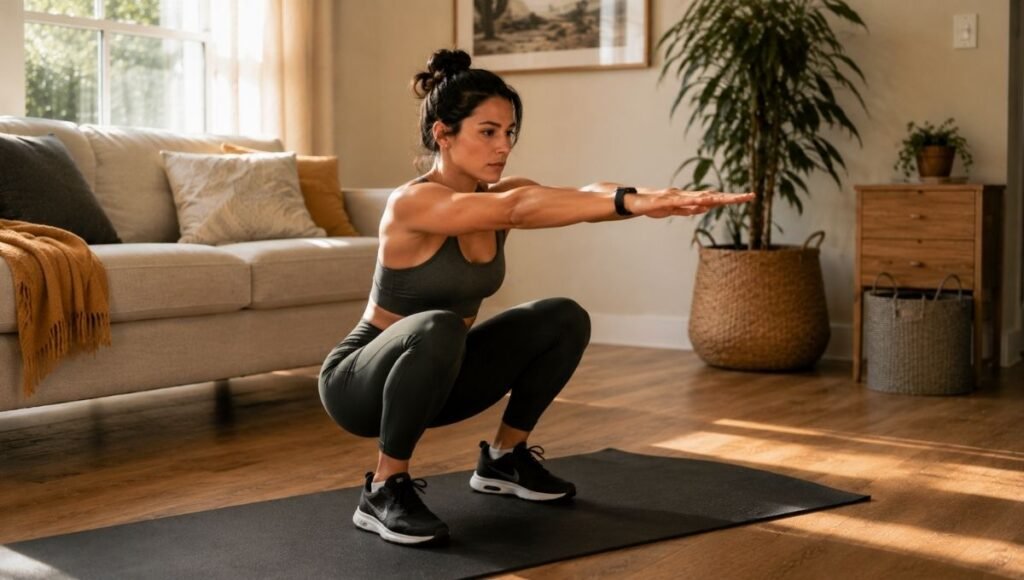
- Slow Squat (3 seconds down, 1 second up)
- Pike Push-Up
- Glute Bridge (slow, 2 second hold at top)
- Diamond Push-Up
Progressive overload without weights:
- Week 1–2: Standard reps at comfortable difficulty
- Week 3–4: Add 2 reps per set, slow tempo to 3 seconds down
- Week 5–6: Progress to harder exercise variations (decline push-up, single-leg glute bridge, pause squat)
- Week 7–8: Add an extra set to main exercises
Option B: With Dumbbells or Resistance Bands
3 days per week, full body
Day A:
- Goblet Squat — 4×10–12
- Dumbbell Floor Press — 3×10–12
- Dumbbell Bent-Over Row — 3×10 per side
- Dumbbell Overhead Press — 3×10–12
- Glute Bridge with Dumbbell — 3×15
- Bicep Curl — 3×12
Day B:
- Romanian Deadlift — 4×10–12
- Push-Up — 3×10–15
- Single-Arm Dumbbell Row — 3×10 per side
- Lateral Raise — 3×12
- Reverse Lunge with Dumbbells — 3×10 per leg
- Tricep Kickback — 3×12
Alternate Day A and Day B across your three weekly sessions.
Progressive overload with dumbbells: Increase reps by 2 each week. Once you hit the top of the rep range (e.g., 15 reps) comfortably, increase weight by the smallest available increment.
How Long Does It Take to Build Muscle at Home?
This is the question everyone wants answered — and the honest answer is slower than the fitness industry suggests and faster than most beginners fear.
Week 1–2: Strength improvements are happening, primarily through neural adaptation — your nervous system becoming more efficient at recruiting muscle fibers. You may not look different, but the exercises feel easier.
Week 3–4: Visible pump after workouts. Some exercises are noticeably easier than they were. Friends who see you regularly may not notice anything yet.
Week 6–8: This is typically when beginners first see visible changes — slightly more muscle definition, particularly in the shoulders and arms. More meaningful changes in the legs and glutes (where the most muscle mass is).
Month 3–6: Significant visible changes for most people who have been consistent. Strength approximately doubled from starting point on most exercises. Body composition meaningfully changed.
The honest caveat: Visible muscle building is slower than visible fat loss. The fitness industry consistently overpromises muscle gains because dramatic transformation images are better marketing. Expect meaningful changes in 3 months, significant changes in 6 months, and a substantially different physique in 12 months of consistent training.
Building Muscle at Home Without Weights: What’s Possible and What Isn’t
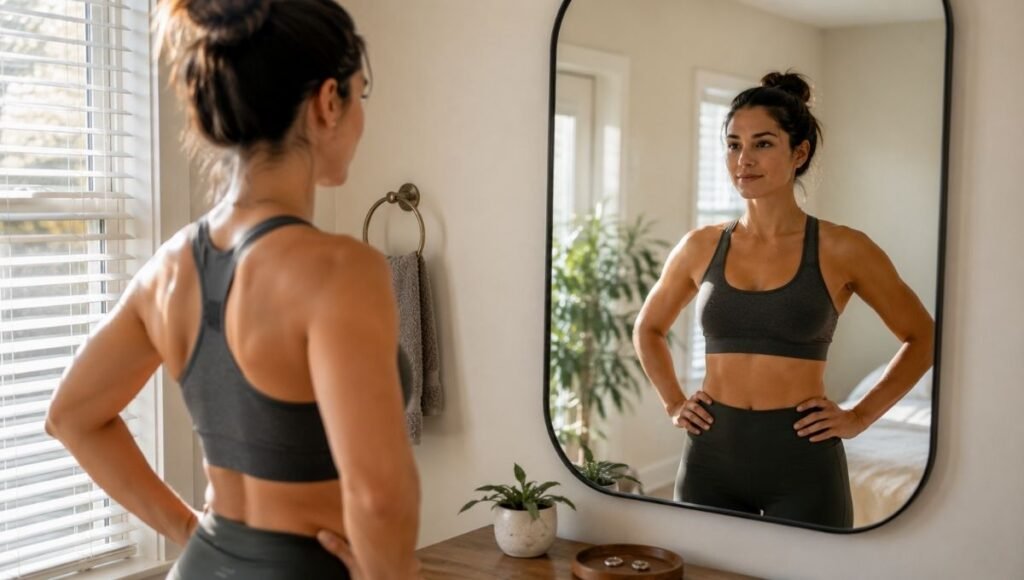
Bodyweight training can absolutely build muscle — this is well-established in the exercise science literature. But it has limitations worth understanding.
What bodyweight training builds effectively:
- Upper body (chest, triceps, shoulders): push-up progressions are highly effective for these muscles
- Core: no equipment needed for excellent core development
- Glutes and quads: squat and lunge progressions produce meaningful results, especially combined with slow tempo and single-leg variations
Where bodyweight training has limitations:
- Upper back: inverted rows and band pull-aparts help, but this is the hardest muscle group to develop without weights
- Hamstrings: glute bridges work the glutes well, but Romanian deadlift variations really need some form of resistance to be maximally effective
- Advanced stages: after 6–12 months of bodyweight training, bodyweight progressions become insufficient for continued significant muscle growth without adding resistance
The practical recommendation: Start bodyweight if you have nothing. Add resistance bands ($20–$35) within the first month to expand your training options, particularly for back and pulling movements. Add adjustable dumbbells when you can invest in them — they remain the most versatile home muscle-building tool.
When You Only Have 20 Minutes
Muscle-building sessions don’t need to be long. A focused 20-minute session beats a distracted 60-minute session every time.
20-minute home muscle building circuit:
- Goblet Squat or Slow Squat — 3×10
- Push-Up (hardest variation you can do with good form) — 3×10
- Romanian Deadlift or Glute Bridge — 3×12
- Bent-Over Row or Inverted Row — 3×10
Rest 45–60 seconds between sets. Total time: 18–22 minutes.
Three of these sessions per week, consistently applied for 8 weeks, will produce visible results.
Warning Signs to Watch
Stop and seek professional advice if you experience:
- Sharp joint pain (not muscle burn) during any exercise
- Shoulder pain during pressing movements — reduce range of motion and consider form review
- Lower back pain during hip hinge exercises (deadlifts, rows) — this usually indicates form breakdown, not injury, but warrants careful attention
- Wrist pain during push-up variations — try push-ups on fists or use push-up handles to reduce wrist extension
Muscle soreness (DOMS) in the 24–48 hours after new exercises is normal and expected, especially in the first few weeks. This is different from joint pain — muscle soreness is in the belly of the muscle, not at the joint.
Frequently Asked Questions
Can you really build muscle at home without a gym? Yes. The mechanism of muscle growth — progressive overload producing micro-tears that are repaired into slightly larger muscle fibers — works equally well with bodyweight, bands, or dumbbells as with gym machines and barbells. Research consistently shows comparable gains for beginners. The limitation is that home training becomes harder to progress at advanced levels, but for most people’s goals, home training is completely sufficient.
How long does it take to see muscle gains at home? Neural adaptations (strength without visible muscle change) begin in 2–3 weeks. Visible muscle changes typically appear at 6–8 weeks of consistent training. Significant body composition changes are noticeable at 3–4 months. The timeline is the same whether training at home or in a gym — training environment affects convenience, not biology.
Do I need protein powder to build muscle at home? No. Protein powder is a convenience, not a requirement. Whole food protein sources — chicken, eggs, Greek yogurt, cottage cheese, fish, legumes — provide the same muscle-building stimulus as protein supplements. If hitting your protein targets through whole foods is difficult, a protein shake is a convenient supplement. But it’s the total protein intake that matters, not the source.
Is bodyweight training enough to build muscle? For beginners: yes, absolutely. For the first 6–12 months, progressive bodyweight training produces meaningful muscle and strength gains. After that, adding resistance (bands, dumbbells) becomes increasingly important to continue progressing. The upper back is the muscle group hardest to develop with bodyweight alone — some form of external resistance helps significantly for pulling movements.
How many days a week should I train to build muscle at home? Three full-body sessions per week is the research-supported optimal frequency for beginners — it provides sufficient training stimulus while allowing 48 hours of recovery between sessions. More than 4 days per week for beginners typically reduces results by impairing recovery.
Start Building Today
You now have the science, the exercises, and two complete programs — one for no equipment and one for dumbbells or bands. The only remaining step is picking one and starting.
Tonight: do one set of push-ups, one set of slow squats, and one set of glute bridges. That’s three exercises. That’s your first home muscle-building session. Everything else builds from there.
For a structured plan that incorporates everything covered here: → Full Body Dumbbell Workout at Home: The Complete Beginner’s 3-Day Plan
To understand the progressive overload principle that makes home muscle building work long-term: → What Is Progressive Overload? The Simple Rule That Makes Home Workouts Actually Work
For a complete exercise library organized by muscle group: → Dumbbell Exercises for Beginners: 15 Moves, Every Muscle Group, No Bench Needed
References
- Calatayud, J., et al. (2015). Muscle activation during push-ups with different suspension training systems. Journal of Human Kinetics.
- Schoenfeld, B.J. (2010). The mechanisms of muscle hypertrophy and their application to resistance training. Journal of Strength and Conditioning Research.
- Morton, R.W., et al. (2018). A systematic review, meta-analysis and meta-regression of the effect of protein supplementation on resistance training-induced gains in muscle mass and strength. British Journal of Sports Medicine.
- American College of Sports Medicine (ACSM). Progression Models in Resistance Training for Healthy Adults. Medicine & Science in Sports & Exercise, 2009.
- MD Anderson Cancer Center. Easy strength training you can do at home. https://www.mdanderson.org/cancerwise/easy-strength-training-you-can-do-at-home.h00-159780390.html