
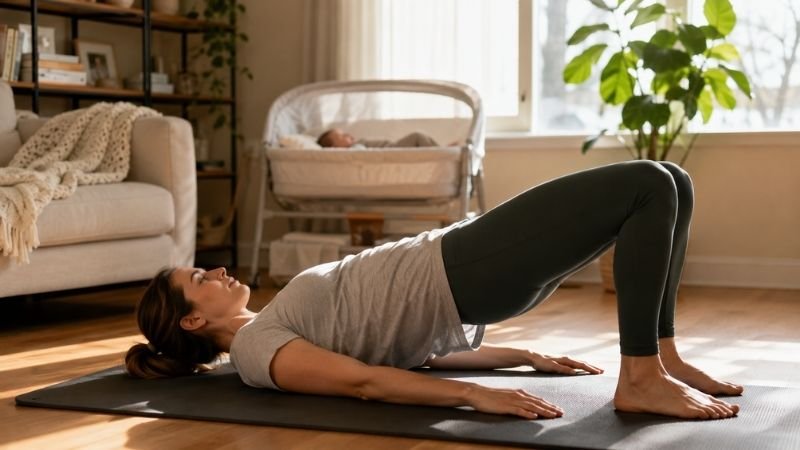
Picture this: it’s 6:30am, the baby is finally asleep, and you have maybe twenty minutes to yourself. You stand in the living room in your pajamas, half a cup of cold coffee in hand, thinking — I want to start moving again. But where do I even begin? Is my body ready? What if I do something wrong?
That moment. That’s exactly who this postpartum workout plan is for.
Not for the Instagram version of postpartum recovery — the one where someone is doing planks at 8 weeks with glowing skin and a sleeping baby. For the real version. The one where you’re exhausted, you’re not sure what your body can handle, and you just want to feel like yourself again without hurting anything in the process.
This guide will give you a clear, week-by-week postpartum workout plan you can do entirely at home, with no equipment required. We’ll talk about when it’s safe to start, what your body actually needs, and how to make progress even when you only have 15 minutes and a baby who naps unpredictably.
One thing we won’t do here: push you to “bounce back.” Your body grew a human being. It deserves a recovery — not a race.
Key Takeaways
- Most women can begin gentle movement around 6 weeks postpartum after vaginal delivery, and 8–12 weeks after a C-section — but always get clearance from your doctor first
- The American College of Obstetricians and Gynecologists (ACOG) recommends starting with pelvic floor and core reconnection before any higher-impact exercise
- Research published in the British Journal of Sports Medicine found that postpartum exercise significantly improves mood, reduces symptoms of postpartum depression, and supports long-term fitness
- Realistic postpartum weight loss is 0.5–1 lb per week — slower if breastfeeding, and that’s completely normal
- You do not need a gym, expensive equipment, or more than 15–20 minutes to make meaningful progress in the early postpartum weeks
First Things First: When Can You Actually Start Working Out After Baby?
This is the question almost every new mom asks — and the honest answer is: it depends on your birth experience, and your doctor or midwife is the only one who can give you a personalized green light.
That said, here’s a general framework most healthcare providers follow:
After vaginal delivery: Gentle movement like walking and pelvic floor exercises can often begin within the first 1–2 weeks, as long as you feel comfortable. More structured exercise is typically cleared around the 6-week postpartum checkup.
After C-section: Your abdominal wall has been through major surgery. Walking is encouraged early, but most doctors recommend waiting until at least 8–12 weeks before returning to core-engaging exercises. Don’t let anyone — including well-meaning fitness influencers — rush this timeline.
The rule that matters most: If something hurts, causes pressure, leaking, or discomfort, stop. Pain is not progress in postpartum recovery. It’s a signal.
Editor note: We know the 6-week wait can feel frustratingly long when you’re eager to move. But this window exists for good reason — your body is doing extraordinary healing work underneath the surface.
What Your Body Actually Needs Before Anything Else
Before you think about squats or cardio, there’s a foundation that needs rebuilding first — and most postpartum fitness content skips right past it.
Your pelvic floor and deep core have been through a lot. During pregnancy, they carried significantly increased load for nine months. During vaginal delivery, they stretched dramatically. During C-section, the abdominal layers were surgically separated. Either way, these muscles need intentional reconnection before they can support more demanding movement.
Starting without this foundation is like trying to build a house on sand. The workouts will feel harder, and you’re more likely to experience issues like leaking, pelvic pressure, or lower back pain that could have been avoided.
The two starting points your body actually needs:
Diaphragmatic breathing (360° breathing): Lie on your back, knees bent. Inhale slowly, letting your belly, ribs, and sides expand in all directions like a balloon. Exhale fully, letting everything gently release. Do this for 5 minutes. It sounds too simple, but it directly re-engages your deep core system and starts the reconnection process.
Pelvic floor contractions (Kegels — done correctly): Contract your pelvic floor muscles as if gently stopping the flow of urine. Hold for 3–5 seconds, then fully release. The release is just as important as the contraction. Do 10 reps, 3 times a day. You can do these lying down, sitting, or standing — even during a 3am feed.
These two things, done consistently in weeks 1–4, set the stage for everything that comes after.
Your 4-Week Postpartum Workout Plan
This plan is designed for moms who have received medical clearance and are ready to begin structured movement. Start at Week 1 regardless of how fit you were before — your body is in a new chapter, and it deserves a fresh start.
All workouts are bodyweight only. A yoga mat is helpful but not required. Each session is designed to take 15–20 minutes.
Week 1 — Reconnect
Goal: Reawaken your core and pelvic floor, start moving gently without strain Frequency: 4 days this week, rest or walk on other days
Each session:
- Diaphragmatic breathing — 5 minutes
- Pelvic floor contractions — 3 sets of 10
- Heel slides — 2 sets of 10 per leg (Lie on back, slowly slide one heel along the floor extending the leg, then return. Core stays relaxed but engaged.)
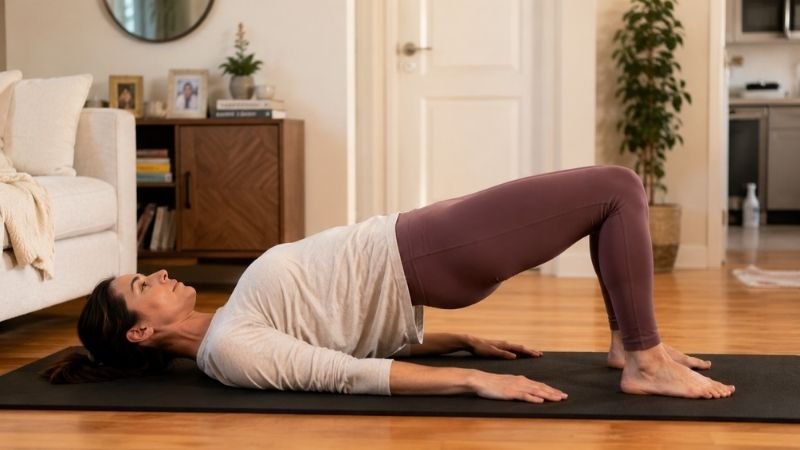
- Glute bridges — 2 sets of 10 (Lie on back, knees bent, slowly lift hips, hold 2 seconds, lower. Focus on squeezing glutes, not pushing through lower back.)
- Cat-cow — 1 minute (On hands and knees, slowly arch and round your back in sync with your breath.)
- Gentle walk — 10–15 minutes if energy allows
How it should feel: Easy. If you feel pelvic pressure, pulling, or pain — that’s your body asking you to back off. Listen to it.
Week 2 — Rebuild
Goal: Add gentle full-body movement, begin reintroducing lower body strength Frequency: 4 days this week
Each session:
- Diaphragmatic breathing — 3 minutes
- Glute bridges — 3 sets of 12
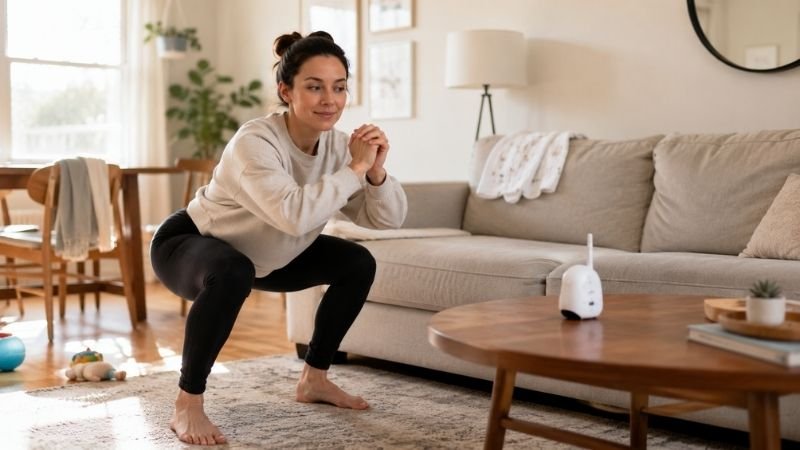
- Bodyweight squats — 3 sets of 10 (Feet shoulder-width apart, sit back like you’re lowering into a chair, keep chest tall. Go only as low as comfortable.)
- Modified push-ups (on knees) — 2 sets of 8
- Bird dog — 2 sets of 8 per side (On hands and knees, extend opposite arm and leg simultaneously, hold 2 seconds, return. Keeps core engaged without crunching.)
- Gentle walk — 15–20 minutes
Checking in with yourself: Can you complete the session without leaking, pressure, or pain? If yes, you’re ready to progress. If no, stay in Week 1 for another week — no judgment, just information.
Week 3 — Strengthen
Goal: Build on the foundation with slightly more challenging bodyweight work Frequency: 4–5 days this week
Each session:
- Squat to chair — 3 sets of 12 (Sit down slowly onto a chair, then stand. Adds control and depth to squats.)
- Reverse lunges — 3 sets of 10 per leg (Step back, lower knee toward floor, return. Easier on the knees than forward lunges.)
- Modified push-ups — 3 sets of 10
- Dead bug — 2 sets of 8 per side (Lie on back, arms pointing to ceiling, knees at 90°. Lower opposite arm and leg toward floor without letting your lower back arch. Return and repeat.)
- Glute bridge with hold — 3 sets of 10, 3-second hold at top
- Walk — 20 minutes or low-impact movement of your choice
Week 4 — Progress
Goal: Add light cardio options and begin building workout consistency Frequency: 5 days this week
Each session (choose A or B):
Option A (Strength focus):
- Squats — 3 sets of 15
- Reverse lunges — 3 sets of 12 per leg
- Push-ups (progress toward full push-up if ready) — 3 sets of 10–12
- Plank (on knees) — 3 holds of 20–30 seconds
- Glute bridge — 3 sets of 12
Option B (Low-impact cardio):
- March in place — 2 minutes
- Step touches — 2 minutes
- Bodyweight squat to march — 2 minutes
- Repeat circuit 3x
- Cool down walk — 5 minutes
By the end of Week 4, you’ve built a real foundation. From here, you can gradually increase reps, add resistance bands, or begin exploring short HIIT sessions if your body feels ready.
What If You Only Have 10–15 Minutes?
This is the reality of early motherhood. The baby falls asleep, you have a window, and you need something that works right now.
Here’s your 12-minute postpartum circuit for those days:
- Diaphragmatic breathing — 2 minutes
- Glute bridges — 3 sets of 10 (2 minutes)
- Bodyweight squats — 3 sets of 10 (2 minutes)
- Bird dog — 2 sets of 8 per side (2 minutes)
- Modified push-ups — 2 sets of 8 (1 minute)
- Gentle stretch — 3 minutes
That’s it. It’s enough. Showing up for 12 minutes is infinitely more effective than waiting for the perfect 45-minute window that never comes.
And if the baby wakes up halfway through? You did half. Half counts. Come back tomorrow.
Postpartum Weight Loss — What’s Actually Realistic
Let’s talk about this honestly, because the internet is full of timelines that set new moms up for disappointment.
The reality: most women retain some weight in the postpartum period, and that’s biologically intentional. If you’re breastfeeding, your body holds on to extra fat stores to support milk production. This is your body working correctly, not against you.
A realistic, healthy postpartum weight loss rate is 0.5–1 lb per week, starting after you’ve been cleared for exercise and when you’re not in an aggressive calorie restriction. Trying to lose weight faster than this — especially while breastfeeding — can reduce milk supply and deplete energy reserves you genuinely need.
The CDC recommends that postpartum women focus on gradual weight loss through a combination of moderate exercise and balanced nutrition, rather than caloric restriction.
What actually helps long-term:
- Consistent movement (the plan above) over crash workouts
- Protein at every meal to support muscle recovery and keep you full
- Sleep — we know, we know. But even one extra sleep block makes a measurable difference in hunger hormones
- Being realistic: your body spent 9 months changing. Give it at least that long to return to its new normal
Sportzillax editor note: We will never tell you to “get your body back.” You didn’t lose your body. You used it to do something extraordinary. The goal now is to feel strong, capable, and good — not to look like you were never pregnant.

Special Considerations
If you had a C-section: Add 2–4 extra weeks before beginning Week 1 of this plan. Focus entirely on breathing, pelvic floor work, and walking for the first 8 weeks. When you do begin the plan, skip any exercise that creates pulling sensation at your incision site, and progress more slowly through Week 2.
If you’re breastfeeding: Stay well-hydrated (aim for at least 2.5–3 liters of water daily), eat enough to support both your recovery and your milk supply, and avoid intense exercise right before nursing — some babies are sensitive to the lactic acid in breast milk after very vigorous workouts.
If you’re experiencing postpartum mood changes: Movement genuinely helps — research consistently shows that exercise reduces postpartum depression symptoms. But if you’re experiencing persistent sadness, anxiety, or feeling disconnected from your baby, please reach out to your healthcare provider. Exercise is a support, not a substitute for proper care. You deserve both.
When to Stop and Talk to Your Doctor
Stop exercising and contact your healthcare provider if you experience:
- Heavy bleeding or a return of bright red bleeding that had stopped
- Pain, pressure, or a feeling of heaviness in your pelvic area
- Any leaking of urine or stool during exercise
- Sharp abdominal pain or pulling at a C-section scar
- Dizziness, chest pain, or shortness of breath disproportionate to effort
- Symptoms of diastasis recti: a visible ridge or “coning” down the center of your abdomen during movement
These aren’t signs to push through. They’re your body asking for professional attention — and that’s always worth a conversation.
Frequently Asked Questions
How soon can you workout after giving birth? With your doctor’s clearance, gentle movement like walking and pelvic floor exercises can begin within the first 1–2 weeks after vaginal delivery. More structured exercise is typically cleared at the 6-week postpartum checkup. After C-section, most doctors recommend waiting 8–12 weeks before core-engaging exercise.
What is the best postpartum workout for beginners? The best starting point is pelvic floor reconnection and gentle bodyweight movements — glute bridges, heel slides, bird dogs, and modified push-ups. This postpartum workout plan is specifically designed for beginners with no equipment needed.
Can I do this postpartum workout plan if I had a C-section? Yes, with modifications. Wait until your doctor clears you (usually 8–12 weeks), then begin Week 1 of this plan. Progress more slowly, avoid any movement that causes pulling at your incision, and give yourself permission to take longer between weeks.
How do I lose weight after having a baby? Focus on consistent movement, adequate protein, and sleep where possible. A realistic postpartum weight loss rate is 0.5–1 lb per week. If breastfeeding, avoid aggressive caloric restriction as this can reduce milk supply. Weight loss after baby is a slow process by design — your body prioritizes recovery and feeding first.
What if I’m too tired to work out? On days you’re exhausted, a 10-minute walk outside counts. A 5-minute breathing session counts. Rest also counts. The goal in early postpartum is to establish the habit of moving, not to hit performance targets. Even tiny, consistent efforts add up more than you think.
Is it safe to do HIIT after having a baby? Not in the first 6–12 weeks. High-impact exercise like running, jumping, and HIIT should wait until your pelvic floor is fully reconnected and you can complete lower-impact workouts without any leaking, pressure, or pain. Rushing into high-impact too soon is one of the most common causes of long-term pelvic floor issues in postpartum women.
How long does postpartum recovery take? Most women feel significantly stronger by 3–4 months postpartum, but full core and pelvic floor recovery can take up to 12 months — especially after C-section. Be patient with yourself. Healing is not linear, and every week of consistent gentle movement is meaningful progress.
You’re Doing Better Than You Think
If you made it to the end of this guide, you’re already ahead — because you’re taking your recovery seriously, you’re thinking about it, and you’re choosing to do it safely instead of rushing it.
That matters more than any number on the scale or any timeline on Instagram.
Start with Week 1. Do it even if it feels almost too easy. Notice how your body responds. Celebrate the fact that you showed up — because showing up, even for 15 minutes while the baby sleeps, is genuinely how lasting change gets built.
You’ve got this. And we’re here for every step of it.
Ready for the next step? When you’ve completed this 4-week plan, check out our [Beginner Home Workout Plan] — a full-body program designed for moms who are ready to level up.
For equipment-free strength training options, explore our guide to [The Best Resistance Bands for Beginners] — an affordable tool that makes home workouts significantly more effective.
References
- American College of Obstetricians and Gynecologists (ACOG). Physical Activity and Exercise During Pregnancy and the Postpartum Period. https://www.acog.org/clinical/clinical-guidance/committee-opinion/articles/2020/04/physical-activity-and-exercise-during-pregnancy-and-the-postpartum-period
- Daley, A.J., et al. (2015). The effectiveness of exercise as a treatment for postnatal depression: a systematic review and meta-analysis. BJOG: An International Journal of Obstetrics & Gynaecology.
- Centers for Disease Control and Prevention (CDC). Losing Weight After Pregnancy. https://www.cdc.gov/healthyweight/healthy_eating/pregnant.html
- NourishMoveLove. 30-Day Postpartum Workout Plan. https://www.nourishmovelove.com/postpartum-workout-plan/