
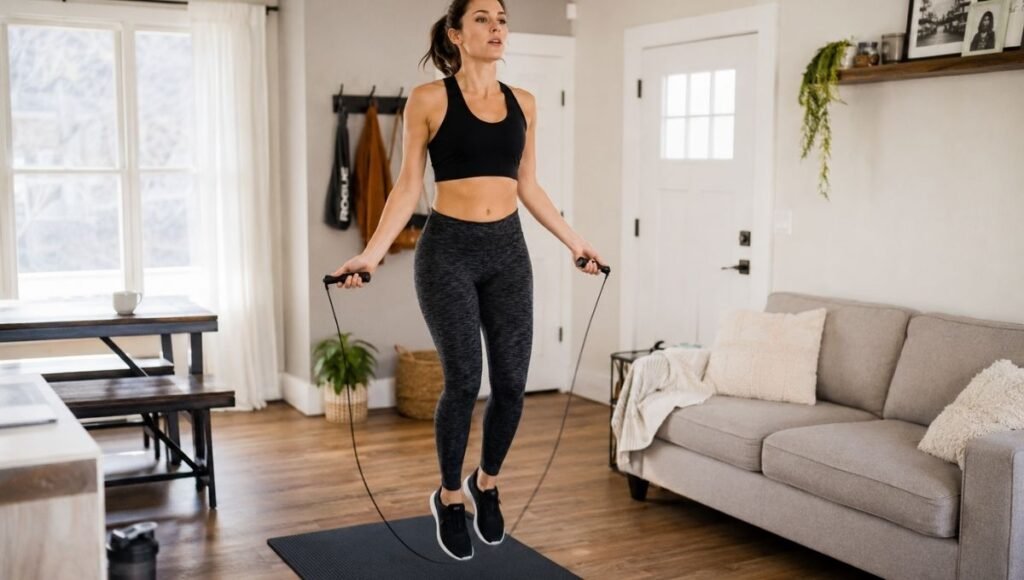
$15. That’s what a decent jump rope costs. Which means if you’re looking for the most calorie-efficient piece of fitness equipment you can buy for home use — the kind that fits in a kitchen drawer, travels in a carry-on, and burns roughly the same calories per minute as running — you’ve been overlooking it.
Here’s the catch: jumping rope is harder than it looks. Not harder than running, not harder than HIIT — just harder than the memory of doing it in primary school suggests. Most adults who try to jump rope for the first time trip over the rope every few jumps, hit themselves in the back of the legs, and give up inside of three minutes wondering why it feels so difficult.
The problem is technique, not fitness. And technique takes about 20 minutes to get right if someone explains it properly.
This guide covers everything you actually need to start a jump rope workout at home: how to size your rope, the most common beginner mistakes and how to fix them, a 4-week progressive workout plan, honest calorie data, a breakdown of the best jump ropes to buy, and how to jump rope in an apartment without your downstairs neighbor filing a formal complaint.
Key Takeaways
- For a 70-kg person jumping rope at sustained intensity, energy expenditure is approximately 13.5 kcal/min — making jumping rope one of the most calorie-intensive activities per minute available
- A 20-minute moderate jump rope session burns roughly the same calories as a 28–30 minute jog at 9 km/h for the same bodyweight — with significantly less impact on joints
- The biggest beginner mistake isn’t fitness — it’s rope length and wrist technique; fix these and you’ll go from tripping every 5 jumps to sustaining 30+ seconds within one session
- Beginners should start with 30 seconds on / 30 seconds rest intervals — not continuous jumping — and build from there over 4 weeks
- Jump rope is one of the few cardio tools effective enough for fat loss and cardio conditioning that costs under $20 and fits in a pocket
- For apartment users: landing on mid-foot with soft knees and minimal vertical height reduces noise by approximately 60% compared to heel-heavy jumping
Why Jump Rope Is the Most Underrated Home Cardio Tool
Most people associate jump rope with school playgrounds or boxing gyms. Both associations are accurate — and both undersell it.
Jump rope is a full-body cardiovascular exercise. Your legs are absorbing impact and producing power. Your core is stabilizing your torso. Your arms and shoulders are rotating the rope. Your coordination and timing are being trained simultaneously. For a single piece of equipment that costs $15 and takes up zero storage space, the return is genuinely exceptional.
Jumping rope can burn about 25% more calories per minute than running. It improves cardiovascular fitness, coordination, foot speed, and can be done in a 6-foot square of floor space — which is less room than you need to properly swing a kettlebell.
The reason most people don’t use jump rope isn’t because it’s ineffective. It’s because they tried it, couldn’t do it well, and concluded they were bad at it. They weren’t bad at it. They just didn’t know the three things that make it click.
Sportzillax editor note: Jump rope is one of the only fitness tools where technique matters as much as fitness. A very fit person can struggle to jump rope for 60 seconds because of poor form. A less fit person with good form can jump rope for 5 minutes continuously. The good news: good form takes about 15 minutes to learn.
Jump Rope Technique: Fix These 3 Things First
Before the workouts, before the equipment recommendations, before anything else — get these right. Every beginner problem with jump rope traces back to one of these three things.
1. Rope Length
The most common beginner mistake, and the easiest to fix.
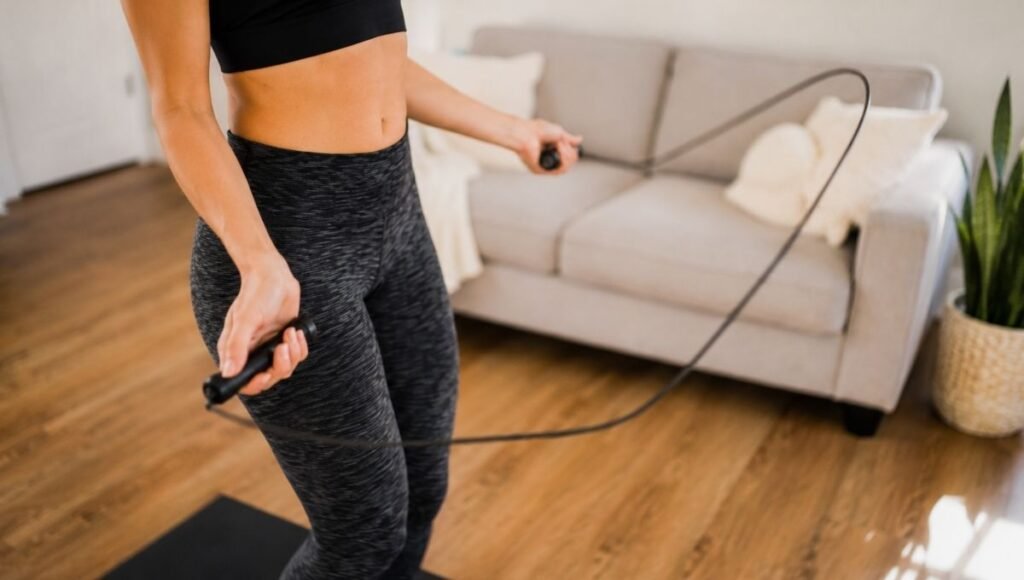
How to size your rope: Stand on the middle of the rope with both feet. Pull the handles up. The handles (not the rope — the handles) should reach approximately to your armpits or slightly below. Too long and the rope takes too wide an arc, requiring you to jump too high. Too short and the rope whips before you can clear it.
Most adjustable ropes have a screw mechanism at the handles. Adjust once, jump a few times, adjust again. Spend 5 minutes on this — it changes everything.
Quick check: If you’re consistently tripping, the rope is probably too long for your current skill level. Shorten it.
2. Wrist Rotation (Not Arm Rotation)
Elbows in, wrists do the turning. Imagine drawing small circles with your thumbs; the rope skims, it doesn’t lasso.
Most beginners rotate their entire arms, which creates a large, slow arc that requires a high jump to clear. Keeping elbows close to your ribs and rotating only from the wrists creates a small, fast arc that requires minimal jump height.
Quick check: If your arms are moving dramatically, you’re using arm rotation. If the movement is almost entirely in your hands and wrists, you’re doing it right.
3. Jump Height
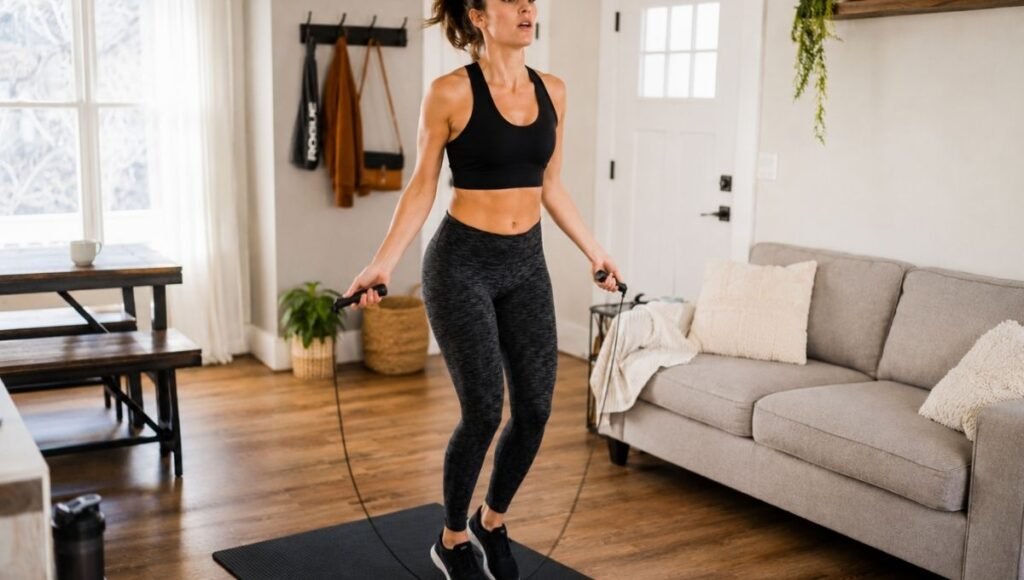
Jump lower than you think. Clear the rope by ~1–2 cm. That’s it. Land mid-foot, knees soft. Let the heel “kiss” the floor quietly after the mid-foot lands.
Most beginners jump 6–10 inches off the ground when they only need to clear the rope by about half an inch. This wastes enormous energy and creates the impact that hurts your calves and ankles. Reduce jump height dramatically — if the rope is rotating fast enough (which it will be with proper wrist technique), you barely need to leave the ground.
Quick check: If you’re landing heavily or your calves are burning within 2 minutes, you’re jumping too high.
How Many Calories Does Jump Rope Burn?
This is one of the most searched questions about jump rope — and the internet is full of wildly inconsistent answers. Here’s the actual data.
Most people burn 140–190 calories for every 1,000 skips of a jump rope at a moderate pace. A 150-pound (68kg) person jumping rope at a slow pace for 10 minutes will burn 105 calories. A 200-pound (90.8kg) person jumping rope at a fast pace for 10 minutes will burn 196 calories.
Practical Calorie Reference Table
| Body Weight | Slow Pace (10 min) | Moderate Pace (10 min) | Fast Pace (10 min) |
|---|---|---|---|
| 130 lbs (59 kg) | ~90 cal | ~115 cal | ~130 cal |
| 150 lbs (68 kg) | ~105 cal | ~138 cal | ~155 cal |
| 170 lbs (77 kg) | ~118 cal | ~156 cal | ~175 cal |
| 200 lbs (91 kg) | ~140 cal | ~183 cal | ~205 cal |
Based on MET values from the 2024 Compendium of Physical Activities
How Jump Rope Compares to Other Cardio
At moderate pace, jump rope (MET 11.8) burns more calories per minute than running at 9 km/h (MET ~9.8) for the same bodyweight. A 20-minute moderate jump rope session burns roughly the same as a 28–30 minute jog at 9 km/h.
The practical advantage is time efficiency and space. You don’t need a track, a treadmill, or even a full room. You need a $15 rope and a 6-foot square.
The afterburn effect: HIIT jump rope (intervals of intense jumping) also produces meaningful EPOC (excess post-exercise oxygen consumption) — your metabolism stays elevated for hours after the session. Research published in the Journal of Sports Science and Medicine found that HIIT protocols burn 25–30% more calories than continuous moderate exercise over the same time period, partly due to the afterburn effect.
Is Jump Rope Good for Weight Loss?
Honest answer: yes, as a component of a complete approach.
Jump rope is excellent cardio — it burns meaningful calories, improves cardiovascular fitness, and can be done at home in minimal time. But the same principle that applies to all cardio applies here: exercise supports fat loss; nutrition drives it.
A 20-minute jump rope HIIT session burns approximately 200–250 calories for most people. That’s meaningful — but it’s not going to overcome a significant calorie surplus from food. The combination that works: jump rope 3–4 times per week for cardio, strength training 3 times per week to build muscle and raise resting metabolism, and a moderate 300–500 calorie daily deficit from nutrition.
Jump rope’s particular advantage for fat loss is its efficiency. When you have 20 minutes, a 20-minute jump rope HIIT session burns more calories than a 20-minute walk by a significant margin — and requires no equipment beyond the rope.
Your 4-Week Beginner Jump Rope Workout Plan
This plan assumes you’re starting from zero — no previous jump rope experience, moderate general fitness. Each week builds on the last.

Week 1 — Learn the Basics
Frequency: 3 sessions this week Session duration: 15 minutes total
Before each session, spend 3 minutes practicing without the rope: mimic the arm movement and practice the low hop rhythm. This trains the timing before the rope adds complexity.
Main session format (20 seconds on / 40 seconds rest, 8 rounds):
- Rounds 1–4: Basic two-foot jumps, focus on wrist rotation and low hop height
- Rounds 5–8: Same, but try to count consecutive jumps without tripping
Target by end of week 1: 10+ consecutive jumps without tripping.
Note on calf soreness: Your calves will be noticeably sore after sessions 1 and 2. This is completely normal — jumping rope loads the calves more intensely than most people expect. Reduce jump height, do gentle calf stretches after each session, and don’t push through sharp pain.
Week 2 — Build Duration
Frequency: 3–4 sessions Session duration: 18 minutes total
Main session format (30 seconds on / 30 seconds rest, 10 rounds):
- Rounds 1–5: Basic two-foot jumps
- Rounds 6–10: Try alternating feet (running-in-place rhythm) — step right, step left, repeat
Target by end of week 2: 20+ consecutive jumps. Beginning to alternate feet during some intervals.
Week 3 — Add Intensity
Frequency: 4 sessions Session duration: 20 minutes total
Main session format (40 seconds on / 20 seconds rest, 8 rounds):
- Rounds 1–2: Slow warm-up pace
- Rounds 3–6: Moderate pace, alternating feet
- Rounds 7–8: Fast pace, basic two-foot jumps (all out)
Target by end of week 3: 30+ consecutive jumps. Can sustain 40 seconds of jumping with good form.
Week 4 — Full HIIT Circuit
Frequency: 4 sessions Session duration: 20–25 minutes
Session structure:
- 3 minutes: slow warm-up jumps
- 6 rounds of: 45 seconds moderate jumping / 15 seconds rest
- 4 rounds of: 30 seconds fast jumping / 30 seconds rest
- 3 minutes: slow cool-down jumping
- 5 minutes: standing forward fold + calf stretch + standing quad stretch
By end of week 4, most beginners can sustain 60+ consecutive jumps and complete the full session without stopping.
Jump Rope in an Apartment: The Noise Problem Solved
The most common reason people give up on home jump rope is downstairs neighbors. Here’s what actually works.
Noise equals inefficiency. Loud landings usually mean too much vertical travel or sloppy timing. As form improves, noise drops — and so does wasted energy.
The three-layer noise reduction approach:
- Technique first: Jump lower than you think. Clear the rope by ~1–2 cm. Land mid-foot, knees soft. Let the heel “kiss” the floor quietly after the mid-foot lands. This alone reduces noise by 50–60%.
- Mat second: A thick yoga mat or exercise mat absorbs significant impact sound. Stack two if your floors are thin.
- Equipment third: An adjustable rope prevents the rope from slapping the floor (common with too-long ropes). A too-long rope forces a high jump; a too-short rope invites whip-cracks. Adjustable length is non-negotiable.
For ultra-quiet days: Cordless/ropeless jump rope handles exist. They have weighted ends that mimic the feel of jumping without an actual rope — training timing and footwork with zero cable noise. Not a replacement for real rope training, but useful for very early mornings or late nights when any impact is too much.
Best Jump Rope for Beginners: What to Actually Buy
You don’t need to spend $50 on a jump rope. But you also shouldn’t buy the $5 rope from the bargain bin — the plastic handles crack, the rope tangles, and the length is usually wrong from the factory.
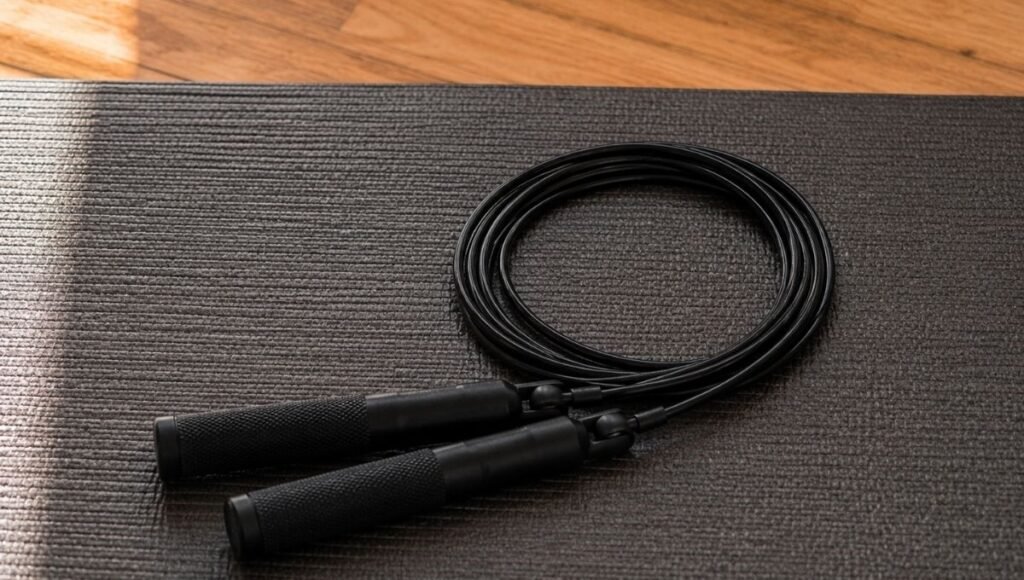
Best Jump Rope for Beginners: Crossrope Get Lean Set or Similar Adjustable
Price: ~$60–$80 | Why: Adjustable length, quality handles, comes with two rope weights (light and heavy). The ability to easily adjust length is worth the price premium for a beginner — it’s the single most important variable in jump rope.
Budget alternative: Any adjustable PVC speed rope in the $15–$20 range. Look specifically for “adjustable” in the description and read reviews for handle durability. The rope mechanism should be ball-bearing (smooth spin) rather than fixed attachment.
Best Jump Rope for Cardio / Weight Loss
Recommendation: Standard adjustable speed rope (PVC or steel cable), 4–5mm cable diameter Why: Lightweight enough to rotate fast, durable enough to last, and cheap enough to replace if it wears. Speed ropes and PVC ropes shine in steady-state training, where you maintain a consistent pace for longer periods — ideal for 20–30 minutes of uninterrupted jumping to steadily burn calories while improving endurance and aerobic fitness.
Best Jump Rope for Heavier Calorie Burn
Recommendation: Weighted jump rope (1/4 lb per rope) Why: The heavy rope engages the upper body, particularly the shoulders, arms, and core, offering a strong anaerobic challenge alongside the cardiovascular benefit. Burns more calories per minute but requires more skill to maintain form.
What to Avoid
- Fixed-length ropes sold in packs without adjustment mechanism
- Rope length listed as “one size fits all” — this is not true for jump ropes
- Plastic bead ropes (from children’s toys) — too slow for effective adult training
The 10-Minute Jump Rope Workout (For Busy Days)
No time for a full session? Ten minutes of intervals beats zero minutes of the perfect workout.
10-minute HIIT circuit (no warm-up needed if you go slow for first 90 seconds):
- 90 seconds: slow, easy jumps (warm-up)
- 6 rounds of: 30 seconds moderate jumping / 15 seconds rest
- 4 rounds of: 20 seconds fast jumping / 10 seconds rest
- 60 seconds: slow jumping to cool down
Calorie estimate: approximately 100–140 calories depending on body weight and effort.
That’s a meaningful cardio stimulus in 10 minutes, requiring one piece of $15 equipment.
Warning Signs to Watch
Jump rope is low injury-risk when done correctly, but watch for these:
- Sharp ankle or shin pain (not soreness — actual sharp pain): Stop immediately. Rest, ice, and give it 48 hours before trying again. If it persists, see a physiotherapist.
- Knee pain during or after jumping: This usually means you’re landing too hard (heel striking) or jumping too high. Reduce height, land on mid-foot.
- Wrist pain: Often from gripping the handles too tightly. Relax your grip — hold the handles firmly but not clenched.
- Extreme calf soreness for 5+ days: Normal soreness peaks at 24–48 hours. If you’re still limping at day 5, you did too much too soon. Scale back significantly next session.
Anyone with existing ankle, knee, or joint injuries should consult a healthcare provider before starting jump rope training.
Frequently Asked Questions
How many calories does jump rope burn in 10 minutes? On average, jumping rope burns between 110 and 135 calories in 10 minutes at sustained intensity. For a lighter person at slow pace, this drops to approximately 90–105 calories. For a heavier person at fast pace, it can reach 150–200 calories. Body weight and jump speed are the two biggest variables.
Is jump rope good for weight loss? Yes, as part of a complete approach. Jump rope provides efficient calorie-burning cardio — burning more calories per minute than walking or moderate cycling. Combined with strength training and a moderate calorie deficit, it’s an effective fat loss tool. Jump rope alone without dietary attention will produce limited weight loss results.
How long should a beginner jump rope? Start with 10–15 minutes of total session time (including rest intervals), 3 days per week. Week 1 should feel manageable — the goal is learning technique, not maximizing effort. Progress to 20 minutes by week 3 and add sessions as your calves and ankles adapt.
Why do my calves hurt so much after jump rope? Jump rope loads the calves intensely — more than most cardio exercises. The first 1–2 weeks will produce significant calf soreness. This is normal. Reduce jump height, stretch thoroughly after sessions, and add calf raises to strengthen the muscle for future sessions. The soreness diminishes significantly after week 2 as your calves adapt.
Can I do jump rope in an apartment? Yes, with proper technique. Land on mid-foot with soft knees, minimize jump height (just enough to clear the rope), and use a thick mat. The biggest source of apartment jump rope noise is poor technique — loud landings mean you’re jumping too high. As technique improves, noise drops significantly.
Start Jumping Today
You now have everything: technique fixes, a 4-week plan, calorie data, and equipment recommendations. All that’s missing is the rope.
Grab one. Practice the sizing. Do 5 minutes of wrist rotation and low hops. Trip over the rope a few times — everyone does. Come back tomorrow and do it again.
By week 4, you’ll be doing something that looked impossible in week 1. That’s jump rope.
For cardio that complements your jump rope sessions: → Cardio at Home: The Best No-Equipment Workouts for Beginners
For HIIT training to pair with jump rope intervals: → Beginner HIIT Workout at Home: 20 Minutes, No Equipment, Real Results
For building up your home gym setup beyond a jump rope: → Home Gym Setup on a Budget: What to Buy First (And What to Skip)
References
- Adult Compendium of Physical Activities (2024). MET values for rope skipping. https://pacompendium.com
- Protéalpes. Jumping Rope: How Many Calories Do You Burn? https://protealpes.com/en/outils/calories-corde-a-sauter/
- Elevate Rope. How Many Calories Are Burned Jumping Rope? https://www.elevaterope.com/blogs/elevate-rope/jump-rope-calories-burned
- Elite Jumps. What Style of Jump Rope Burns the Most Calories? https://elitejumps.co/blogs/guides/which-jump-rope-burns-more-calories
- Centers for Disease Control and Prevention (CDC). Physical Activity Guidelines for Americans. https://www.cdc.gov/physicalactivity/basics/adults/index.htm