
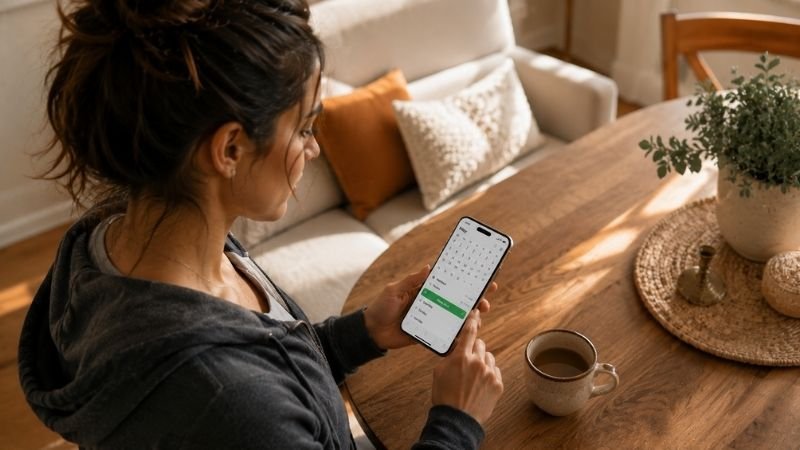
Here’s a scenario that plays out in homes across the country every January: someone buys a piece of gym equipment with the best intentions. Maybe it’s a treadmill, maybe a weight bench, maybe one of those all-in-one home gym machines they saw advertised. Three weeks later, it’s covered in laundry. Six months later, it’s on Facebook Marketplace.
The problem isn’t the equipment. The problem is buying the wrong thing, in the wrong order, for the wrong reasons — usually because a slick ad or a friend’s shiny garage gym made it look like the answer.
A good home gym setup doesn’t have to be expensive, elaborate, or Instagram-worthy. It has to be right for your actual goals, your actual space, and your actual budget. And it has to be something you’ll actually use — which is a much higher bar than most equipment guides acknowledge.
This guide will walk you through exactly how to build a home gym that works — starting with nothing, scaling to your budget, and making sure every dollar you spend actually moves the needle on your fitness.
Key Takeaways
- The average monthly gym membership costs $40–$70 — a $200 home gym setup pays for itself in 3–5 months
- A yoga mat + resistance bands + one pair of dumbbells covers 80% of effective home workouts for beginners
- The most common home gym mistake is buying large, expensive equipment before establishing a consistent training habit — equipment bought before a habit is formed ends up unused within 6 weeks in most cases
- Adjustable dumbbells are the single highest-value piece of equipment for most home gym users — they replace up to 15 fixed-weight pairs in the space of a shoebox
- You need less space than you think: a yoga-mat-sized area (6ft × 2ft) is sufficient for a complete beginner workout program
- The CDC recommends 150 minutes of moderate activity + 2 days of muscle strengthening per week — all of this can be achieved with under $200 of home equipment
The Most Honest Thing Anyone Will Tell You About Home Gyms
Before we talk about equipment, let’s talk about the real issue.
Most home gym guides assume you already have a consistent workout habit and just need to bring it home. But for most people searching “home gym setup” — especially beginners — the real challenge isn’t equipment. It’s building the habit of using it.
This matters enormously for what you should buy first.
Buying a $1,500 all-in-one home gym machine before you’ve established a training routine is like buying a professional espresso machine before you know if you’ll drink coffee every day. The machine is fine. The timing is wrong.
The principle that prevents the “expensive clothes rack” outcome:
Buy equipment that matches your current habit level, not your aspirational habit level.
If you currently work out zero days a week, start with what you can do in your living room with minimal investment. Prove to yourself you’ll show up for 6–8 weeks. Then invest more. Equipment bought after a habit is established gets used. Equipment bought to create a habit usually doesn’t.
Sportzillax editor note: This is the advice that saves people hundreds of dollars and prevents that specific feeling of opening the garage and seeing a dusty piece of equipment that represents good intentions from three years ago.
How to Set Up a Home Gym: Start With Your Goals
Before any equipment discussion, answer this: What are you actually training for?
This determines everything — what you buy, how much space you need, and what order to buy it in.
Goal: General fitness and staying active → Yoga mat + resistance bands covers most of what you need. Add dumbbells when you’re ready for structured strength training.
Goal: Fat loss and cardio → No equipment needed to start. Home cardio circuits, walking, and HIIT require zero gear. Add resistance bands or jump rope for variety.
Goal: Building muscle and strength at home → Dumbbells are your foundation. Adjustable dumbbells are the most space-efficient and cost-effective starting point. Add a pull-up bar and resistance bands as you progress.
Goal: Replacing a full gym membership → Adjustable dumbbells + resistance bands + pull-up bar covers the vast majority of gym exercises. You’ll miss the cable machine and barbell, but for 80% of your training, this works.
Home Gym Setup by Budget
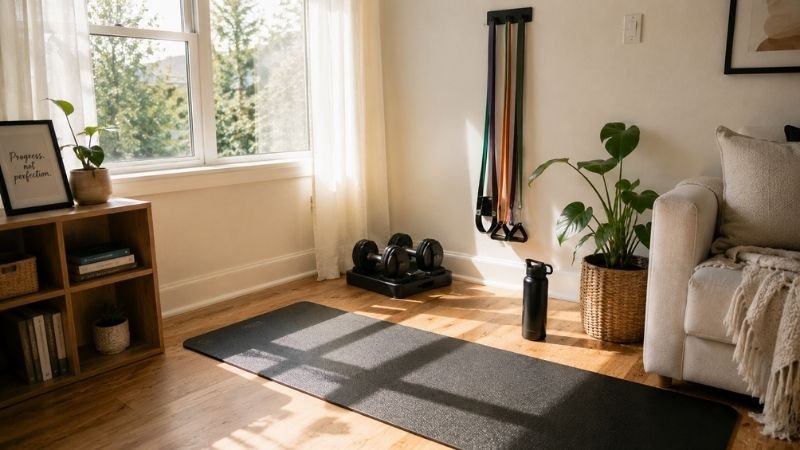
Budget Level 0: $0 — Start Here First
Yes, $0. Before you spend a single dollar, you should complete at least 4 weeks of bodyweight-only training to:
- Establish the habit of working out
- Identify what you actually enjoy
- Build a baseline level of fitness that makes weighted training more effective
A yoga-mat-sized space in your living room and your own bodyweight is a complete training tool for beginner-to-intermediate fitness. Push-ups, squats, lunges, glute bridges, planks, and mountain climbers are genuinely effective exercises that require nothing but floor space.
If you’re not working out at all right now, this is where you start. Period.
Budget Level 1: $50–$100 — The Minimum Effective Home Gym
This is the point where you’ve established the habit and want to add resistance and variety.
What to buy:
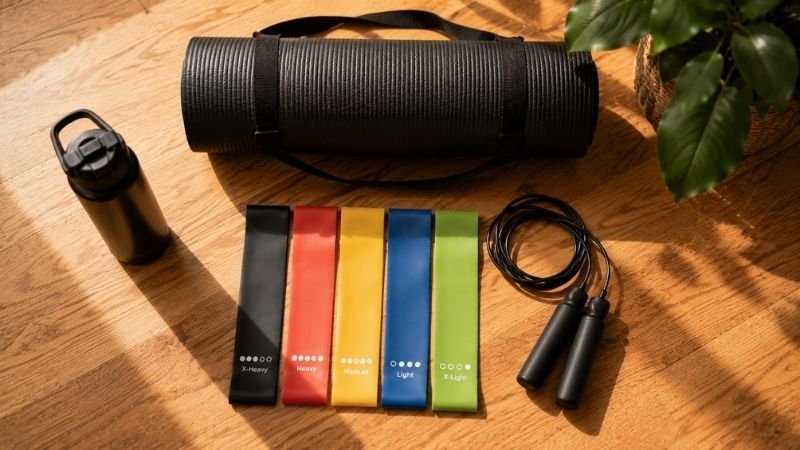
Resistance band set ($15–$35): Loop bands or tube bands with handles. This single purchase opens up dozens of exercises your bodyweight can’t provide — banded squats, rows, bicep curls, shoulder press, lateral walks, and more. A quality set of 3–5 resistance levels covers most beginner and intermediate needs. The most versatile and cost-effective piece of equipment available.
Yoga mat ($20–$40): Not strictly necessary, but makes floor exercises significantly more comfortable and defines your “workout space” psychologically. A designated space matters more than you’d think for habit consistency.
Jump rope ($10–$20): The most efficient cardio tool available per dollar spent. 20 minutes of moderate jump rope is comparable cardiovascular work to 20 minutes of jogging, in a fraction of the space. Optional for apartment dwellers with downstairs neighbors.
Total investment: $45–$95 What this covers: Full-body resistance training, cardio, flexibility. Enough for a 3-day-per-week complete program.
Budget Level 2: $150–$300 — The Complete Beginner Home Gym
This is the setup that covers everything a beginner needs for 12–18 months of progressive training.
Add to Level 1:
A pair of fixed dumbbells ($30–$60): If you’re new to training and just want one pair, choose weights that challenge you for moderate reps (10–15 per set). Women: 10–15 lbs for most exercises. Men: 15–25 lbs. Fixed dumbbells are cheaper upfront but you’ll need to upgrade as you get stronger.
OR — Better option:
Adjustable dumbbells ($150–$200): More expensive upfront, but replaces 5–8 pairs of fixed dumbbells. Bowflex-style or Core Home Fitness adjustable sets in the 5–52.5 lb range cover beginner through intermediate lifting for years. The per-dollar value is significantly higher than fixed weights over time.
For a detailed comparison of adjustable dumbbell options, see our Best Adjustable Dumbbells for Home Workouts guide.
Total investment: $165–$295 What this covers: Complete strength training, cardio, flexibility. All five fundamental movement patterns (push, pull, squat, hinge, carry) are covered.
Budget Level 3: $300–$500 — The Serious Home Gym
At this level, you’re building something that genuinely competes with a gym membership for effectiveness.
Add to Level 2:
Pull-up bar ($25–$50): A doorframe pull-up bar opens up vertical pulling movements (pull-ups, chin-ups, hanging) that are difficult to replicate with dumbbells and bands alone. One of the best strength-to-cost-ratio pieces of equipment available. Make sure your doorframe can support it and check installation requirements for your rental agreement.
Adjustable weight bench ($100–$200): A flat/incline adjustable bench enables dumbbell chest press, incline rows, step-ups, and seated exercises. Look for one with at least 3 incline positions and a weight rating of 300+ lbs. Note: the floor press is a legitimate bench alternative for many exercises — don’t let not having a bench stop you from training.
Foam roller ($20–$40): For recovery and myofascial release. Particularly valuable after lower body sessions. Not exciting, but consistently used by people who train regularly.
Total investment: $315–$490 What this covers: A training environment that replicates approximately 85-90% of what a commercial gym provides.
Small Home Gym Ideas: Space-Saving Solutions
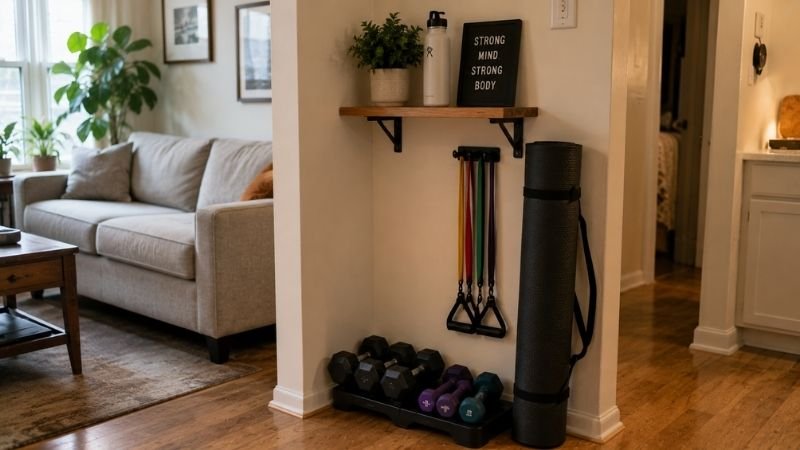
Space is the constraint most people underestimate. Here’s how to set up a home gym in a small apartment, shared living space, or single room.
The minimum viable space: A yoga mat area (approximately 6ft × 2ft) is sufficient for a complete bodyweight and resistance band workout. Most people have this available somewhere in their home.
Storage-smart equipment choices:
- Resistance bands: hang on a hook, fit in a drawer
- Adjustable dumbbells: one set replaces a full rack, takes up one square foot of floor space
- Yoga mat: rolls up and leans against a wall
- Jump rope: coils and hangs on a hook
- Pull-up bar: mounts in a doorframe, removes in seconds
What to avoid in small spaces:
- Treadmills (large footprint, significant noise, rarely used as often as anticipated)
- Full cable machines (space-intensive, expensive, limited versatility per dollar)
- Fixed dumbbell racks (beautiful but require significant dedicated floor space)
- Exercise bikes (large footprint unless you get a foldable model)
The corner gym: A single corner of a room — roughly 4ft × 4ft — can house a yoga mat, adjustable dumbbells on a small stand, a foam roller, and resistance band storage. This is genuinely sufficient for a complete training program.
Home Gym Essentials: The Non-Negotiables vs The Nice-to-Haves
Let’s separate what you actually need from what the fitness industry wants to sell you.
Non-Negotiables (buy these)
| Item | Why it’s essential | Estimated cost |
|---|---|---|
| Yoga mat | Floor exercise comfort, space definition | $20–$40 |
| Resistance bands (set) | Resistance training without heavy equipment | $15–$35 |
| Adjustable dumbbells | Progressive overload, versatility, compact | $150–$200 |
| Water bottle | Hydration during training | $10–$25 |
Nice-to-Haves (buy after establishing habit)
| Item | Why it’s useful | Estimated cost |
|---|---|---|
| Pull-up bar | Vertical pulling movements | $25–$50 |
| Adjustable bench | More exercise variety | $100–$200 |
| Foam roller | Recovery | $20–$40 |
| Jump rope | Cardio variety | $10–$20 |
Skip These (for most home gym users)
| Item | Why to skip | What to do instead |
|---|---|---|
| Treadmill | Large, noisy, expensive, often unused | Walk outside / low-impact home cardio |
| All-in-one gym machines | Low versatility per dollar | Dumbbells + bands cover more |
| Fixed dumbbell racks | Space-intensive | Adjustable dumbbells |
| Heavy free weights before habit established | Injury risk, often unused | Start light, progress over time |
The 3 Most Common Home Gym Setup Mistakes
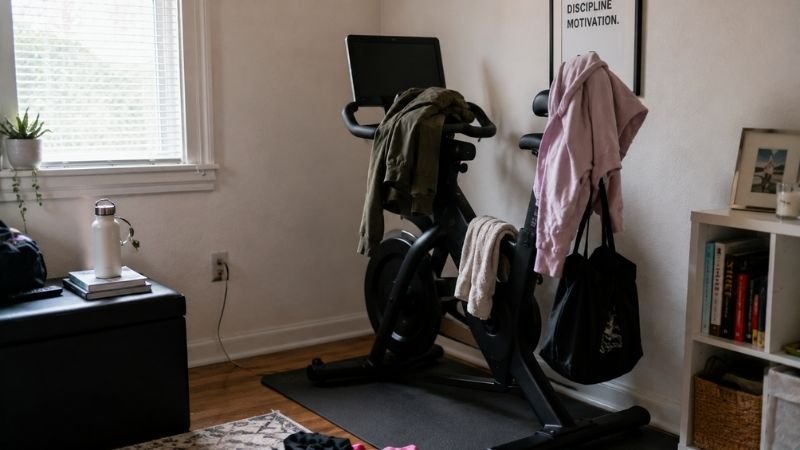
Mistake 1: Buying for your aspirational self, not your actual self. The most common and costly mistake. You buy the equipment for the version of you who works out 5 days a week, but you currently work out 0 days. Start small, establish the habit, then invest. Equipment bought after a habit is formed gets used consistently. Equipment bought to create a habit collects dust.
Mistake 2: Prioritizing cardio machines over strength equipment. Treadmills and ellipticals are large, expensive, and produce a limited range of training outcomes compared to free weights and bands. For most home gym users, resistance training equipment delivers significantly more value per dollar and per square foot. Cardio can be done outside, in a small space with no equipment, or with a $15 jump rope.
Mistake 3: Underestimating the importance of setup. Where your equipment lives matters for whether you use it. Equipment buried in a closet gets used less than equipment visible in a dedicated corner. The simple act of having your yoga mat unrolled and your resistance bands hanging on a hook makes it 10x easier to start a session on a busy day. Design your setup for the version of you who is tired and unmotivated — not the version who woke up excited to train.
Setting Up Your Home Gym: The Practical Checklist
Once you know what to buy, here’s the sequence for actually setting it up:
Step 1 — Choose your space. Pick the spot. A corner of the bedroom, a section of the living room, a garage corner. It doesn’t need to be permanent — just consistent.
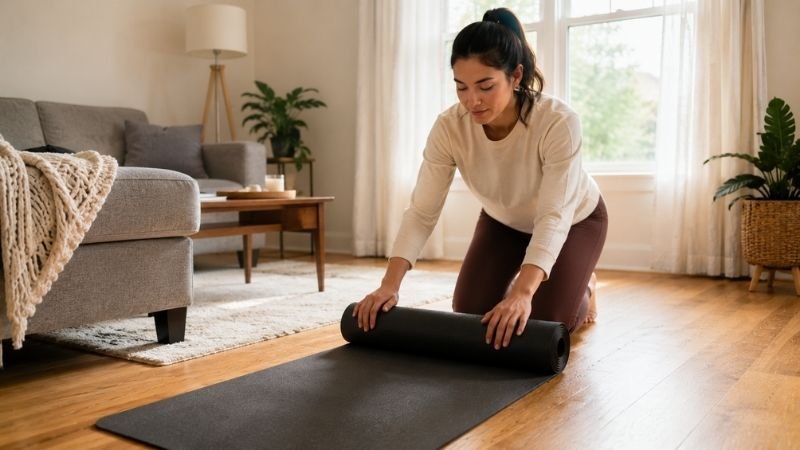
Step 2 — Define the floor area. Roll out your yoga mat. This becomes your training zone. Everything else radiates from here.
Step 3 — Organize storage. Resistance bands on a hook at eye level. Dumbbells on a small tray or directly on the floor next to the mat. Jump rope looped on the same hook as the bands. The goal: everything you need to start a workout is visible and reachable in under 10 seconds.
Step 4 — Remove friction. Put your workout clothes and water bottle nearby. The harder it is to start, the less often you will. Remove every obstacle between you and beginning a session.
Step 5 — Set the environment. Good lighting, enough ventilation, a phone holder if you follow workout videos. Small details that make the space feel purposeful rather than improvised.
How Much Does a Home Gym Cost? (Honest Numbers)
| Level | What’s included | Total cost | Replaces |
|---|---|---|---|
| Level 0 | Nothing (bodyweight only) | $0 | Beginner gym sessions |
| Level 1 | Mat + bands + jump rope | $45–$95 | Light resistance training + cardio |
| Level 2 | Level 1 + adjustable dumbbells | $195–$295 | Most beginner-intermediate gym sessions |
| Level 3 | Level 2 + pull-up bar + bench | $315–$490 | 85–90% of gym functionality |
At Level 2 ($200–$300 total), most home gym users break even against gym membership costs within 3–5 months. After that, every month is money saved — plus the time saved not commuting.
Warning: When to Get Professional Guidance Before Buying
A home gym is excellent for general fitness. But if you’re managing any of the following, get professional input before investing in equipment:
- A recent joint injury or surgery (knee, shoulder, hip, lower back)
- A chronic health condition that affects exercise capacity
- You’re postpartum and within 12 weeks of delivery
- You’ve been sedentary for more than 2 years
This isn’t about avoiding exercise — it’s about making sure your equipment choices support your specific situation rather than aggravating it. A physiotherapist or certified trainer can save you from expensive purchases that don’t suit your needs.
Frequently Asked Questions
What equipment do I need for a home gym? For most beginners: a yoga mat, a set of resistance bands, and a pair of adjustable dumbbells covers everything needed for a complete strength and conditioning program at home. A pull-up bar and adjustable bench are valuable additions once you’ve established a training habit.
How do I set up a home gym in a small space? A yoga mat area (approximately 6ft × 2ft) is genuinely sufficient for a complete bodyweight and resistance band workout. Adjustable dumbbells replace an entire rack in one square-foot of floor space. The key is choosing compact, multi-purpose equipment — resistance bands, adjustable weights, and a doorframe pull-up bar — rather than large single-purpose machines.
How much does a home gym cost on a budget? A fully functional beginner home gym can be set up for $50–$100 (mat, resistance bands, jump rope). Adding adjustable dumbbells brings total investment to $150–$300. At this level, you’re covering 80–90% of what a gym provides for the cost of 2–4 months of membership.
Is a home gym worth it? For people who use it consistently, yes — significantly. The average gym membership costs $40–$70 per month. A $200 home gym setup pays for itself in 3–5 months. The additional benefits — no commute, no waiting for equipment, training at any hour — make it genuinely compelling for anyone with a consistent habit or the intention to build one.
What should I buy first for a home gym? In order: (1) yoga mat, (2) resistance bands, (3) adjustable dumbbells. This sequence gives you increasing capability while managing cost and risk of under-use. Buy the mat and bands first, train with them for 4–6 weeks, then invest in dumbbells when you’ve proven you’ll use them.
Build It One Piece at a Time
The best home gym setup isn’t the most expensive one — it’s the one you actually use. That means starting smaller than you think you need to, proving the habit, and scaling from there.
Buy the mat. Unroll it tonight. Do something on it — even just the warm-up from one of our workout guides. That’s the real first step of your home gym setup.
Once you have the basics and you’re ready to add dumbbells: → Best Adjustable Dumbbells for Home Workouts (2026): Honest Reviews for Every Budget
Ready to put your home gym to work with a structured plan: → Beginner Workout Plan at Home: Your First 4 Weeks, Day by Day
For resistance band exercises you can start today: → Resistance Band Exercises for Beginners: 12 Moves + A Complete Home Workout Plan
References
- Health and Fitness Association. 2023 State of the Fitness Industry Report. Average gym membership cost data.
- Centers for Disease Control and Prevention (CDC). Physical Activity Guidelines for Americans. https://www.cdc.gov/physicalactivity/basics/adults/index.htm
- American Council on Exercise (ACE). Home Gym Setup Recommendations. https://www.acefitness.org
- Compare the Market. Home Fitness Equipment Injury Report, 2023.
- Global Wellness Institute (GWI). 2020 Global Wellness Economy Monitor.