
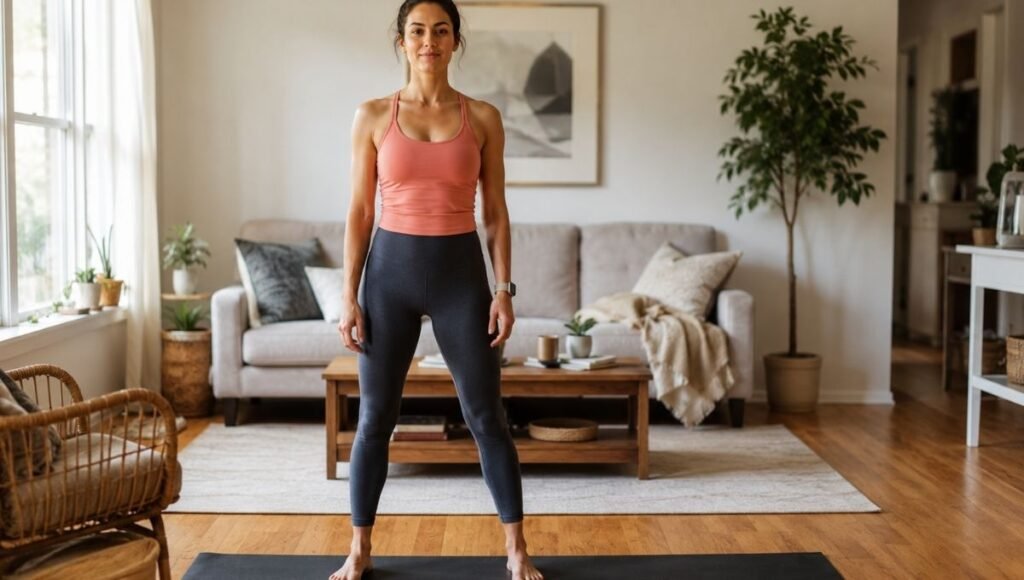
Here’s the thing about most beginner workout plans: they’re designed for a gym. They assume you have access to a lat pulldown machine, an elliptical, and a cable station. They assume you have 60 minutes, childcare sorted, and a 15-minute commute that you’ve already factored in.
And if your reality is closer to a living room with 25 minutes before the next responsibility kicks in — none of that works for you.
This guide is built from a completely different starting point: your home, your schedule, your life as it actually exists. This beginner workout plan for women is designed to be done in a yoga-mat-sized space, with zero equipment required, in 25–35 minutes per session. It’s structured around 4 full weeks — not just “week one” — with a clear, day-by-day progression so you always know exactly what today’s workout looks like.
You don’t need a gym membership. You don’t need expensive equipment. You need this plan, some floor space, and the commitment to show up three times a week.
Key Takeaways
- This plan requires zero equipment — all exercises use bodyweight; a pair of light dumbbells can be added from week 3 onward but are optional
- The CDC recommends at least 150 minutes of moderate-intensity activity weekly plus 2 days of muscle-strengthening — this plan meets both with 3 sessions per week
- Research published in the Journal of Strength and Conditioning Research confirms that 3 full-body sessions per week produces optimal strength adaptation for beginners while allowing adequate recovery
- Women who strength train consistently will not build bulky muscles — building significant mass requires years of heavy progressive overload, very high caloric intake, and specific hormonal conditions most women don’t have naturally
- Most women notice improved energy and mood within 2–3 weeks; visible changes in muscle tone typically appear at 6–8 weeks of consistent training
- Consistency beats intensity every time — a 25-minute session you actually complete 3 times per week produces better results than a 60-minute session you do once
Why This Plan Is Designed Specifically for Women
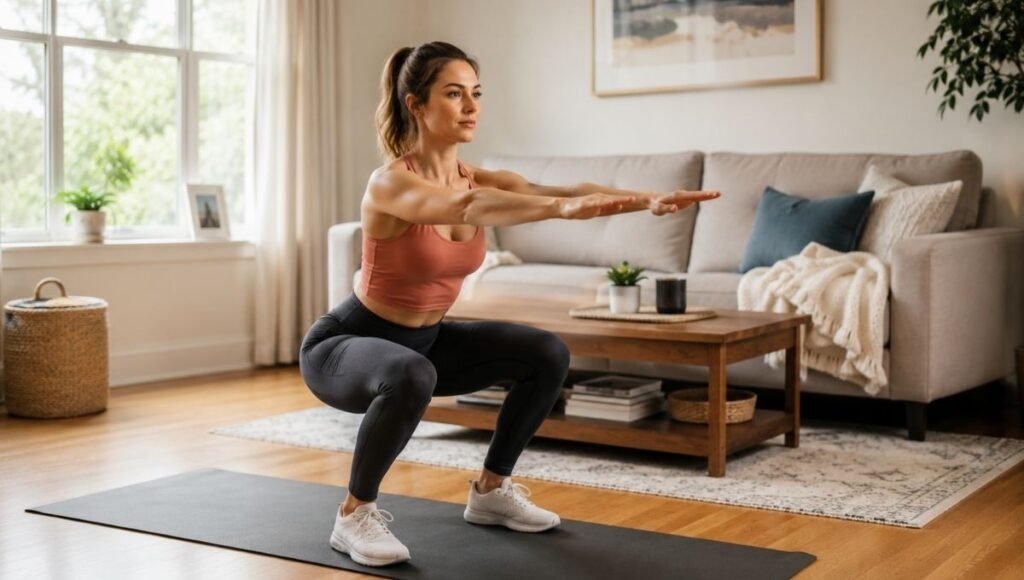
Before we get to the workouts, it’s worth explaining why this plan looks the way it does — because the best beginner workout plan for women isn’t the same as a gender-neutral beginner plan with pink colors.
Lower body training is prioritized. Women naturally carry more muscle-building potential in the glutes, hips, and thighs than in the upper body. The exercises that produce the most visible and functional results for women — squats, lunges, glute bridges, and hip work — are built into every session.
The “I’ll get too bulky” concern is addressed directly. Women produce approximately 10–30 times less testosterone than men, which is the primary hormonal driver of significant muscle mass building. Consistent strength training produces improved muscle tone, better posture, a higher resting metabolic rate, and functional strength. Not bulk. This concern should never stop a woman from picking up weights.
Hormonal cycle fluctuations are acknowledged. Your energy, recovery rate, and even strength levels fluctuate across your menstrual cycle. This is normal and doesn’t mean something is wrong with your training. In the week before your period, if everything feels harder, reduce reps by 2 per set and increase rest time. The plan doesn’t need to change — just your expectations for that week.
Pelvic floor and core safety are built in. All core exercises in this plan are safe for most women, including those who have had children. We’ve excluded high-pressure exercises (heavy crunches, V-sits) in favor of movements like dead bugs, bird dogs, and glute bridges that support rather than stress the core.
Sportzillax editor note: The fitness industry spent decades telling women to do cardio and avoid weights. That advice produced generations of women with good cardiovascular fitness and minimal functional strength. The research is clear now: strength training is one of the most important things women can do for their long-term health — for bone density, metabolic health, injury prevention, and quality of life.
How This 4-Week Beginner Workout Plan for Women Is Structured
Training days: 3 per week, non-consecutive (e.g., Monday/Wednesday/Friday or Tuesday/Thursday/Saturday) Session length: 25–35 minutes Equipment: None required (light dumbbells optional from week 3) Rest days: Walking, gentle stretching, or complete rest
Each week, one of three things changes to create progressive overload without adding complexity:
- Week 1–2: Learn the movements, build the habit
- Week 3: Increase reps and add optional resistance
- Week 4: Reduce rest time and add one new exercise variation
The Warm-Up (Same Every Session — 4 Minutes)
Never skip this. Cold muscles and connective tissue don’t respond well to sudden demand.
- March in place — 60 seconds (lift knees to hip height, pump arms)
- Arm circles — 20 seconds forward, 20 seconds backward
- Hip circles — 15 seconds each direction
- Slow bodyweight squat — 8 reps (warm-up pace, focus on feeling the movement)
- Inchworm — 3 reps (hinge forward, walk hands to plank position, hold 1 second, walk back, stand)
Week 1 — Build the Foundation
Goal: Learn the form. Make showing up 3 times feel normal. The workouts should feel manageable — you’re not trying to crush yourself in week 1.
Sets/Reps: 2 sets per exercise. Rest 75 seconds between sets.
Session A (Monday or Tuesday)
Bodyweight Squat — 2 × 12 Feet shoulder-width apart, toes slightly outward. Sit back and down, keeping chest tall and heels flat. Lower until thighs are parallel, drive through heels to stand. Squeeze glutes at the top.
Feel it in: quads, glutes, hamstrings
Modified Push-Up (knees) — 2 × 8 From knees, maintain a straight line from knees to shoulders. Lower chest toward floor, elbows at 45 degrees. Press back up fully.
Feel it in: chest, shoulders, triceps
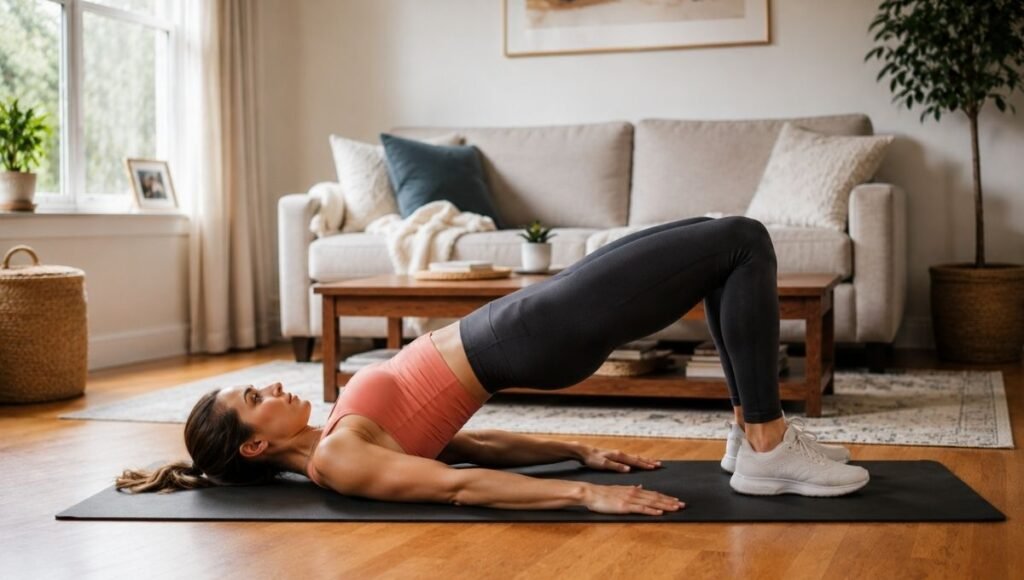
Glute Bridge — 2 × 12 Lie on back, knees bent, feet flat. Drive hips toward ceiling, squeeze glutes hard at the top. Hold 2 seconds. Lower slowly.
Feel it in: glutes, hamstrings
Dead Bug — 2 × 6 per side Lie on back, arms to ceiling, knees at 90 degrees. Brace core. Slowly lower right arm overhead while extending left leg toward floor — lower back stays pressed to floor. Return and alternate.
Feel it in: deep core, transverse abdominis
Standing Side Leg Raise — 2 × 10 per side Stand tall (hold wall for balance if needed). Raise one leg to the side, lower with control. Keep hips level throughout.
Feel it in: glute medius, outer hip
Session B (Wednesday or Thursday — Rest or Light Walk)
Session C (Friday or Saturday)
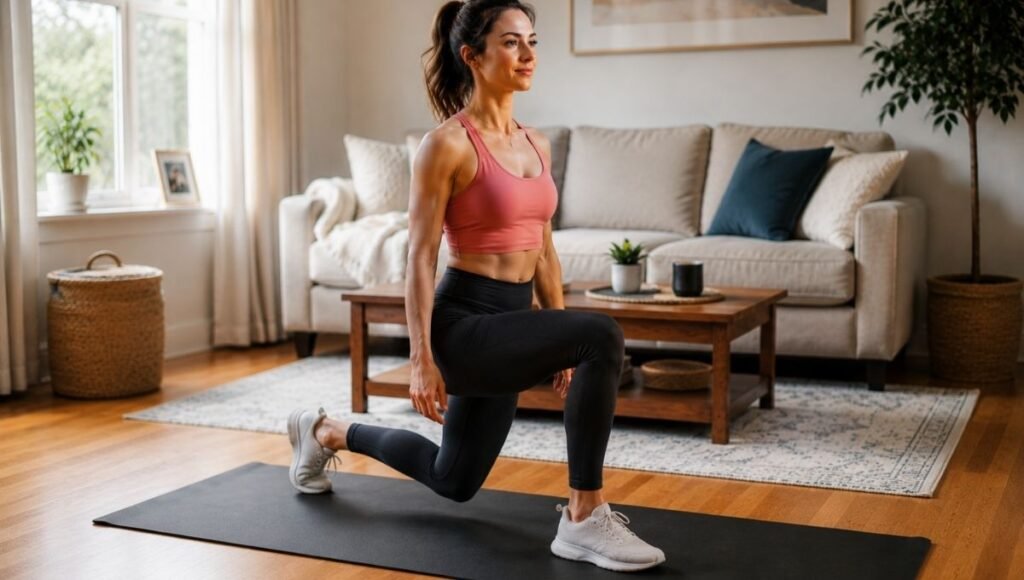
Reverse Lunge — 2 × 10 per leg Stand tall. Step one foot back, lower back knee toward floor. Return to standing. Easier on knees than forward lunges — correct starting point.
Feel it in: quads, glutes of front leg
Bird Dog — 2 × 8 per side On hands and knees. Extend right arm forward and left leg back simultaneously. Keep hips level. Hold 1 second. Return and alternate.
Feel it in: lower back, glutes, core stabilizers
Glute Bridge — 2 × 15 Same as Session A, increase reps by 3.
Wall Push-Up — 2 × 10 Hands on wall at shoulder height. Lower chest toward wall, press back. Easier than floor push-up — appropriate if floor push-up was very challenging.
Standing Bicycle Twist — 2 × 10 per side Standing, drive one knee up while twisting opposite elbow toward it. Controlled rhythm.
Feel it in: obliques, hip flexors, elevates heart rate
Week 1 Notes
The squats and lunges will likely make your glutes and quads sore for the first 2–3 days. This is normal — it’s called DOMS (delayed onset muscle soreness). It peaks at 24–48 hours and resolves within 72 hours. Light walking on rest days helps it clear faster. Don’t skip Session C because you’re sore from Session A — gentle movement through soreness is appropriate; complete rest makes it linger longer.
Week 2 — Build Volume
Goal: Add one more set to each exercise. Notice what’s getting easier. The soreness should be significantly less than week 1.
Sets/Reps: 3 sets per exercise. Rest 60 seconds between sets.
All exercises remain the same as Week 1. The progression is: one additional set, slightly reduced rest.
Session A addition: After completing the main circuit, add:
- Plank Hold (knees) — 3 × 20 seconds
Session C addition: After completing the main circuit, add:
- Superman Hold — 3 × 8 reps (lie on stomach, raise arms and legs simultaneously, hold 2 seconds)
Week 3 — Add Challenge
Goal: Increase reps and introduce resistance if available. Progress to harder exercise variations where possible.
Sets/Reps: 3 sets. Rest 45–60 seconds. Increase reps by 2–3 on all exercises.
New in Week 3:
Full Push-Up (if ready): Attempt 2–3 full push-ups before dropping to knees. Even if you only manage 2 full before continuing on knees, that’s meaningful progress.
Goblet Squat (if you have a dumbbell): Hold a single dumbbell vertically at chest height. The counterbalance naturally improves form and adds meaningful resistance. Start with a weight challenging for 10 reps.
Single-Leg Glute Bridge: Extend one leg while bridging — significantly harder than standard version. Attempt on both legs, reduce to standard if form breaks.
Sumo Squat: Wider stance, toes out more. Targets inner thighs and glutes differently from standard squat. Add 2 sets to each session.
Week 4 — Finish Strong
Goal: Reduce rest time and add a fourth training session if life allows. End the month stronger than you started.
Sets/Reps: 3 sets. Rest 30–45 seconds between exercises. Rest 60 seconds between rounds.
Session structure shifts to circuit format:
Complete all exercises back-to-back as a circuit with minimal rest, then rest 60–90 seconds and repeat the circuit 3 times.
Circuit:
- Goblet Squat (or Bodyweight Squat) — 15 reps
- Push-Up (full or modified) — 10 reps
- Reverse Lunge — 10 per leg
- Glute Bridge (single-leg or standard) — 12 reps
- Bird Dog — 8 per side
- Plank Hold — 30 seconds
- Standing Side Leg Raise — 12 per side
Total time for 3 rounds: approximately 25–30 minutes
By the end of week 4, you’ve done 12 sessions. You’ve learned proper form on all major movement patterns. Your glutes, legs, and core are measurably stronger. You’re ready to add weights and progress to an intermediate program.
The 10-Minute Version (For Days When Life Happens)
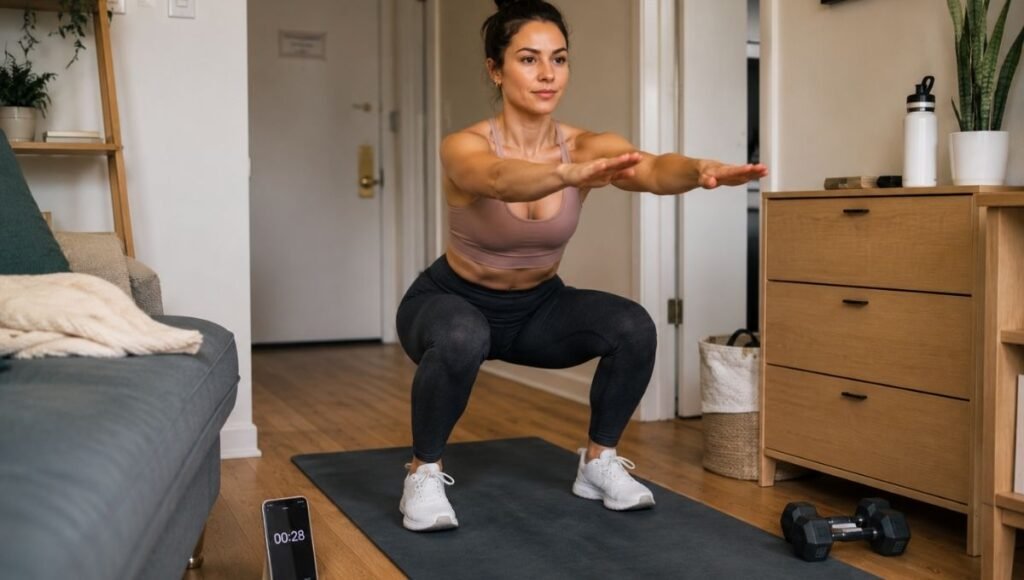
Some days, 25 minutes isn’t available. On those days, do this:
10-minute circuit (2 rounds, minimal rest):
- Bodyweight Squat — 12 reps
- Glute Bridge — 15 reps
- Modified Push-Up — 8 reps
- Dead Bug — 6 per side
That’s it. It keeps the habit alive. It deposits into your consistency. Three of these per week, done week after week, produces real change over time.
HIIT Workout for Women: How to Add Cardio to This Plan
Strength training is the foundation of this plan. But if you want to add cardiovascular work — for heart health, additional calorie burn, or simply because you enjoy it — here’s how to integrate it without overloading your recovery.
The simplest approach: Add a 20–30 minute walk on your rest days. Walking is consistently underrated as cardiovascular exercise. Three rest-day walks per week provides meaningful cardiovascular benefit without interfering with strength recovery.
For more intensity: On 1–2 rest days, substitute the walk with a 20-minute low-impact cardio circuit. Standing marching, step touches, skater slides, and shadow boxing — all done without jumping — provide genuine cardiovascular stimulus without the joint impact of jumping exercises.
What not to do: Don’t add intense HIIT sessions on the days between your strength sessions, especially in weeks 1–2. Your muscles need those rest days to repair and strengthen. Compressing recovery time in the early weeks is one of the most common reasons beginners burn out before seeing results.
For a complete low-impact cardio option that pairs perfectly with this plan, see: Low Impact HIIT Workout: All the Intensity, None of the Jumping
Workout Plan for Women Over 30: What Changes

The exercises in this plan are appropriate for all ages. But if you’re in your 30s or beyond and haven’t trained consistently before, a few things are worth noting:
Recovery takes slightly longer. Muscle protein synthesis — the repair process that makes you stronger — is marginally slower after 30 than in your early 20s. This doesn’t mean the exercises work less well; it means rest days are more important, not less. Don’t skip them.
Bone density benefit becomes more significant. Women begin losing bone density in their late 30s, accelerating at perimenopause. Resistance training — including the bodyweight exercises in this plan — is one of the most effective evidence-based interventions for maintaining and building bone density. This isn’t just about aesthetics; it’s long-term health.
Protein needs are higher. To maximize muscle adaptation from training, women over 30 generally need at least 0.7–1g of protein per pound of body weight daily. Prioritize protein at each meal — eggs, Greek yogurt, chicken, legumes, cottage cheese.
Hormonal fluctuations are real. Particularly in perimenopause, energy levels and recovery can vary significantly across the month. Give yourself permission to have lower-intensity sessions when needed — training through complete exhaustion doesn’t serve you.
When to Seek Professional Guidance Before Starting
This plan is appropriate for most healthy adults. Consider medical clearance first if you:
- Have been completely sedentary for more than 2 years
- Are managing a chronic health condition (cardiovascular disease, diabetes, osteoporosis, joint conditions)
- Are postpartum and within 8–12 weeks of delivery (see our Postpartum Workout Plan for the appropriate starting point)
- Experience pelvic floor symptoms (leaking, prolapse pressure) during exercise — consult a pelvic floor physiotherapist before progressing
Frequently Asked Questions
What is the best beginner workout plan for women at home? A 3-day-per-week full body program using compound bodyweight movements — squats, lunges, push-ups, glute bridges, and core exercises — is the most effective starting point. This provides each muscle group with sufficient stimulus while allowing recovery between sessions. The plan in this guide follows this structure across 4 weeks with progressive difficulty.
How many days a week should a woman workout as a beginner? Three days per week on non-consecutive days is the research-supported sweet spot for beginners. More frequent training without adequate recovery leads to diminishing returns and increased injury risk. As fitness improves after 6–8 weeks, you can add a fourth session.
Can I lose weight following a beginner workout plan at home? Yes, as part of a complete approach. The exercises in this plan build muscle, which raises your resting metabolic rate over time. Combined with reasonable nutritional attention (not crash dieting — just prioritizing protein and avoiding significant calorie surplus), consistent home training produces meaningful fat loss. Exercise alone without any dietary awareness typically produces minimal weight loss results.
Will I get bulky from this workout plan? No. Building significant muscle bulk requires years of heavy progressive overload, a consistent calorie surplus, and testosterone levels that women simply don’t have naturally. Consistent training with this plan produces improved muscle tone, better posture, increased strength, and a leaner appearance — not bulk.
What do I do after completing the 4-week plan? You’ve built a solid foundation. The natural next step is adding resistance. A pair of adjustable dumbbells opens up significantly more exercise variety and allows meaningful progressive overload. See our Full Body Dumbbell Workout at Home for the next level, or our Dumbbell Exercises for Beginners guide for a complete exercise library.
You’ve Already Done the Hard Part
Deciding to start is harder than the first workout. You’ve done the deciding. Now it’s just execution.
Three sessions this week. Twenty-five minutes each. You don’t have to be perfect. You don’t have to crush every set. You just have to show up, move well, and come back two days later.
Week 4 is coming regardless. The question is whether you’ll be 12 sessions stronger when it gets there.
When you’ve completed this plan and you’re ready to add weights: → Dumbbell Exercises for Beginners: 15 Moves, Every Muscle Group, No Bench Needed
For a safe core program that complements this plan: → Beginner Core Workout at Home: 10 Safe Exercises (No Crunches Needed)
For postpartum women specifically: → Postpartum Workout Plan: Your Safe, Realistic Guide to Moving Again After Baby
References
- Schoenfeld, B.J., et al. (2016). Effects of Resistance Training Frequency on Measures of Muscle Hypertrophy: A Systematic Review and Meta-Analysis. Sports Medicine.
- Cederholm, T., et al. (2017). ESPEN guidelines on definitions and terminology of clinical nutrition. Clinical Nutrition. (protein recommendations)
- Centers for Disease Control and Prevention (CDC). Physical Activity Guidelines for Americans. https://www.cdc.gov/physicalactivity/basics/adults/index.htm
- American College of Sports Medicine (ACSM). Resistance Training for Health and Fitness. Position Stand, 2009.
- National Institutes of Health (NIH). Bone health and osteoporosis. Office of the Surgeon General, 2004.