
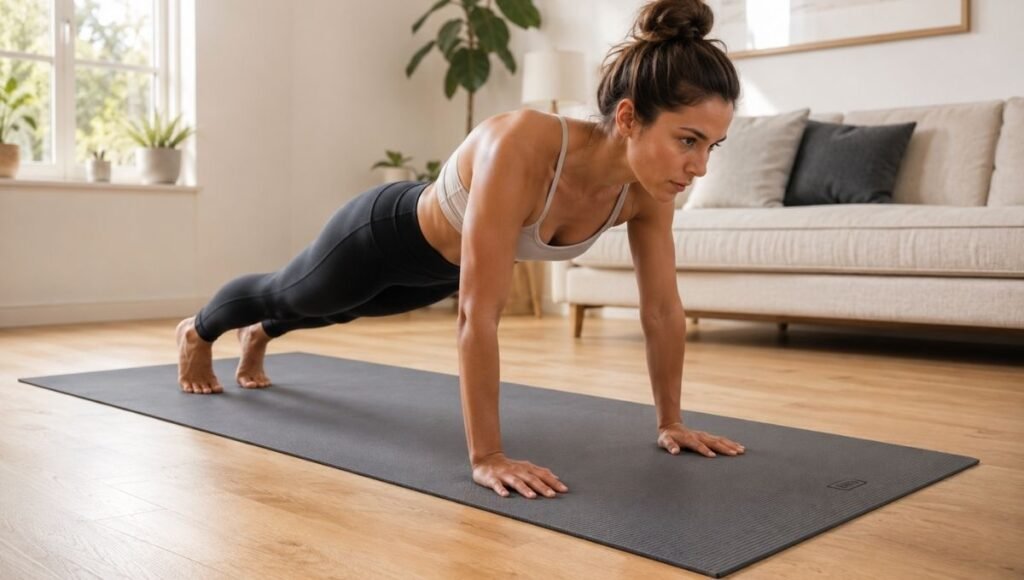
You bought a yoga mat. It slides across your hardwood floor every time you do a lunge. Or the corners curl up and trip you mid-squat. Or it smells like a chemical factory for the first three weeks. Or — and this one stings — you bought the $12 Amazon mat and it left a grey stripe across your white floor.
Finding a good yoga mat sounds simple. It is not.
The problem isn’t that there aren’t enough options. It’s that there are too many, most of the buying guides out there are clearly written by people who haven’t done a burpee in their lives, and the marketing language (“superior grip,” “premium cushioning,” “eco-friendly”) has become completely meaningless.
This guide is for people who use their mat for home workouts — not just slow flow yoga twice a week, but HIIT circuits, strength training, floor exercises, postpartum recovery, whatever your routine actually looks like. We’ll cover what actually matters when choosing a mat, honest picks at every price point, and a simple decision tool so you can stop overthinking and just buy the right one.
Key Takeaways
- For most home workout users doing a mix of exercises, a 4–6mm mat in TPE or natural rubber provides the best balance of cushioning, stability, and grip
- Thickness and density are not the same thing — a 6mm low-density foam mat will feel unstable, while a firm 4mm mat can be more supportive
- Standard mats of approximately 1/8 inch (3.175mm) work well for flowing practice, while thicker mats are better for restorative yoga and anyone with tender knees or joints
- The most common yoga mat failure for home workout users isn’t wear — it’s slipping on hardwood floors and curling edges; both are preventable with the right material choice
- A good yoga mat at any price point should pass four tests: it doesn’t slide on your floor, the corners lie flat, it doesn’t compress to nothing under weight, and it can be wiped clean
- Budget doesn’t have to mean bad: solid TPE mats in the $25–$45 range perform comparably to premium brands for most home workout needs
How to Choose a Yoga Mat: What Actually Matters
Most buying guides lead with brand names. This one leads with specs — because understanding what you need makes any buying decision simpler.
Thickness: The Most Misunderstood Spec
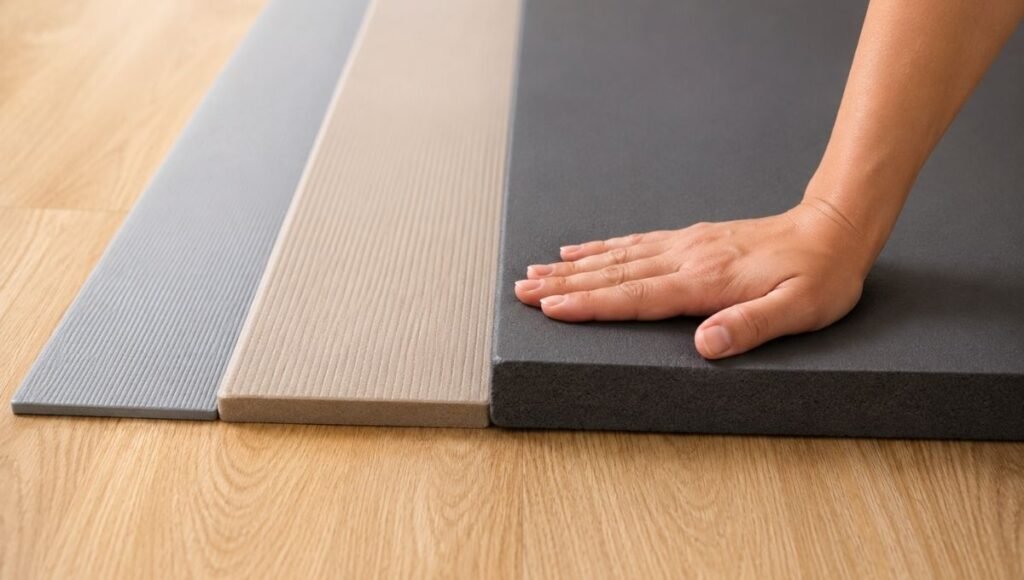
Thickness runs from about 2mm (travel mats) to 10mm (plush foam). The common assumption is thicker = better. This is wrong.
While thicker mats provide more cushioning, they may not be as stable when transitioning from one pose to the next. For beginners, something in the middle — around 1/8 inch — provides enough cushioning and stability for most poses.
For home workouts specifically:
- 3–4mm: Best if you do a lot of standing balance work, yoga flows, or strength exercises where ground contact and stability matter more than cushioning. Not ideal for kneeling or floor-heavy routines.
- 4–6mm: The sweet spot for most home exercisers. Comfortable for floor work, stable enough for standing poses and lunges. This is what we recommend for 80% of people.
- 6–10mm: Good for anyone with sensitive knees, wrists, or joints, or for restorative and floor-based routines. Can feel spongy under weight if density is low.
Density: The Spec Nobody Talks About
Thickness tells you height; density tells you whether the mat stays stable. Low-density foam can feel comfortable at first but becomes unstable for wrists and ankles during holds and transitions — and can wear faster under repeated pressure.
A firm 5mm mat is better than a squishy 8mm mat for most exercises. When you press down on a mat sample in a store (or squeeze it at home), it should resist compression rather than collapsing easily. If your fingers sink in more than halfway, the density is probably too low for strength or balance work.
Material: What Each One Actually Means
PVC (polyvinyl chloride): The most common cheap mat material. Durable, easy to clean, good grip when dry. Problem: PVC mats are non-absorbent and can become slippery when you sweat heavily. Also not environmentally friendly. Fine for light use; not ideal for sweaty home HIIT.
TPE (thermoplastic elastomer): A middle-ground material — more eco-friendly than PVC, lighter than rubber, decent grip. TPE mats may be more environmentally friendly than PVC, and some are fully recyclable, though they are generally less durable than PVC mats of the same thickness. Good for most home workout users who want a balance of performance and price.
Natural rubber: The performance material. Excellent grip in wet and dry conditions, durable, and provides a genuine non-slip surface on most floors. The trade-off: heavier, more expensive, and not suitable for people with latex allergies. If you’re serious about home workouts and want to buy once, natural rubber is worth the investment.
Cork: Naturally antimicrobial and grippier when wet (counterintuitive but true). Great for sweaty practices. Tends to be lighter than rubber. More expensive than TPE, less durable than high-end rubber.
Grip: The Feature That Matters Most for Home Workouts
Grip has two dimensions that most guides conflate: surface grip (your hands and feet staying on the mat) and floor grip (the mat staying on your floor).
For home workouts, floor grip often matters more — especially on hardwood, laminate, or tile. Natural rubber bottoms provide the best floor grip. Suction-cup or textured PVC bottoms are second best. Smooth PVC bottoms on polished hardwood is the worst combination.
Sportzillax editor note: If you’re on hardwood and your current mat slides, the cheapest fix isn’t a new mat — it’s a $10 non-slip rug pad cut to size underneath. But if you’re buying new, just get a rubber-bottom mat and skip the workaround.
What to Look For in a Yoga Mat: The Quick Checklist
Before buying any mat, confirm these five things:
- Bottom material: Is it rubber, textured TPE, or smooth PVC? Rubber or textured = better floor grip.
- Thickness: Is it 4–6mm for general use, or thicker if you have joint sensitivity?
- Edge behavior: Does the product page show flat edges, or do reviews mention curling? Curling corners are a chronic complaint with cheap mats.
- Cleanability: Can it be wiped down with a damp cloth? If it requires special treatment after every use, you won’t do it.
- Weight: If you’re not moving it anywhere, this doesn’t matter. If you’re bringing it to a class or storing it away, over 5 lbs becomes annoying quickly.
Best Yoga Mats for Home Workouts: Our Picks
We’ve organized these by use case rather than by price — because the “best budget mat” for someone on hardwood floors is different from the “best budget mat” for someone on carpet.
Best Overall: Manduka PRO
Price: ~$120–$140 | Thickness: 6mm | Material: PVC (closed cell)
The Manduka PRO is the mat that consistently shows up when serious home exercisers ask what to buy once and never think about again. The closed-cell surface means it doesn’t absorb sweat or bacteria, making it easy to clean and long-lasting. The Manduka PRO offers something for every ability level — comfortable and supportive enough for mobility work when recovering from injury, while offering enough stability for those starting to venture into arm and head balances.
The 6mm thickness provides genuine cushioning without feeling spongy — this is a dense, firm 6mm, not a cheap foam 6mm. The trade-off: it takes a few weeks to break in the surface grip, and it’s heavier than most alternatives.
Best for: Anyone who wants one mat that handles everything — yoga, floor exercises, HIIT, strength training — and doesn’t want to buy again for years. Not ideal for: Anyone on a tight budget or who needs to carry their mat regularly.
Best for Beginners: Iuga Eco-Friendly Non-Slip Yoga Mat
Price: ~$35–$45 | Thickness: 6mm | Material: TPE
The Iuga Eco-Friendly Non-Slip is hands down one of the best budget options we’ve tested for both quality and portability. It provides excellent grip, comfort, and stability, and it’s longer and wider than many other mats, making it even easier to practice on, no matter your size or experience level.
For a first yoga mat for home workouts, the Iuga hits all the important marks without requiring a significant investment. The 6mm thickness is comfortable for floor work, the TPE material provides reasonable grip, and the price leaves room to upgrade later when you know what you actually want.
Best for: Beginners, budget-conscious buyers, anyone trying home fitness for the first time. Not ideal for: Heavy sweaters (open-cell design absorbs moisture), daily intensive use over multiple years.
Best Non-Slip Yoga Mat: Liforme Original
Price: ~$150 | Thickness: 4.2mm | Material: Natural rubber + eco-polyurethane surface
The Liforme soundly delivers functionality with the surprising grip of its smooth surface, which remains intact even when you’re dripping sweat throughout class. Practicing on this mat means no more sliding around during Chaturanga or worrying whether you’re attempting an arm balance on a Slip N Slide.
The Liforme’s polyurethane surface is genuinely different from other mats — it grips more when wet, which makes it ideal for sweaty home HIIT sessions. The alignment markers are a practical bonus for anyone doing floor exercises who wants visual reference points.
Best for: Sweaty home workouts, HIIT, anyone who has experienced hand slipping during push-ups or planks. Not ideal for: Tight budgets; the 4.2mm may not be enough cushioning for people with very sensitive knees.
Best Thick Yoga Mat: Gaiam Essentials Thick Yoga Mat (10mm)
Price: ~$30–$40 | Thickness: 10mm | Material: NBR foam
For anyone who does a lot of kneeling, forearm, or floor-based work and prioritizes joint comfort above all else, a 10mm mat changes the experience significantly. The Gaiam Essentials at 10mm provides genuine cushioning for knees and wrists without costing a premium.
The trade-off: at 10mm, standing balance poses feel less stable — you can feel the mat compressing under your foot. This mat is purpose-built for floor work, and that’s exactly where it excels.
Best for: People with knee or wrist sensitivity, postpartum recovery workouts, yin yoga, stretching routines. Not ideal for: Standing balance poses, HIIT with a lot of jumping, or anyone who prioritizes stability over cushioning.
Best Budget Yoga Mat: BalanceFrom GoYoga Mat
Price: ~$20–$25 | Thickness: 1/2 inch (12mm) or 1/4 inch (6mm) | Material: NBR foam
For anyone who genuinely needs to keep costs under $25 and is doing primarily floor-based home exercises (not hot yoga or sweaty HIIT), the BalanceFrom GoYoga delivers adequate performance. It’s not the most durable mat on the market, and it will show wear faster than premium options. But for light to moderate home use with occasional yoga and stretching, it does the job.
Buy the 6mm version over the 12mm — the thicker version is too spongy for most exercises.
Best for: Tight budgets, light home use, anyone testing the waters before investing more. Not ideal for: Heavy sweaters, daily intensive use, hardwood floors without a non-slip underlay.
Best Yoga Mat for Specific Situations
On Hardwood or Tile Floors
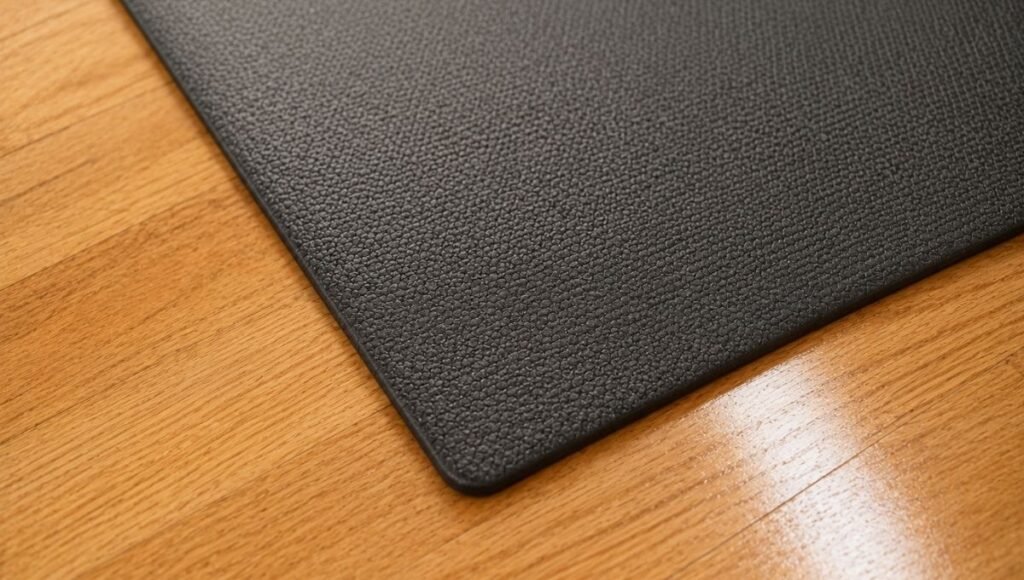
Priority: Floor grip above everything else. Recommendation: Natural rubber bottom (Jade Harmony or Liforme) or any mat with a textured suction-cup bottom. Avoid smooth PVC on polished surfaces — it will slide regardless of what the surface grip is like.
For Postpartum Recovery Workouts
Priority: Cushioning for kneeling and floor exercises; comfortable for extended floor time. Recommendation: 6–8mm firm-density mat. The Manduka PRO or any 6mm natural rubber mat works well. Avoid ultra-thick foam (10mm+) that compresses too much under bodyweight.
For Heavy Sweaters Doing HIIT at Home
Priority: Wet grip (hands and feet staying put when sweaty); easy to wipe clean. Recommendation: Liforme (polyurethane surface grips better when wet) or any natural rubber mat with a textured surface. Pair with a yoga mat towel if you sweat heavily.
For Anyone with Knee or Wrist Sensitivity
Priority: Cushioning + density (firm enough to support, thick enough to protect). Recommendation: 6–8mm firm-density mat. The Manduka PRO (6mm, very dense) or Gaiam 10mm (more cushion but less stable). A small knee pad for specific exercises is also worth considering.
Yoga Mat Maintenance: Making It Last
A good mat is an investment. These three habits extend its life significantly:
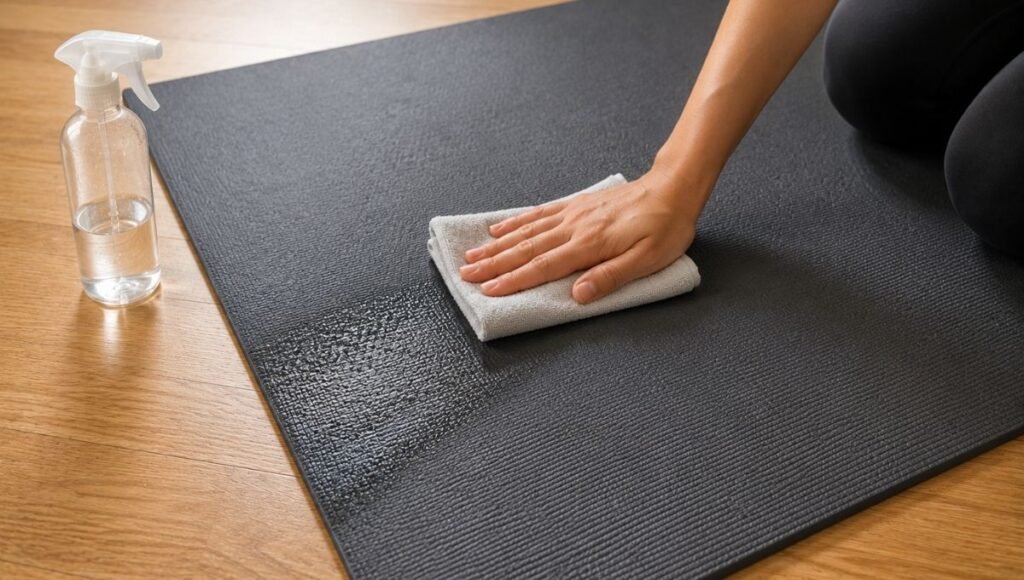
Clean it after sweaty sessions. A quick wipe with a damp cloth (mild soap if needed) after any workout prevents bacteria buildup and maintains grip. Don’t submerge natural rubber mats in water — wipe and air dry.
Roll it correctly. Roll your mat with the top surface facing out (not in). This prevents the edges from curling over time. Store it rolled, not folded.
Keep it out of direct sunlight. UV exposure degrades natural rubber and TPE faster than regular use. Store it away from windows.
When to replace it: When the surface becomes visibly worn (pilling, holes, or smooth patches where grip used to be), or when the mat no longer lies flat despite rolling correctly. A mat that’s actively peeling or shedding material should be replaced — that material ends up on your skin and floor.
Frequently Asked Questions
What is the best yoga mat for home workouts? For most home workout users doing a mix of yoga, floor exercises, and bodyweight training, a 4–6mm mat in natural rubber or TPE provides the best balance of grip, cushioning, and stability. The Manduka PRO is the premium choice; the Iuga Eco-Friendly is the best value pick. If floor grip on hardwood is your main concern, prioritize natural rubber over other materials.
How thick should a yoga mat be for home exercise? 4–6mm covers most home workout needs. Thinner (3–4mm) if you do a lot of standing balance work and prioritize stability. Thicker (6–10mm) if you have sensitive knees, wrists, or do a lot of floor-based exercises. Remember: density matters as much as thickness — a firm 5mm mat is more supportive than a spongy 8mm mat.
What is the best non-slip yoga mat? For dry conditions, natural rubber provides the best grip. For sweaty conditions (HIIT, hot yoga), the Liforme’s polyurethane surface is specifically designed to grip better when wet. On hardwood floors, any mat with a natural rubber bottom will outperform smooth PVC.
What should I look for when buying a yoga mat? Five things: bottom grip (will it stay on your floor type?), thickness for your joint needs, density (does it compress significantly under pressure?), cleanability (can you wipe it down easily?), and edge behavior (do reviews mention curling corners?). For home workout users, floor grip and density are often the most important factors.
How long does a yoga mat last? A high-quality yoga mat can last several years with regular use, depending on the material and intensity of practice. Natural rubber mats often last longer because they provide strong grip and resist wear better than many foam-based mats. Premium mats used regularly with proper care typically last 3–7 years. Budget foam mats may show significant wear within 12–18 months of regular use.
The Bottom Line on Yoga Mats
The right yoga mat for home workouts isn’t the most expensive or the thinnest or the most sustainable — it’s the one that solves your specific problem on your specific floor for your specific workout routine.
If you’re buying your first mat: start with a 5–6mm TPE mat in the $30–$50 range. The Iuga is a solid first choice. Use it for a few months, notice what bothers you (too slippery? too thin? corners curling?), and upgrade from there with actual experience.
If you’re ready to invest: natural rubber in the 4–6mm range (Manduka PRO, Jade Harmony, or Liforme depending on your priority) will serve you for years without needing replacement.
Once you’ve got your mat, put it to work: → Beginner Workout Plan at Home: Your First 4 Weeks, Day by Day
→ Resistance Band Exercises for Beginners: 12 Moves + A Complete Home Workout Plan
→ Home Gym Setup on a Budget: What to Buy First (And What to Skip)
References
- REI Expert Advice. How to Choose a Yoga Mat. https://www.rei.com/learn/expert-advice/yoga-gear.html
- OutdoorGearLab. The Best Yoga Mats of 2026. https://www.outdoorgearlab.com/topics/fitness/best-yoga-mat
- Yoga Journal. Best Yoga Mats of 2026. https://www.yogajournal.com/lifestyle/best-yoga-mats-guide/
- Truemed. The Best Yoga Mat — and How to Make It More Affordable. https://www.truemed.com/blog/best-yoga-mat
- BetterMe. The Best Yoga Mats of 2026 — What to Look for and What to Avoid. https://betterme.world/articles/yoga-mat/