
Let’s be honest about something most fitness content won’t say upfront: you don’t need a gym to lose weight. You don’t need expensive equipment. You don’t need to spend 90 minutes working out five days a week.
What you need is a plan that’s actually designed for your life — one that fits in 20–30 minutes, works in a living room, and doesn’t require you to own anything beyond a yoga mat.
If you’ve been putting off starting because you can’t get to a gym right now, or because the gym felt expensive, or because there’s simply no time to commute, drive, change, work out, change again, and drive home — this is for you. Working out at home to lose weight is not a compromise. For most beginners, it’s actually the most effective starting point, because the biggest barrier to consistency is always friction, and home workouts have almost none.
This guide gives you a science-backed approach to home fat loss: why the training combination matters, what exercises to prioritize, and a complete 4-week workout schedule you can start this week.
Key Takeaways
- Research published in Obesity Reviews found that combining strength training and cardio produces significantly greater fat loss than either alone — the combination is the key, not more hours of either individually
- A realistic home fat loss rate is 0.5–1 lb per week when combining consistent training with a moderate calorie deficit — not 5 lbs per week, and that’s a feature, not a bug (faster loss typically means muscle loss alongside fat)
- The CDC recommends 150 minutes of moderate cardio + 2 days of strength training per week — this plan meets both guidelines in under 3.5 hours of total weekly training
- Strength training is the most important element for sustainable fat loss — it builds muscle that raises your resting metabolic rate, meaning you burn more calories even at rest
- You can get an effective fat loss workout in as little as 20 minutes — session quality and consistency matter more than session length
Why Most Home Weight Loss Plans Fail (And What to Do Instead)
Before the plan, let’s diagnose the problem. Most home workout plans for weight loss focus almost entirely on cardio — jumping jacks, high knees, burpees, endless HIIT circuits. The logic seems right: more movement, more calories burned, more weight lost.
But there’s a missing piece that makes this approach less effective than it looks.
Cardio burns calories during the session. Strength training builds muscle — and muscle burns calories all the time, including when you’re sitting on the couch. A pound of muscle burns approximately 6–10 calories per day at rest compared to 2 calories per day for a pound of fat. That difference sounds small, but across weeks and months, building lean muscle progressively raises your resting metabolic rate in ways that cardio alone cannot.
The most effective home fat loss approach for beginners combines both:
- Strength training (2–3 sessions/week): builds muscle, raises metabolism, shapes body composition
- Low-to-moderate cardio (2–3 sessions/week): burns additional calories, improves cardiovascular health
This isn’t a complicated formula. It’s two types of movement, alternated across the week, done consistently.
Sportzillax editor note: If you’re only doing cardio and wondering why you’re not losing weight, this is probably the reason. Cardio without strength training produces weight loss but also muscle loss — leaving you lighter but softer, with a slower metabolism than when you started.
The Best Home Exercises for Weight Loss
Not all exercises are equal for fat loss. The most effective home exercises are compound movements — exercises that work multiple muscle groups simultaneously. These produce greater calorie burn during the session and greater hormonal response (growth hormone, testosterone) that supports fat loss.
Here are the 8 most effective home exercises for weight loss, requiring zero equipment:
Lower Body (highest calorie burn, largest muscle groups):
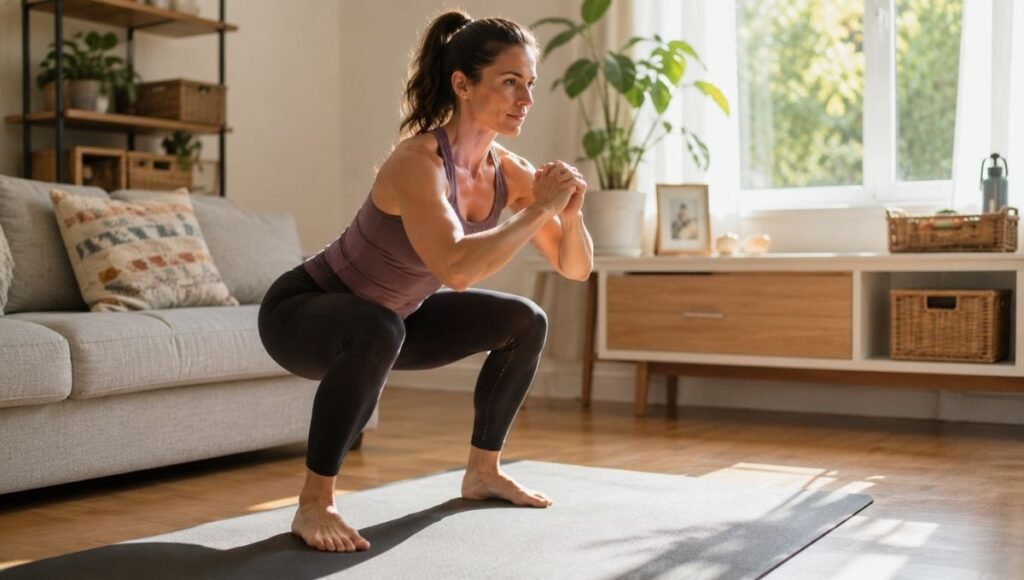
Bodyweight Squat: Feet shoulder-width apart, lower into a squat, drive through heels to stand. Works quads, glutes, hamstrings. The largest muscle groups in your body — training them burns more calories than any upper body exercise.
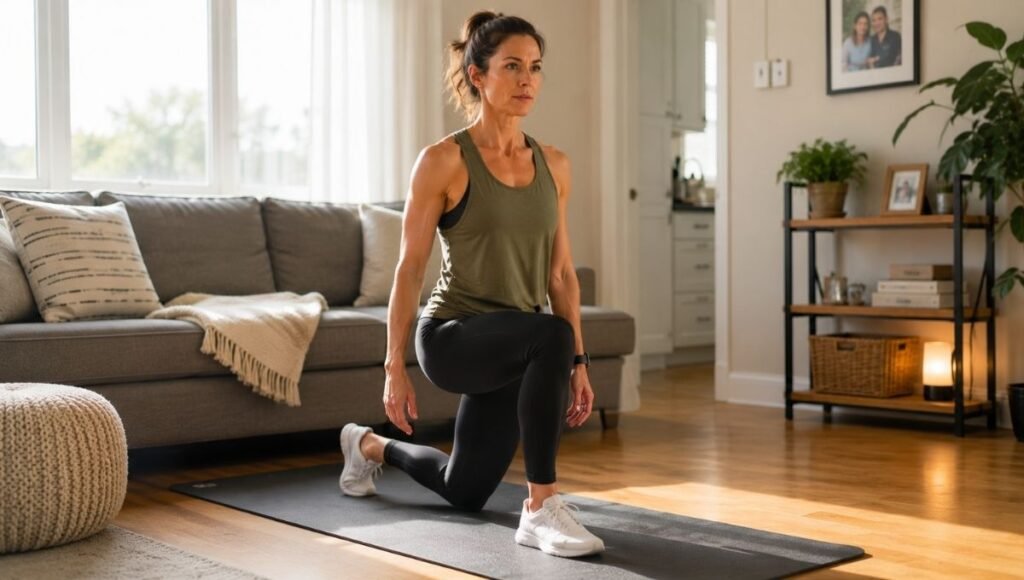
Reverse Lunge: Stand tall, step one foot back, lower back knee toward floor, return. Alternating legs. Works the same muscles as squats with greater glute activation and balance challenge.
Glute Bridge: Lie on back, knees bent, drive hips up and squeeze glutes. Works glutes and hamstrings in a low-impact position — excellent for anyone with knee sensitivity.
Upper Body:
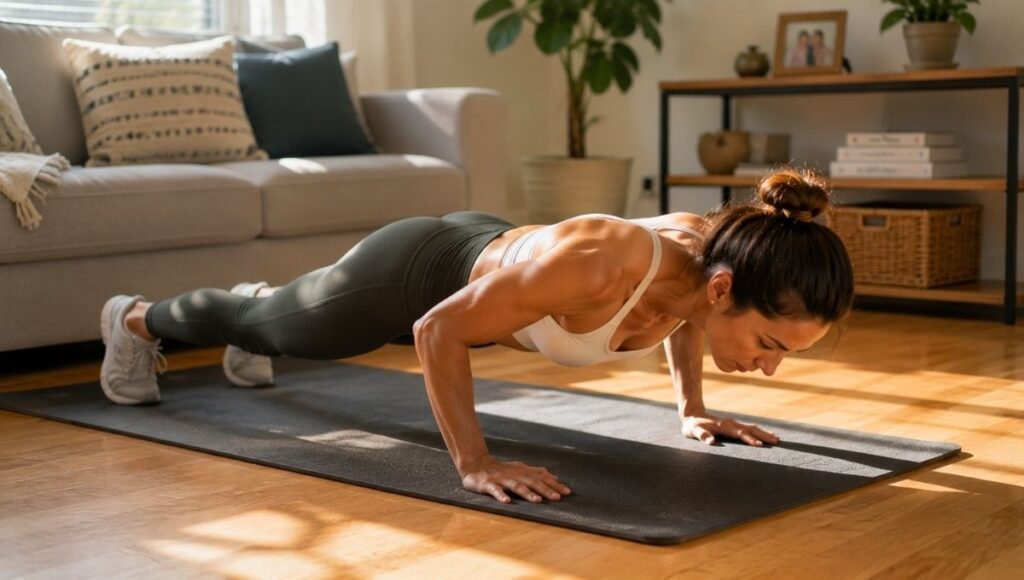
Push-Up (Modified or Full): From knees or toes, lower chest toward floor, press up. Works chest, shoulders, triceps, and core simultaneously. One of the most efficient upper body exercises available.
Standing Dumbbell Row (or Resistance Band Row): Hinge forward, pull weight toward hip, squeeze shoulder blade. Works back and biceps — the muscles most people skip when training at home.
Full Body / Cardio:
Mountain Climber (Slow): From plank, drive alternating knees toward chest in a controlled pace. Works core, shoulders, and elevates heart rate.
Skater Slide: Step laterally in a skating motion, reaching one hand toward the opposite foot. Low-impact cardio that works outer glutes and elevates heart rate without jumping.
Burpee (Modified): From standing, lower hands to floor, step or jump feet back to plank, step or jump feet forward, stand. The most calorie-intensive single exercise in this list — use the step version if jumping isn’t appropriate.
Best Home Workout for Weight Loss: The 4-Week Plan
This plan follows a 3-day strength + 3-day cardio structure — the most evidence-backed approach for home fat loss. Each session takes 20–30 minutes.
Week 1–2: Build the Foundation
Strength Session (Monday, Wednesday, Friday):
Warm-up: 3 minutes of marching in place + arm circles
Circuit (2 rounds, 45 seconds on / 15 seconds rest):
- Bodyweight Squat
- Modified Push-Up
- Glute Bridge
- Reverse Lunge (alternating)
- Mountain Climber (slow)
- Standing Marching in Place
Rest 60 seconds between rounds. Cool-down: 2 minutes of forward fold + standing quad stretch
Cardio Session (Tuesday, Thursday, Saturday):
- 20–25 minute brisk walk outside or marching in place at home
- Alternatively: the 20-minute low-impact cardio circuit from our Cardio at Home guide
Sunday: Complete rest
Week 1–2 notes: These sessions should feel manageable, not crushing. If you’re completely new to exercise, completing all 6 sessions in a week is the win — not how hard each session feels.
Week 3–4: Add Challenge
Strength Session (Monday, Wednesday, Friday):
Circuit (3 rounds, 40 seconds on / 20 seconds rest):
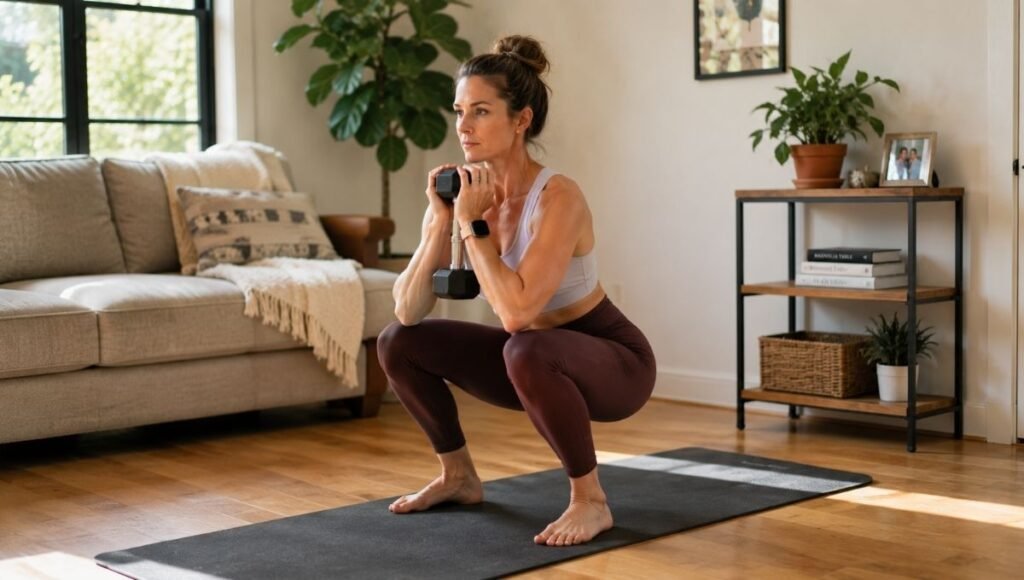
- Goblet Squat (hold a dumbbell at chest, or use a water bottle/heavy bag for resistance)
- Full Push-Up (or modified if needed)
- Single-Leg Glute Bridge (one leg elevated)
- Reverse Lunge with Knee Drive (step back, lower, drive knee to chest on return)
- Slow Mountain Climber
- Skater Slide
Rest 60 seconds between rounds.
Cardio Session (Tuesday, Thursday, Saturday):
- 25–30 minute brisk walk, or
- 20-minute HIIT circuit (see our Beginner HIIT Workout guide)
Sunday: Complete rest
Week 3–4 notes: You’re adding one more circuit round and slightly harder exercise variations. The same exercises from weeks 1–2 appear in modified form — your body knows the movements now, and the challenge comes from progression.
Home Workout for Weight Loss Female: What’s Different
The exercises above work equally well for women and men. But there are a few things worth addressing specifically for women working out at home for fat loss.
The hormonal reality: Women’s menstrual cycles affect energy, recovery, and water retention throughout the month. In the week before your period, you may feel more fatigued and notice the scale is up 2–5 lbs — this is water retention, not fat gain. Don’t adjust your diet or panic about the number. It resolves within a few days.
Lower body training matters more than you think: The exercises that produce the greatest fat loss results for women — squats, lunges, and glute bridges — are also the exercises that produce the greatest body composition change (more muscle in the glutes and thighs, less fat overall). Don’t skip lower body sessions in favor of extra arm work.
Lifting weights will not make you bulky: Building significant muscle mass requires years of heavy training and specific caloric conditions. The strength training in this plan builds functional strength, improves muscle tone, and raises your metabolic rate — not mass. Women who strength train consistently look more defined and leaner, not larger.
Protein is especially important: To preserve muscle while in a calorie deficit, aim for 0.7–1g of protein per pound of body weight daily. This is higher than standard dietary guidelines and significantly supports fat loss results.
How Much Weight Can You Lose Working Out at Home?
Let’s talk expectations — because the answer matters for your motivation and your strategy.
Realistic home fat loss rate: 0.5–1 lb per week, assuming consistent training and a moderate calorie deficit (300–500 calories below maintenance).
In 4 weeks: 2–4 lbs of primarily fat loss In 8 weeks: 4–8 lbs In 3 months: 6–12 lbs
These numbers feel slower than what gets advertised. They’re also the numbers that actually stick — research consistently shows that faster weight loss (crash diets, extreme restriction) produces more muscle loss and has dramatically higher regain rates than slower, consistent approaches.
The scale also doesn’t tell the whole story. In weeks 1–4, your body composition is changing even when your weight isn’t. You’re building muscle while losing fat — the scale may not move much, but how you look and feel in your clothes will. Measure your waist monthly alongside the scale for a more complete picture.
What to Do When You Only Have 10–15 Minutes
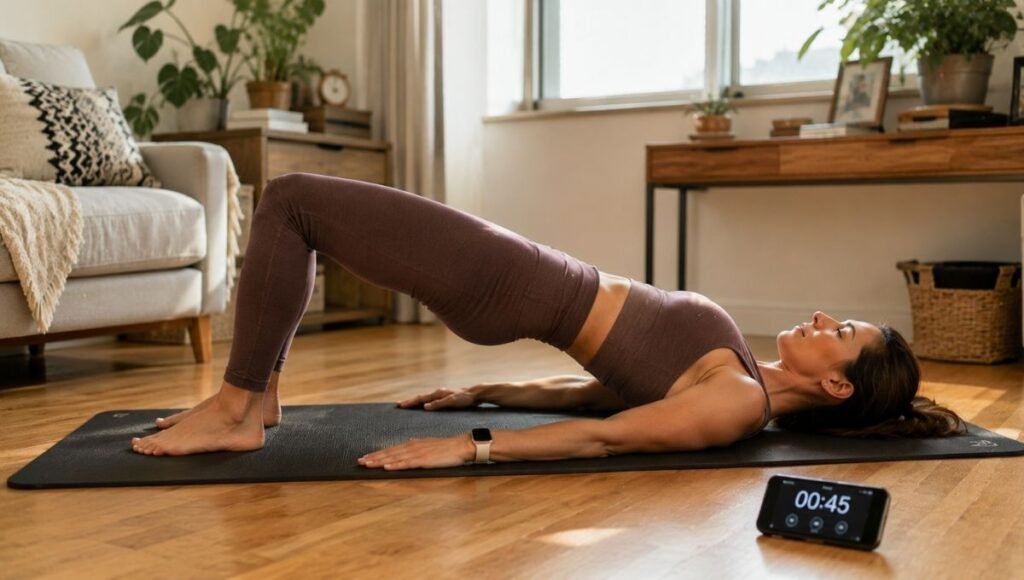
Life doesn’t always cooperate with a 25-minute session. On days when 10 minutes is all you have, use this:
10-minute fat loss circuit (2 rounds, no rest between exercises, 30 seconds rest between rounds):
- Bodyweight Squat — 45 seconds
- Push-Up — 30 seconds
- Glute Bridge — 45 seconds
- Mountain Climber — 30 seconds
Done in 10 minutes. It’s not a full session. But it maintains the habit, keeps your metabolism active, and is dramatically better than doing nothing. Consistency beats perfection — always.
The Nutrition Component You Can’t Ignore
Working out at home to lose weight works. But it works significantly better when paired with basic nutrition awareness.
You don’t need to count every calorie or follow a restrictive diet. The principles that support home training fat loss:
Eat enough protein: Protein preserves muscle during fat loss and keeps you fuller longer. At every meal, include a meaningful protein source — chicken, eggs, Greek yogurt, cottage cheese, lentils, tofu.
Create a modest calorie deficit: 300–500 calories below your maintenance level is the sweet spot for fat loss that preserves muscle. More aggressive restriction typically leads to muscle loss, hormonal disruption, and rebound weight gain.
Don’t out-exercise a poor diet: A 25-minute home workout burns 150–250 calories. A single high-calorie meal can easily exceed a full week’s training calorie burn. Exercise supports fat loss; nutrition drives it.
When to Seek Professional Guidance
This home workout plan is appropriate for most generally healthy adults. Consult your doctor before starting if you:
- Have been completely sedentary for more than 2 years
- Have a diagnosed heart condition, hypertension, or metabolic disorder
- Are postpartum and within 12 weeks of delivery
- Have a recent joint injury that hasn’t fully healed
- Experience chest pain, severe shortness of breath, or dizziness during light activity
Frequently Asked Questions
Can you lose weight just by working out at home? Yes — with two important qualifications. First, nutrition must support a calorie deficit; exercise alone rarely produces significant fat loss without dietary awareness. Second, the training combination matters — strength training plus moderate cardio produces meaningfully better fat loss results than cardio alone. This plan addresses both.
What is the best home workout for weight loss? The most effective home workout for weight loss combines full-body strength training (2–3 days) and moderate cardio (2–3 days) in the same week. For strength, compound bodyweight exercises (squats, push-ups, lunges, glute bridges) produce the highest calorie burn and greatest metabolic benefit. For cardio, brisk walking or low-impact home circuits are effective and sustainable.
How long does it take to lose weight working out at home? With consistent training (5–6 days of combined strength and cardio) and a modest calorie deficit, most beginners see body composition changes within 4–6 weeks and meaningful scale changes within 6–8 weeks. Realistic expectation: 0.5–1 lb of fat loss per week.
Is 20 minutes of home workout enough to lose weight? Yes, as a component of a complete approach. A 20-minute strength session burns 150–200 calories and — more importantly — builds muscle that raises your resting metabolism. Three 20-minute strength sessions per week, combined with regular walking and reasonable nutrition, produces real fat loss results. Longer isn’t always better; consistency is.
What home workout burns the most fat? The training approach that burns the most fat over time is strength training combined with cardio — not either alone. In a single session, HIIT burns the most calories per minute. But strength training’s contribution to long-term metabolic rate increase means it produces more total fat loss over weeks and months than HIIT alone.
Start This Week
You now have the approach, the exercises, and a 4-week plan. The only thing missing is starting.
This week: complete 3 strength sessions and 3 walks. That’s the entire prescription for week 1. No perfection required — just showing up.
For a more detailed beginner program to run alongside this plan: → Beginner Workout Plan at Home: Your First 4 Weeks, Day by Day
For the cardio component on your off days: → Cardio at Home: The Best No-Equipment Workouts for Beginners
To understand why the scale might not be moving as expected: → Why Am I Not Losing Weight? 8 Real Reasons Your Progress Has Stalled
References
- Willis, L.H., et al. (2012). Effects of aerobic and/or resistance training on body mass and fat mass in overweight or obese adults. Journal of Applied Physiology.
- Centers for Disease Control and Prevention (CDC). Physical Activity for a Healthy Weight. https://www.cdc.gov/healthyweight/physical_activity/index.html
- Donnelly, J.E., et al. (2009). American College of Sports Medicine Position Stand: Appropriate Physical Activity Intervention Strategies for Weight Loss. Medicine & Science in Sports & Exercise.
- Swift, D.L., et al. (2014). The role of exercise and physical activity in weight loss and maintenance. Progress in Cardiovascular Diseases.