

There’s a version of this question that comes from excitement — you’ve just decided to start working out and you want to go all in. Five days a week, maybe six. You’re motivated, you have the energy, you want results fast.
And there’s another version of this question that comes from guilt — you’ve been managing two workouts a week and wondering if that’s even worth it. If two sessions are enough. If you’re selling yourself short.
Both versions deserve an honest answer. And the honest answer isn’t “it depends on your goals” — which is technically true but completely unhelpful. The honest answer is that for most beginners training at home, 3 days per week is the number that research consistently points to as the sweet spot, and more than that is often counterproductive in your first 3 months.
Let’s talk about why — and then build the right weekly structure for your specific situation.
Key Takeaways
- The CDC recommends at least 150 minutes of moderate-intensity activity per week plus 2 days of muscle-strengthening — three 30-minute sessions covers this completely
- A 2023 study found that 3 days per week of strength training produced significantly greater strength gains than 2 days per week for beginners — the minimum effective dose is higher than most people think
- Research consistently shows that muscles need 48–72 hours of recovery between sessions targeting the same muscle group — this physiologically limits how often you can productively train
- Consistency over frequency: a 3-day program you actually complete every week beats a 5-day program you manage 2 weeks out of 4
- For fat loss specifically, the combination of 3 strength sessions + 3–4 walks per week produces better body composition results than more frequent intense training alone
Why 3 Days Per Week Is the Research-Backed Starting Point

When exercise scientists ask “how often should beginners train?”, the answer that consistently emerges from the literature is 3 full-body sessions per week on non-consecutive days.
Here’s the physiological reason: when you train, you create microscopic damage in your muscle fibers. Your body repairs this damage during recovery — building the fibers back slightly stronger. This repair process takes 48–72 hours for most muscle groups. Train the same muscles before that window is complete and you’re compounding damage on already-compromised tissue, reducing the quality of adaptation and increasing injury risk.
Three sessions per week, with rest days between, aligns almost perfectly with this recovery window. Monday, Wednesday, Friday. Tuesday, Thursday, Saturday. Any three non-consecutive days that fit your schedule.
What about training more days by targeting different muscle groups each day? This works — but it adds significant complexity and requires more exercise knowledge to execute well. Full-body training 3 days per week is simpler, equally effective, and more forgiving for beginners learning correct form. Advanced splits make sense once you’ve built a foundation.
Sportzillax editor note: Dr. Shawn Arent of the University of South Carolina puts it perfectly: “You might want to work out five days per week. But the real question is what will you actually do? Consistency matters.” A 3-day plan that runs consistently for 3 months will outperform a 5-day plan that collapses after 3 weeks.
How Many Days a Week Should Beginners Work Out for Different Goals?
The base answer is 3 days for everyone. What changes based on your goal is what you do with those 3 days — and what you add around them.
If Your Goal Is General Fitness and Health
3 days per week of full-body strength training is sufficient and appropriate. On your off days, aim for daily movement — walking, gentle stretching, active life activities. You don’t need structured cardio sessions; the strength training plus regular walking covers the CDC’s guidelines completely.
Starting point: Mon/Wed/Fri, 25–35 minutes per session. Rest days are active (walk) not sedentary.
If Your Goal Is Fat Loss
3 days of strength training + 3–4 days of moderate cardio (walking, low-impact home cardio) is the evidence-backed combination. Strength training builds muscle that raises your resting metabolism; cardio creates additional calorie deficit. Neither alone is as effective as both together.
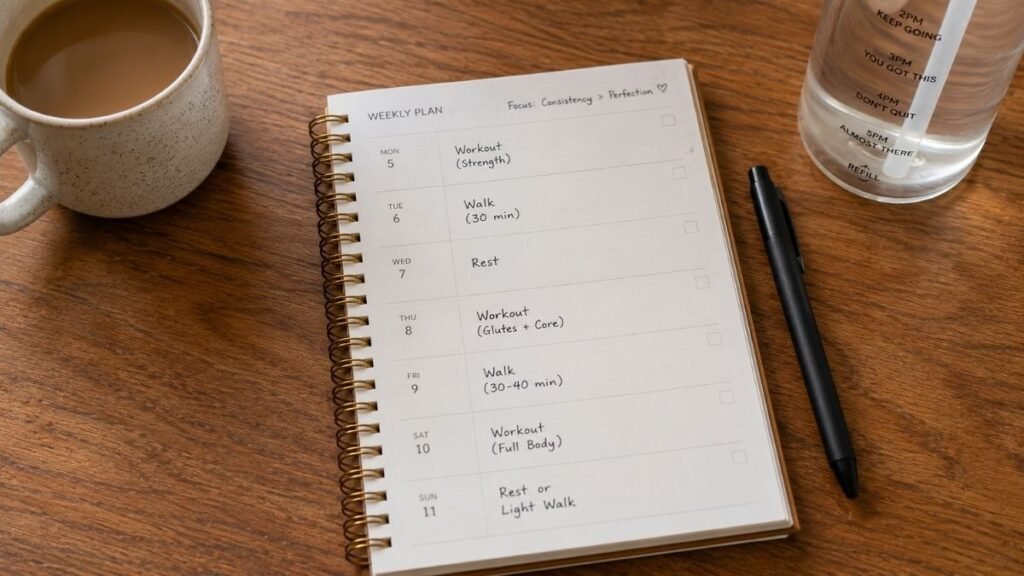
This looks like: strength sessions on Mon/Wed/Fri, 20–30 minute walks on Tue/Thu/Sat, rest on Sunday. Total structured activity: 6 days, but the intensity alternates — hard days (strength) followed by easy days (walking).
Starting point for fat loss: see our Cardio at Home guide for the walking and cardio component alongside your strength training.
If Your Goal Is Building Strength and Muscle
3 days per week remains optimal for beginners, but session design matters more. Each session should include compound movements (squat, hinge, push, pull) with progressive overload applied consistently. As you advance past 3–4 months, you might move to 4 days.
Don’t rush to 4–5 days before you’ve exhausted the progress available from 3 well-designed sessions. Most beginners have 6–12 months of meaningful progress available from a 3-day program before frequency needs to increase.
Can You Work Out Every Day?

Technically yes. Practically, for most beginners, it’s a mistake.
Daily intense training without adequate recovery leads to a predictable pattern: you start strong, accumulate fatigue over 2–3 weeks, performance declines, motivation follows, and you stop entirely. The effort is real; the results are diminished because recovery never happens.
Daily movement is different from daily training. Walking every day, gentle stretching, light yoga — these support recovery rather than impeding it. The distinction is intensity: high-intensity exercise requires recovery time; low-intensity movement facilitates it.
If you genuinely want to do something every day, structure it as: 3 high-intensity training days (strength or HIIT) and 4 low-intensity movement days (walking, stretching, light activity). This is sustainable, effective, and won’t lead to the burnout cycle.
How Many Days Rest Should You Take Between Workouts?
For full-body strength training: at least one full day between sessions, ideally two. This is the 48–72 hour recovery window described above.
For cardio-only sessions: 1 day between intense cardio sessions (HIIT, running), but you can do moderate cardio (walking, cycling) on consecutive days.
For beginners especially, erring toward more rest rather than less is correct. The fitness gains from training come during recovery, not during the training session itself. A beginner who rests adequately will outperform a beginner who trains more frequently but recovers poorly.
Signs you haven’t recovered sufficiently:
- Your performance in the session feels worse than last time with no other explanation
- You feel genuinely fatigued before you start (not just unmotivated — actually tired)
- Muscle soreness from your last session hasn’t resolved
- Sleep quality has declined since starting your program
If you’re experiencing these consistently, add a rest day before your next session.
How Often Should You Work Out to Lose Weight Specifically?

The question most people really want answered: how often do I need to train to actually lose weight?
The honest, research-backed answer: frequency matters less than you think for weight loss; nutrition matters more. Exercise contributes approximately 20–30% of your total daily calorie expenditure. The other 70–80% is your resting metabolism (largely determined by muscle mass and genetics) and daily life activity (non-exercise movement like walking, standing, fidgeting).
This means:
- Training 5 days per week without addressing nutrition will produce minimal fat loss
- Training 3 days per week with a modest calorie deficit will produce meaningful fat loss
- Training 3 days per week with adequate protein and a 300–500 calorie daily deficit is the most effective combination for most people
For fat loss, the optimal frequency is 3 strength sessions + as much low-intensity movement as possible throughout the day. More training sessions don’t directly accelerate fat loss — they just burn additional calories, which you could equally achieve through nutrition adjustments.
What Happens If You Only Have Time for 2 Days Per Week?
Two days per week is better than nothing — significantly better. And for some people in certain seasons of life (new parents, highly demanding jobs, health limitations), two days is genuinely the realistic maximum.
Two days per week will produce:
- Meaningful improvements in strength over 3–6 months
- Some body composition improvement, especially combined with nutrition attention
- Significant health benefits (cardiovascular, bone density, metabolic)
What two days won’t produce as effectively: rapid strength gains or significant muscle building. The 2023 study referenced earlier found no significant strength gains in beginners training twice per week compared to three times per week. For strength specifically, 3 days is the minimum effective dose.
If you have 2 days: make both sessions full-body, with compound exercises, and add daily walking. You’re not doing nothing — you’re doing something meaningful.
If you have 2 days and want to maximize them: train on non-consecutive days (e.g., Tuesday and Friday), make each session 35–45 minutes with 5–6 compound exercises, and add 20–30 minutes of walking on your off days.
How to Build Your Weekly Schedule
Here are three practical templates based on available time:
The 3-Day Minimum Effective Program (Recommended for beginners)
- Monday: Full-body strength (30 min)
- Tuesday: Walk or rest
- Wednesday: Full-body strength (30 min)
- Thursday: Walk or rest
- Friday: Full-body strength (30 min)
- Saturday/Sunday: Active rest (walk, stretch, family activities)
The 3+3 Fat Loss Program
- Monday: Strength training (30 min)
- Tuesday: Low-impact cardio or walk (20–30 min)
- Wednesday: Strength training (30 min)
- Thursday: Low-impact cardio or walk (20–30 min)
- Friday: Strength training (30 min)
- Saturday: Low-impact cardio or walk (20–30 min)
- Sunday: Complete rest
The 2-Day Survival Program (For genuinely busy periods)
- Tuesday: Full-body strength (40 min)
- Friday: Full-body strength (40 min)
- All other days: Walk when possible, 20+ minutes
All three produce meaningful results. The 3-day program is optimal. The 2-day program is legitimate. The 3+3 accelerates fat loss.
The Most Important Factor That Isn’t Frequency
Here’s what the research on training frequency consistently shows that most advice articles bury: the frequency that produces the best results is the frequency you can actually sustain.
A 5-day program completed at 60% consistency produces less adaptation than a 3-day program completed at 100% consistency. Your body adapts to the stimulus it consistently receives — not the stimulus you planned to give it.
When deciding how many days to train, ask yourself two questions:
- What’s the maximum number of days I can realistically train in a busy week — not an ideal week, but a week when things go wrong?
- Can I genuinely see myself maintaining this for 6 months?
If the honest answer to question 1 is 3, design a 3-day program. If it’s 2, design a 2-day program and make it excellent. Starting with fewer days and building frequency over time as the habit solidifies is a far more effective strategy than starting at 5 days and collapsing.
When to Talk to a Doctor
Consider medical guidance before starting or significantly increasing training frequency if you:
- Have been completely sedentary for more than 2 years
- Are managing a chronic health condition (heart disease, diabetes, hypertension)
- Have experienced a recent injury or surgery
- Are postpartum and within 12 weeks of delivery
- Experience persistent fatigue, pain, or unusual shortness of breath during light activity
These aren’t reasons not to train — they’re reasons to start with professional guidance.
Frequently Asked Questions
Is working out 3 days a week enough to see results? Yes — for beginners, 3 full-body strength sessions per week is the research-supported optimal frequency. Most beginners have 6–12 months of meaningful strength and body composition progress available from a consistent 3-day program before needing to increase frequency.
Can I work out every day as a beginner? Daily intense training as a beginner is likely to lead to overreaching and burnout within 2–4 weeks. Daily movement (walking, stretching) is beneficial and sustainable. The recommended approach: 3 structured training days and 4 active recovery days per week.
How many days a week should I workout to lose weight? Three strength sessions per week combined with daily moderate movement (walking) produces the best fat loss results for most beginners. Adding more training sessions doesn’t proportionally accelerate fat loss — a modest calorie deficit and adequate protein have more impact than workout frequency for weight loss outcomes.
How do I know if I need more rest between workouts? Signs you need more recovery: performance declining compared to previous sessions, persistent muscle soreness that hasn’t resolved, unusual fatigue before sessions, and worsening sleep quality since starting training. Add a rest day if you experience two or more of these consistently.
Is 2 days a week enough to build muscle? Two days produces some strength and muscle improvements, but research shows it’s below the minimum threshold for significant strength gains in beginners. Three days per week is the minimum effective dose for meaningful strength development. Two days is better than zero and appropriate for periods when more isn’t realistic.
Start This Week
You now have a clear answer: 3 days per week for most beginners, with the flexibility to start at 2 if life requires it, and to build toward 4–5 as fitness improves and the habit solidifies.
Pick your three days. Put them in your calendar as appointments. Show up consistently for 4 weeks before evaluating whether to adjust.
For a complete 4-week beginner program that fits the 3-day framework: → Beginner Workout Plan at Home: Your First 4 Weeks, Day by Day
For the strength training component of your 3 sessions: → Full Body Dumbbell Workout at Home: The Complete Beginner’s 3-Day Plan
For the cardio component on your off days: → Cardio at Home: The Best No-Equipment Workouts for Beginners
References
- Ralston, G.W., et al. (2017). The Effect of Weekly Set Volume on Strength Gain: A Meta-Analysis. Sports Medicine.
- Schoenfeld, B.J., et al. (2016). Effects of Resistance Training Frequency on Measures of Muscle Hypertrophy. Sports Medicine.
- Centers for Disease Control and Prevention (CDC). Physical Activity Guidelines for Americans. https://www.cdc.gov/physicalactivity/basics/adults/index.htm
- American College of Sports Medicine (ACSM). Quantity and Quality of Exercise for Developing and Maintaining Cardiorespiratory, Musculoskeletal, and Neuromotor Fitness in Apparently Healthy Adults. Medicine & Science in Sports & Exercise, 2011.