
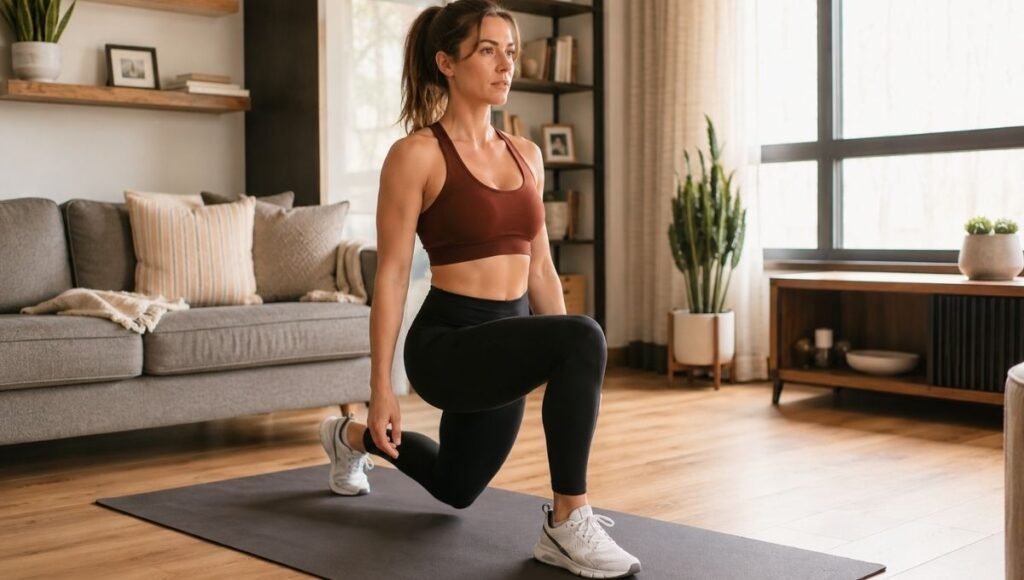
There’s a version of this scenario you’ve probably lived: you decide today is the day. You clear space in the living room, change into workout clothes, open YouTube — and then spend 20 minutes scrolling through options before closing the laptop and calling it a wash.
Too many choices, not enough direction. That’s the real barrier between most people and a consistent home workout routine.
This guide removes that barrier entirely. You’re getting one complete full body workout at home, designed for beginners, requiring zero equipment, fitting into 20–30 minutes depending on how much time you have. You’ll also get a 4-week schedule so you know exactly what to do on each training day — not just today, but for the next month.
No gym. No equipment beyond a yoga mat (optional). No guessing what to do next.
Key Takeaways
- A complete full body workout at home activates all major muscle groups — legs, glutes, back, chest, shoulders, and core — in a single session using only your bodyweight
- Research published in the Journal of Human Kinetics confirms that bodyweight training produces comparable strength and muscle adaptations to resistance machine training for beginners
- The CDC recommends at least 150 minutes of moderate-intensity activity weekly plus 2 days of muscle-strengthening — this 4-week plan meets both guidelines with 3 sessions per week
- For beginners, 3 full-body sessions per week on non-consecutive days produces optimal strength adaptation while allowing 48 hours of recovery between sessions
- You need as little as a 6-foot by 2-foot space for a complete full body home workout — less than the space a dining chair takes up
- Most beginners notice improved strength and energy within 2–3 weeks; visible body composition changes typically appear at 6–8 weeks of consistent training
Why Full Body Workouts at Home Are the Smart Starting Point
If you’re new to training and building a home workout habit, a full-body approach beats split training every time. Here’s why:
Full-body workouts train every major muscle group in each session. When you train 3 days per week, every muscle group gets worked 3 times — which is the research-recommended frequency for beginner strength adaptation. A split routine training different body parts on different days gives you less total stimulus per muscle group unless you’re training 5+ days per week.
For home training specifically, full-body workouts solve the equipment problem elegantly. You don’t need separate equipment for chest day, back day, and leg day — you need a floor and gravity. Bodyweight exercises like push-ups, squats, lunges, and glute bridges cover all major movement patterns without requiring any gear.
Sportzillax editor note: The most common beginner mistake isn’t doing the wrong exercises — it’s overcomplicating the structure. Push something, pull something, squat something, hinge at the hip, and challenge your core. That’s a complete workout. Everything else is details.
What Muscles Does a Full Body Workout Train?
A properly designed full body workout hits five fundamental movement patterns, each targeting different muscle groups:
Push (chest, shoulders, triceps): Any movement where you push weight away from you — push-ups, wall push-ups, pike push-ups. These train the anterior (front) upper body.
Pull (back, biceps, rear shoulders): Any movement where you pull weight toward you — inverted rows under a table, resistance band rows, Superman holds. These train the posterior (back) upper body — arguably the most neglected area in home workouts.
Squat (quads, glutes, hamstrings): Lower into and drive back up from a squat position — chair squats, bodyweight squats, goblet squats. These train your largest muscle groups.
Hinge (hamstrings, glutes, lower back): Hinge at the hips with a flat back — Romanian deadlift, glute bridge, good morning. The posterior chain exercises most people skip.
Core (all abdominal and spinal muscles): Stabilize your spine against movement — plank, dead bug, bird dog. Not just crunches.
A full body workout covers all five patterns in every session. If your current workout is push-up heavy and squat-light (or skips pulling entirely), you’re missing movement patterns that matter significantly for functional strength and posture.
The Complete Full Body Workout at Home (No Equipment)
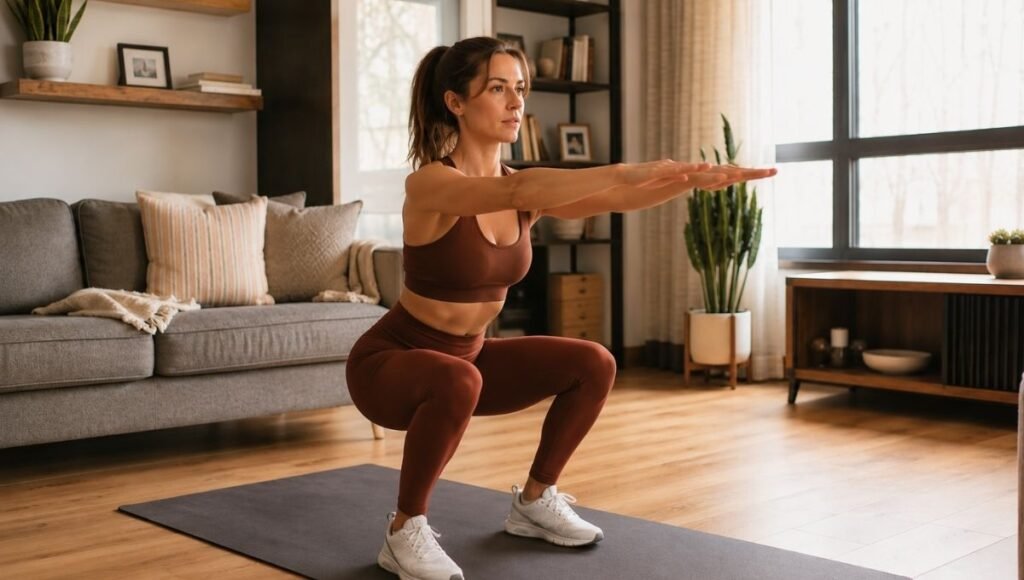
This is your primary workout template. Do this 3 times per week on non-consecutive days.
Warm-Up (5 minutes — do this every session)
- March in place — 60 seconds
- Arm circles — 20 seconds forward, 20 seconds backward
- Slow bodyweight squat — 8 reps (warm-up pace, focus on form)
- Hip circles — 15 seconds each direction
- Inchworm — 4 reps (hinge forward, walk hands to plank, hold 1 second, walk back, stand)
Main Circuit
Perform 3 rounds of the following 8 exercises. Rest 45–60 seconds between exercises. Rest 90 seconds between rounds. Total main circuit time: approximately 20–25 minutes.
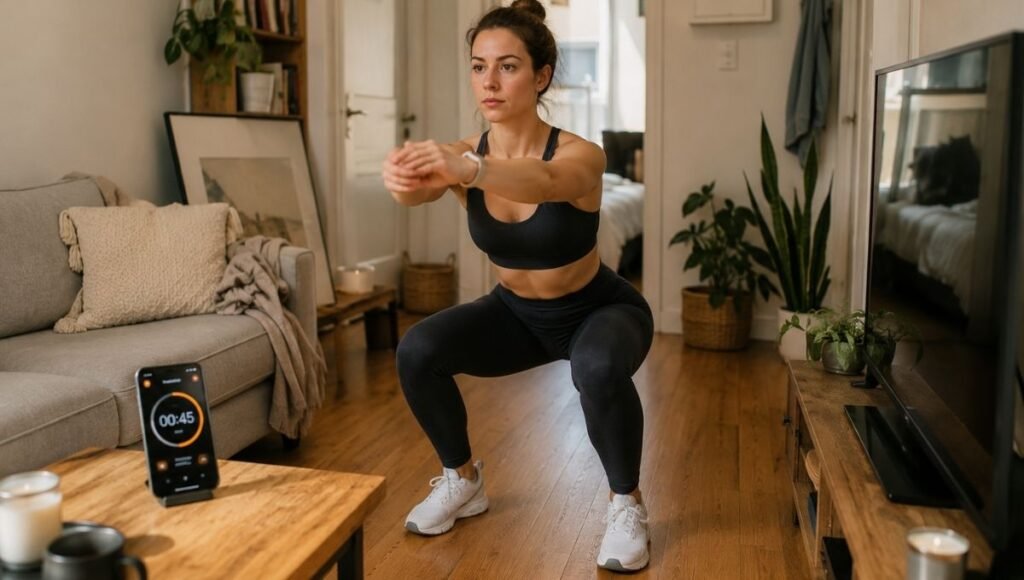
Exercise 1: Bodyweight Squat Muscles: Quads, glutes, hamstrings
Feet shoulder-width, toes slightly turned out. Sit back and down, keeping chest tall and heels flat. Lower until thighs reach parallel, then drive through heels to stand. Squeeze glutes at the top.
- Beginner: 3×10 (chair squat — tap the chair and stand)
- Standard: 3×12
- Advanced: 3×15 with 3-second descent
Exercise 2: Modified or Full Push-Up Muscles: Chest, shoulders, triceps, core
From knees or toes: maintain a straight line from head to knees/feet. Lower chest toward floor with elbows at 45-degree angle. Press back up fully.
- Beginner: 3×8 on knees
- Standard: 3×10 full
- Advanced: 3×12 with 2-second pause at the bottom
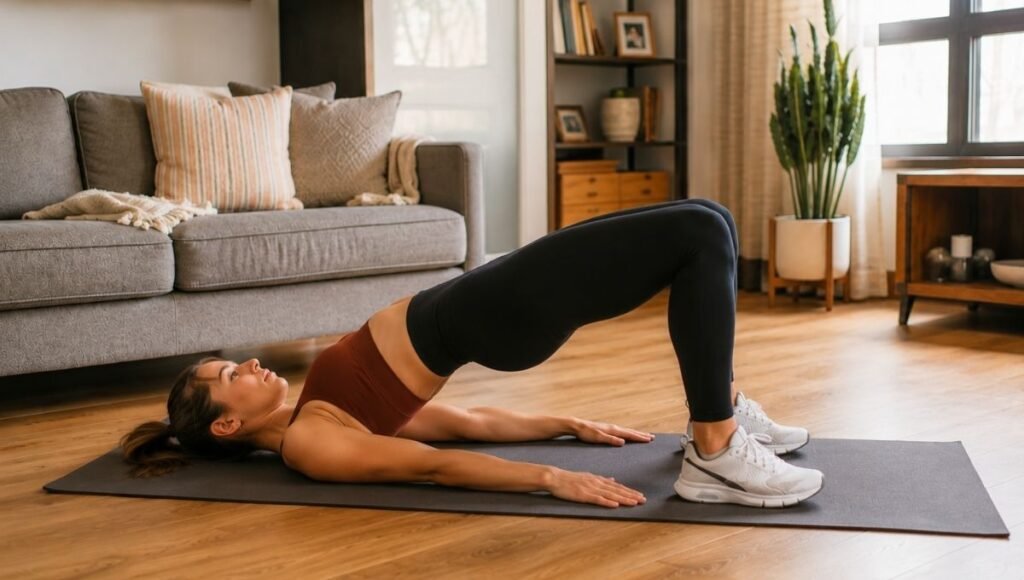
Exercise 3: Glute Bridge Muscles: Glutes, hamstrings, lower back
Lie on your back, knees bent, feet flat. Drive hips toward ceiling, squeeze glutes hard at the top. Hold 1–2 seconds. Lower slowly.
- Beginner: 3×12
- Standard: 3×15 with 2-second hold at top
- Advanced: Single-leg version, 3×10 per side
Exercise 4: Reverse Lunge Muscles: Quads, glutes, hamstrings, core stability
Stand tall. Step one foot back, lower back knee toward floor, return to standing. Alternate legs. Easier on knees than forward lunges — the correct starting point for beginners.
- Beginner: 3×8 per leg (holding wall for balance if needed)
- Standard: 3×10 per leg
- Advanced: 3×12 per leg with 2-second pause at bottom
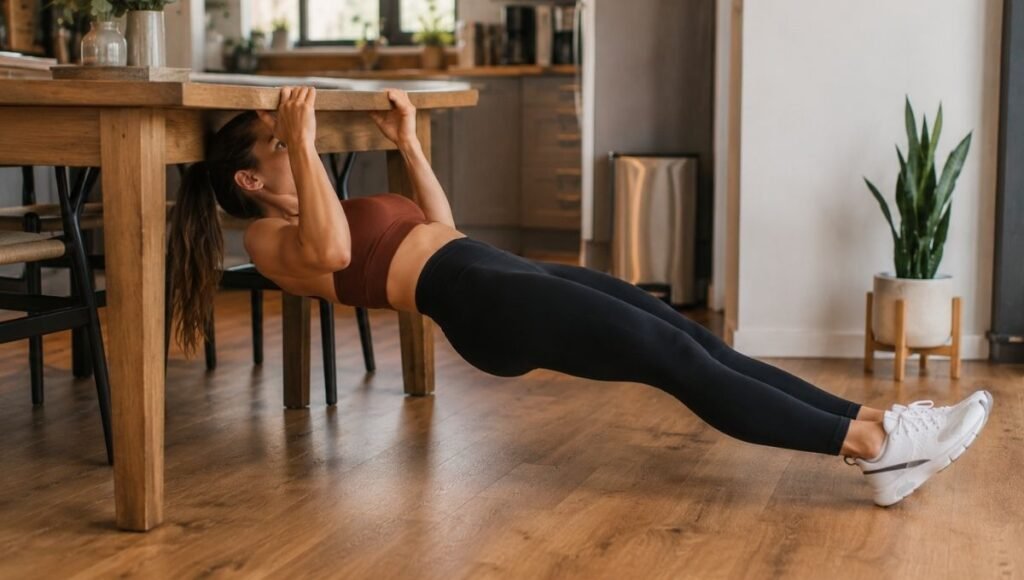
Exercise 5: Inverted Row (under a sturdy table) Muscles: Mid-back, biceps, rear shoulders
Lie under a sturdy table. Grip the edge with both hands, body straight from head to heels. Pull your chest up to the table, squeeze shoulder blades at the top. Lower slowly. This is one of the best at-home back exercises available.
- Beginner: Body positioned more upright (easier angle)
- Standard: Body more horizontal (harder)
- Advanced: Pause 1 second at the top of each rep
No table option: Superman holds — lie on your stomach, simultaneously raise arms and legs off the floor, hold 2 seconds. 3×10.
Exercise 6: Dead Bug Muscles: Deep core, transverse abdominis
Lie on your back, arms pointing to ceiling, knees at 90 degrees. Brace core. Slowly lower right arm overhead while extending left leg toward floor — lower back stays pressed to floor. Return and alternate.
- Beginner: 3×6 per side
- Standard: 3×8 per side
- Advanced: 3×10 per side with a light dumbbell in extended arm
Exercise 7: Standing Side Leg Raise Muscles: Glute medius, outer thighs, hip stabilizers
Stand tall, hold wall if needed. Raise one leg out to the side to hip height, lower with control. Complete all reps on one side before switching.
- All levels: 3×12 per side (increase speed and reduce pause for more difficulty)
Exercise 8: Plank Hold Muscles: Core, shoulders, hip stabilizers
From knees or feet: maintain a straight line from head to knees/heels. Brace core — don’t let hips sag or pike up.
- Beginner: 3 × 20-second hold (knees)
- Standard: 3 × 30-second hold (feet)
- Advanced: 3 × 45-second hold with one alternating shoulder tap per second
Cool-Down (3 minutes — do this every session)
- Standing forward fold — 30 seconds
- Standing quad stretch — 20 seconds per leg
- Chest opener (clasp hands behind back, squeeze shoulder blades) — 20 seconds
- Seated spinal twist — 20 seconds per side
- Child’s pose — 30 seconds
Your 4-Week Full Body Home Workout Schedule
| Week | Sessions/Week | Sets per Exercise | Rest Between Sets | Focus |
|---|---|---|---|---|
| Week 1 | 3 | 2 sets | 75 seconds | Learn form |
| Week 2 | 3 | 3 sets | 60 seconds | Build volume |
| Week 3 | 3 | 3 sets | 45 seconds | Increase density |
| Week 4 | 3–4 | 3 sets | 45 seconds | Progress variations |
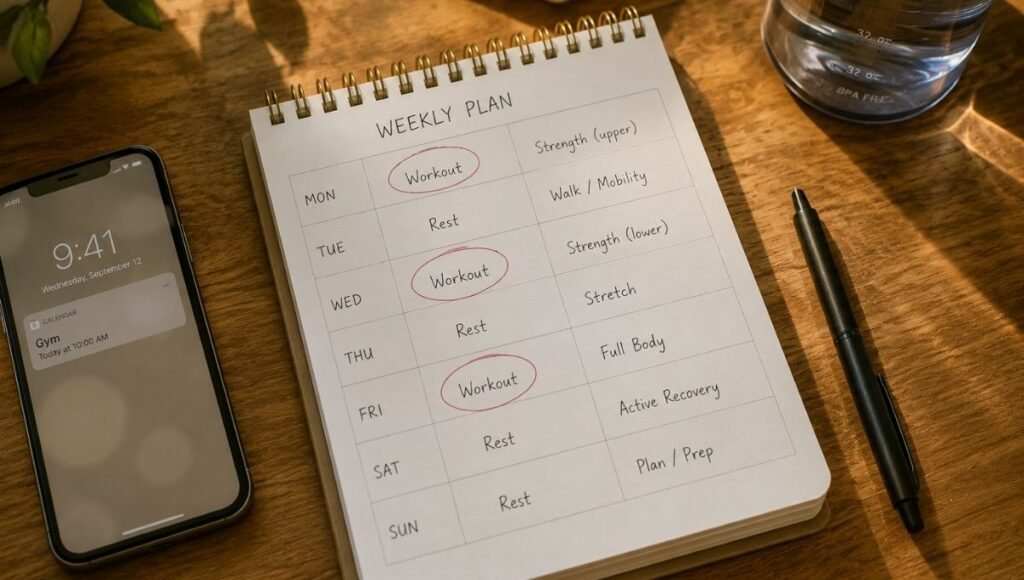
Example weekly schedule:
- Monday: Full body workout
- Tuesday: Walk or rest
- Wednesday: Full body workout
- Thursday: Walk or rest
- Friday: Full body workout
- Saturday/Sunday: Active rest or light stretching
How to know when to progress: If you complete all sets and reps with good form and feel like you could do 3–4 more reps in each set, move to the next difficulty level or reduce rest time by 15 seconds.
Full Body Workout at Home for Women: What to Know
The exercises in this guide work equally well for everyone — the fundamental movement patterns don’t change based on gender. But a few things are worth addressing specifically for women:
Lower body training deserves equal priority to upper body. The exercises that produce the most visible body composition results for women — squats, lunges, glute bridges, and side leg raises — target the glutes and legs. These are also the largest muscle groups in your body, producing the greatest metabolic benefit of any exercise. Don’t skip them in favor of extra push-ups.
You won’t build bulk from bodyweight training. Building significant muscle mass requires heavy weights, high caloric intake, and specific hormonal conditions. Consistent bodyweight training produces improved muscle tone, better posture, higher resting metabolic rate, and functional strength — not a bulky appearance.
Protein intake supports results. Aim for 0.7–1g of protein per pound of body weight daily to support muscle adaptation from training. This doesn’t require protein shakes — chicken, eggs, Greek yogurt, and legumes all provide adequate protein from whole food sources.
The 20-Minute Version (When Time Is Short)
On days when 30 minutes isn’t realistic, this condensed version keeps the habit alive:
20-minute full body workout at home:
Warm-up: 3 minutes (march + arm circles + 5 squats)
2 rounds of:
- Bodyweight Squat — 45 seconds
- Push-Up — 30 seconds
- Glute Bridge — 45 seconds
- Reverse Lunge — 45 seconds (alternating)
- Plank Hold — 30 seconds
Rest 30 seconds between exercises, 60 seconds between rounds.
Cool-down: 2 minutes
That’s 20 minutes. It counts. Three sessions like this per week, sustained consistently over months, produces meaningful results.
Does Home Workout Actually Work for Building Strength?
This is the question that stops a lot of people before they start. The honest answer: yes, for beginners and intermediate exercisers, bodyweight training is completely sufficient.
Research consistently shows that at-home workouts using bodyweight exercises may help improve muscular strength, endurance, and balance when performed with appropriate volume and progressive challenge. The mechanism is identical to gym training — your muscles are being challenged, experiencing micro-tears, and rebuilding stronger.
What home training does well: building functional strength, improving body composition, increasing cardiovascular fitness, improving posture and mobility. All of these outcomes are achievable with zero equipment.
Where home training becomes limiting: very heavy compound lifts (barbell squats over 200 lbs, bench pressing heavy loads), and advanced strength building once you’ve exhausted bodyweight progressions. For most people’s goals — general fitness, fat loss, strength maintenance, looking and feeling better — home training is completely sufficient for years.
When to Seek Professional Help Before Starting
This plan is appropriate for most generally healthy adults. Consider medical guidance first if you:
- Have been completely sedentary for more than 2 years
- Have a diagnosed cardiovascular condition or metabolic disorder
- Have a recent joint injury (knee, hip, shoulder, lower back) that hasn’t fully healed
- Are postpartum and within 8–12 weeks of delivery
- Experience chest pain, dizziness, or severe shortness of breath during light activity
Frequently Asked Questions
Are full body home workouts effective? Yes. Research confirms bodyweight training produces comparable strength adaptations to machine training for beginners. The key variables are progressive overload (making the workouts gradually harder over time), adequate training frequency (3 sessions per week), and consistency over months rather than weeks. Home workouts fail not because of insufficient exercises — they fail because of insufficient consistency.
How long should a full body home workout be? 20–35 minutes is the practical sweet spot for most home exercisers. This is long enough to cover all major muscle groups adequately and short enough to be repeatable 3 times per week without burnout. Sessions shorter than 15 minutes are better than nothing but insufficient for significant adaptation. Sessions longer than 45 minutes rarely produce proportionally better results for beginners.
Can I do a full body workout at home without equipment? Yes — every exercise in this guide requires zero equipment. A yoga mat improves floor comfort but isn’t necessary. All you need is enough floor space to lie down and stand up. The inverted row under a table is the only exercise requiring a piece of furniture.
How many days a week should I do a full body home workout? Three days per week on non-consecutive days is the research-supported optimal frequency for beginners. This provides each muscle group with sufficient stimulus while allowing 48 hours of recovery between sessions. Training the same muscles daily as a beginner typically leads to overreaching and burnout within 2–3 weeks.
How quickly will I see results from a home workout? Strength improvements typically begin within 2–3 weeks. These are primarily neural adaptations — your nervous system becoming more efficient at recruiting muscle fibers, not necessarily muscle growing yet. Visible body composition changes typically appear at 6–8 weeks of consistent training. Scale changes (for weight loss) depend primarily on nutrition alongside training.
Start Right Now
You have a complete workout. You have a 4-week schedule. You have modifications for every fitness level.
The only remaining step is the hardest one — starting. Not planning, not researching more options, not waiting until Monday.
Roll out your mat (or don’t — the floor is fine). Do the warm-up. Do the first round of the circuit. The second round will feel easier.
When you’ve completed 4 weeks and you’re ready for the next challenge: → What Is Progressive Overload? The Simple Rule That Makes Home Workouts Actually Work
When you want to add dumbbells and increase the intensity: → Full Body Dumbbell Workout at Home: The Complete Beginner’s 3-Day Plan
For a structured long-term plan that builds on this foundation: → Beginner Workout Plan at Home: Your First 4 Weeks, Day by Day
References
- Calatayud, J., et al. (2015). Muscle activation during push-ups with different suspension training systems. Journal of Human Kinetics.
- Guo, Y., et al. (2021). The effectiveness of home-based exercise interventions on muscular fitness in older adults. International Journal of Environmental Research and Public Health.
- Centers for Disease Control and Prevention (CDC). Physical Activity Guidelines for Americans. https://www.cdc.gov/physicalactivity/basics/adults/index.htm
- American College of Sports Medicine (ACSM). Progression Models in Resistance Training for Healthy Adults. Medicine & Science in Sports & Exercise, 2009.
- Healthline. 30 Moves to Make the Most of Your At-Home Workout. https://www.healthline.com/health/fitness-exercise/at-home-workouts