
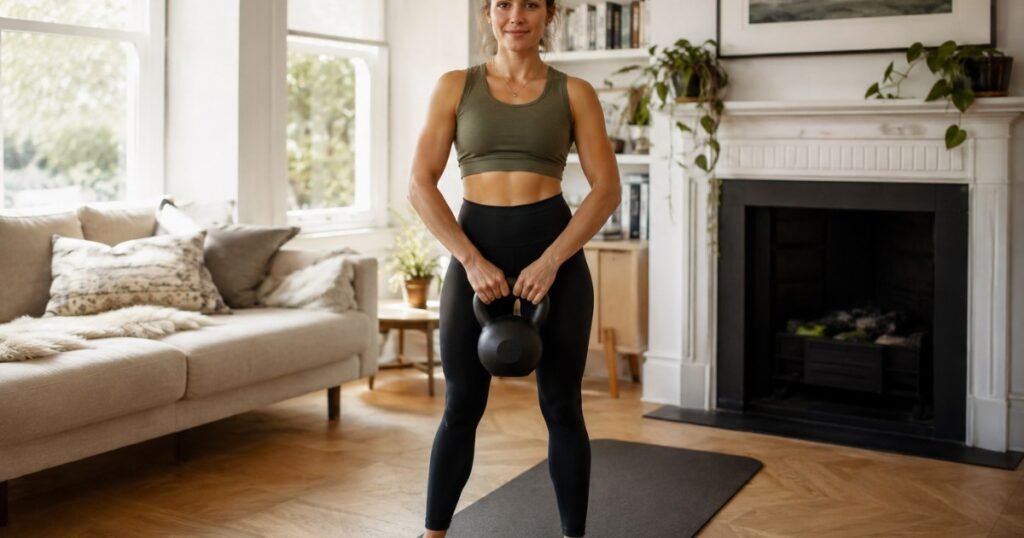
You bought a kettlebell. Maybe it was an impulse buy, maybe you’d been thinking about it for weeks. Either way, it’s now sitting in the corner of your room looking at you — and you’re looking back at it wondering what, exactly, you’re supposed to do with it.
This is more common than you’d think. The kettlebell is one of the most versatile pieces of home gym equipment available, but the internet doesn’t make it easy for beginners. Search for kettlebell exercises and you’ll find 50-exercise lists, Olympic lifting tutorials, and programs that assume you already know what a “clean and press” feels like.
You don’t need any of that. You need a clear progression from the most fundamental movements to the more advanced ones, with honest guidance on form, what to avoid, and how to put it all into a workout you can actually follow.
This guide gives you the 15 best kettlebell exercises for beginners — organized from foundational to advanced — what muscles each one works, the most common mistakes, and a complete 3-day workout plan. One kettlebell. Your living room. Real results.
Key Takeaways
- A single kettlebell covers all major muscle groups through pushing, pulling, hinging, squatting, and carrying movements — no additional equipment needed
- Research found that kettlebell training burns approximately 20 calories per minute at moderate intensity — comparable to running at a fast pace
- Women beginners: start at 8–12 kg. Men beginners: start at 12–16 kg. Never sacrifice form for heavier weight
- The swing, goblet squat, and deadlift are the three movements every beginner should master before attempting anything else
- A 3-day-per-week kettlebell program is the optimal frequency for beginners — enough stimulus for adaptation, enough recovery to avoid burnout
Why Kettlebell Exercises Are So Effective
Build Strength and Muscle
Kettlebells load your muscles through full ranges of motion — particularly the hip hinge pattern (deadlift, swing) that most gym machines can’t replicate effectively. This produces real functional strength that carries over to daily life: picking up groceries, carrying children, getting up from the floor.
Unlike isolation machines that work one muscle at a time, kettlebell exercises like the swing, clean, and Turkish get-up recruit dozens of muscles simultaneously. More muscles recruited per exercise means more total training stimulus in less time.
Train Your Whole Body at Once
The unique characteristic of kettlebell training is its integration of strength, balance, and coordination in the same movement. A goblet squat isn’t just a leg exercise — it’s also a core stability challenge, a shoulder mobility test, and a grip strength builder. This whole-body integration is why kettlebell workouts produce visible results from relatively short sessions.
Perfect for Home Workouts
One 12 kg kettlebell weighs 26 lbs, takes up the floor space of a shoebox, and costs $30–$60. For apartment dwellers or anyone without a dedicated gym space, a kettlebell is the highest-value piece of fitness equipment per dollar available. No adjustments needed, no assembly, no machine parts to break — just pick it up and train.
Sportzillax editor note: The kettlebell is uniquely suited to the home exerciser precisely because it doesn’t require a rack, a bench, or a cable machine. Every exercise in this guide can be done in a yoga-mat-sized space.
How to Choose the Right Kettlebell Weight Before Starting
“What weight should I start with?” is the most common kettlebell question — and it has a concrete answer, not “it depends.”
Women beginners: 8 kg (18 lbs) for lower body and swing movements. 6 kg for upper body exercises like press and halo. If you’re postpartum or completely new to any form of exercise, start at 6 kg for everything.
Men beginners: 12 kg (26 lbs) for most exercises. 16 kg if you have a background in weightlifting or general strength training.
The test: You should be able to complete 10 reps with good form, with the last 2–3 reps feeling genuinely challenging. If 15 reps feels effortless, go heavier. If your form breaks down by rep 6, go lighter.
The most important rule: Never increase weight before mastering technique at the current weight. Adding load to poor form doesn’t make you stronger — it makes injury inevitable.
For complete home gym setup guidance, see our Home Gym Setup on a Budget guide.
15 Best Kettlebell Exercises for Beginners
1. Kettlebell Swing
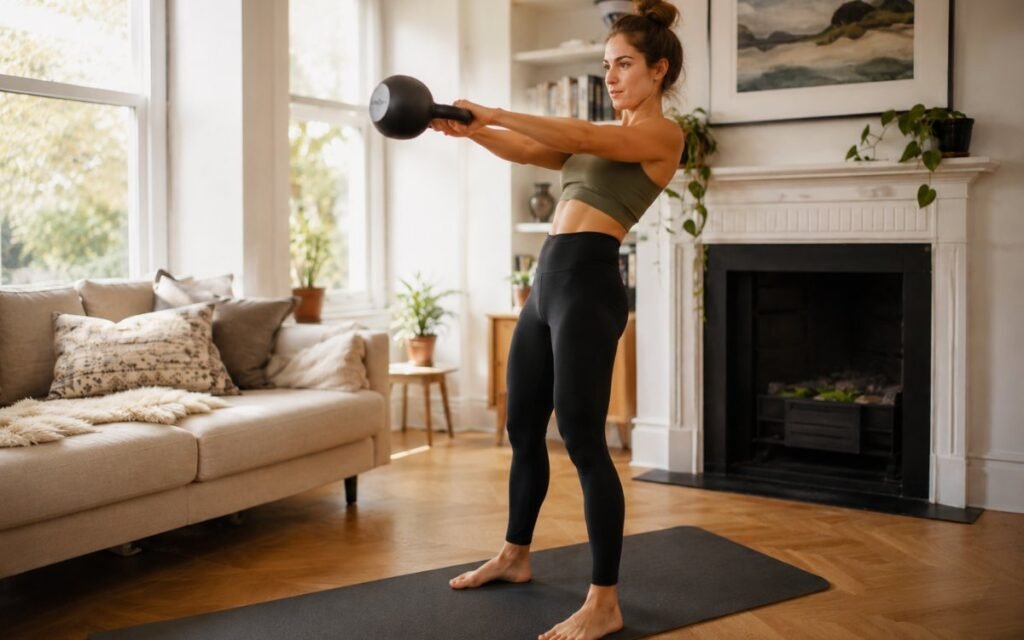
Works: Glutes, hamstrings, lower back, core, shoulders
The swing is the foundational kettlebell movement — everything else builds on it. It’s also one of the most efficient fat-burning exercises available, elevating heart rate while loading the posterior chain.
How to do it:
- Stand with feet slightly wider than hip-width, kettlebell on the floor in front of you.
- Hinge at hips, grip the handle with both hands, tilt the bell toward you.
- Hike the kettlebell back between your legs, then explosively snap your hips forward to standing — this drives the bell upward to chest height.
- Let it fall back, immediately hinge your hips back to receive it, and use the momentum to load the next rep.
Beginner tip: The bell should float up to chest height from hip power alone. If your arms are pulling it up, your hips aren’t doing their job.
Common mistake: Squatting instead of hinging. The hips go back, not down. Think of pushing your hips toward the wall behind you, not lowering your body toward the floor.
2. Goblet Squat
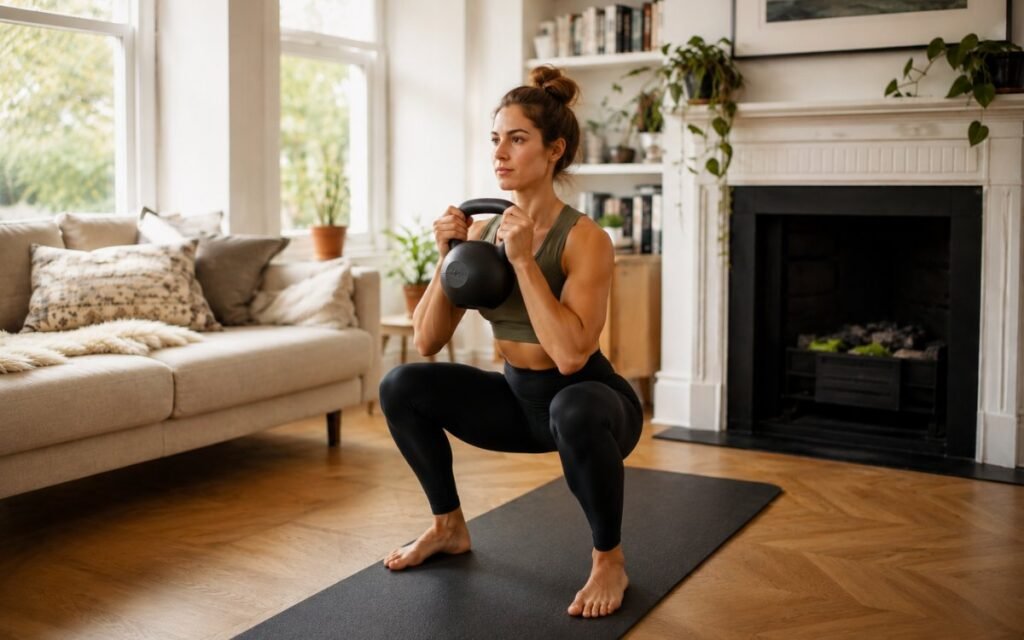
Works: Quads, glutes, hamstrings, core, upper back
The goblet squat is the fastest way to learn proper squat form. Holding the kettlebell at chest height acts as a counterbalance, naturally keeping your torso upright and teaching you exactly where the weight should sit in your squat.
How to do it:
- Hold the kettlebell by the horns (sides of the handle) at chest height, close to your body.
- Feet slightly wider than hip-width, toes turned out 15–30 degrees.
- Brace core, sit back and down — keeping chest tall, heels flat, knees tracking over toes.
- Lower to parallel or slightly below. Elbows inside knees at the bottom.
- Drive through heels to stand, squeezing glutes at top.
Beginner tip: At the bottom of the squat, use your elbows to gently press your knees outward — this activates the glutes and corrects knee cave simultaneously.
Common mistake: Heels rising off the floor. This is an ankle mobility issue — elevate your heels slightly on a folded mat while you work on ankle flexibility.
3. Kettlebell Deadlift
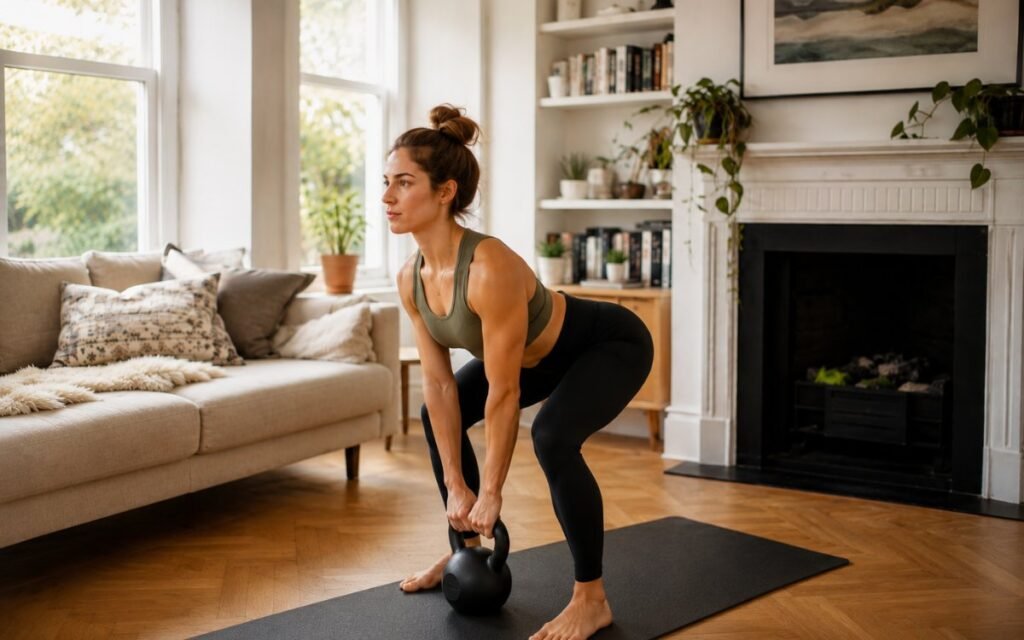
Works: Hamstrings, glutes, lower back, core, grip
Learn this before anything else. The deadlift teaches the hip hinge pattern that underpins the swing, the clean, and virtually every power movement in kettlebell training. It also directly translates to daily life — every time you pick something up from the floor.
How to do it:
- Kettlebell on floor between feet, slightly forward of mid-foot.
- Hinge at hips — push them back until you can grip the handle with a flat back.
- Brace core, take a breath in, drive through heels and stand — hips and chest rising at the same rate.
- Fully extend at the top: hips forward, glutes squeezed.
- Hinge back down with control.
Beginner tip: Think “hips to the wall behind you” on the way down — not “bend your knees.” The knees will bend naturally as part of the hinge.
Common mistake: Rounding the lower back to reach the kettlebell. If you can’t maintain a flat back at the bottom, place the kettlebell on a step or yoga block to reduce how far you reach.
4. Kettlebell Row
Works: Mid-back, biceps, rear shoulders, core stability
Most home workouts neglect the upper back — the area most affected by hours of desk work and screen time. The kettlebell row directly targets the muscles that improve posture and counteract forward rounding.
How to do it:
- Hinge forward at hips, one hand on a sturdy surface for support.
- Kettlebell in opposite hand, arm hanging straight down.
- Pull elbow directly upward — think “elbow to ceiling,” not “hand to hip.”
- Squeeze shoulder blade at top. Lower slowly.
Beginner tip: Keep your torso still throughout. A common compensatory error is rotating the entire body to help the weight up — this reduces back activation.
Common mistake: Flaring the elbow out to the side instead of pulling it straight up along the body.
5. Kettlebell Press
Works: Shoulders, triceps, upper back, core
The kettlebell press builds pressing strength and shoulder stability that transfers to every pushing movement in training and daily life.
How to do it:
- Hold kettlebell at shoulder height — bell resting on the outside of your forearm, elbow pointing slightly forward and down.
- Brace core. Press the kettlebell directly overhead until arm is fully extended.
- Lower with control back to shoulder position.
Beginner tip: The kettlebell should travel in a straight line overhead — not forward, not backward. If it drifts forward, your core isn’t braced enough.
Common mistake: Arching the lower back to get the weight overhead. If this happens, the weight is too heavy — reduce it until you can press with a neutral spine.
6. Kettlebell Clean
Works: Full body — glutes, hamstrings, core, shoulders, forearms
The clean moves the kettlebell from the floor to the rack position (at shoulder level) in one fluid motion. It’s the gateway to more advanced movements like the clean and press.
How to do it:
- Start like a swing — hike the bell back between legs.
- As you snap your hips, guide the bell in a tight arc close to your body.
- As the bell rises, rotate your forearm so the bell “flips” to rest on the outside of your forearm at shoulder height.
- Pause in rack position, then lower with control.
Beginner tip: Keep the bell close to your body throughout — it should travel along your centerline, not arc out in front of you.
Common mistake: Letting the bell bang against your wrist at the top. This happens when the bell arcs too far out — keep it close, and rotate your forearm to receive it.
7. Kettlebell Lunge
Works: Quads, glutes, hamstrings, balance
Adding a kettlebell to lunges significantly increases the challenge for the lower body while also demanding core stability to maintain an upright torso.
How to do it:
- Hold kettlebell in goblet position (at chest) or by your side.
- Step one foot back, lower back knee toward floor.
- Return to standing. Alternate legs.
Beginner tip: Start with the kettlebell at your chest (goblet position) — the counterbalance helps with balance and keeps your torso upright. Progress to holding it at your side as balance improves.
Common mistake: Letting the front knee collapse inward. Focus on pushing the front knee outward over the second toe throughout.
8. Kettlebell Russian Twist
Works: Obliques, core rotators, hip flexors
The Russian twist trains rotational core strength — the kind that stabilizes your spine during athletic movements and daily activities like turning, reaching, and carrying.
How to do it:
- Sit on the floor, knees bent, feet flat (or slightly elevated for more challenge).
- Lean back slightly to create tension in the core — body at roughly 45 degrees.
- Hold kettlebell with both hands. Rotate your torso to one side, tapping the bell near the floor. Rotate to the other side.
Beginner tip: Start with feet flat on the floor. Elevating the feet increases difficulty significantly.
Common mistake: Moving only the arms without genuine torso rotation. The movement should come from the core, not the arms swinging the weight.
9. Kettlebell Floor Press
Works: Chest, shoulders, triceps
The floor press is a bench press performed lying on the floor — it naturally limits range of motion to a joint-safe position and is one of the most effective chest exercises you can do at home without any bench.
How to do it:
- Lie on your back, knees bent, feet flat.
- Hold kettlebell at chest level, elbow at about 45 degrees from your body.
- Press the bell straight up until arm is fully extended.
- Lower slowly until elbow touches the floor. Pause briefly, then press again.
Beginner tip: The brief pause at the bottom (elbow on floor) removes momentum and forces the muscles to initiate each rep from a dead stop — making it harder and more effective than a continuous movement.
Common mistake: Flaring the elbow out to 90 degrees. Keep it at 45 degrees to protect the shoulder joint.
10. Kettlebell Halo
Works: Shoulder mobility, rotator cuff, core stability
The halo is deceptively demanding. Rotating the kettlebell around your head requires shoulder flexibility, activates the stabilizing muscles of the shoulder joint, and demands continuous core engagement.
How to do it:
- Hold kettlebell upside down (bottom facing up) with both hands gripping the horns, at chest height.
- Slowly circle the kettlebell around your head — to one side, behind your head, around to the other side.
- Keep hips and lower body completely still. Only the arms and bell are moving.
Beginner tip: Move slowly, especially when learning. Start lighter than you think you need to.
Common mistake: Rushing the movement behind the head. This is where people clip themselves — keep the bell close to the back of your head and move with control.
11. Farmer’s Carry
Works: Grip, forearms, core, traps, entire body (stability)
The farmer’s carry is one of the most functional exercises available — it trains your body to stabilize under load while walking, which is exactly what you do whenever you carry shopping bags, luggage, or anything else.
How to do it:
- Hold one or two kettlebells at your sides, arms straight.
- Stand tall: shoulders back, core braced.
- Walk forward with controlled, even steps — don’t let the weight pull your shoulder down or your torso lean.
Beginner tip: The challenge is maintaining an upright posture as the weight tries to pull you sideways. Focus on keeping both shoulders level throughout.
Common mistake: Letting the shoulder of the loaded side drop. Pack the shoulder down and maintain level shoulders for the entire carry.
12. Single-Arm Kettlebell Swing
Works: Glutes, hamstrings, core anti-rotation, shoulder stability
Once you’ve mastered the two-arm swing, the single-arm version adds a rotational challenge: your core must now resist the force trying to rotate you toward the working arm. This significantly increases core and shoulder demand.
How to do it:
- Same setup as two-arm swing, but grip with one hand.
- Execute the same hip-drive pattern, letting the bell swing to chest height.
- Switch hands at the top or complete all reps on one side before switching.
Beginner tip: Master 20+ consecutive two-arm swings with good form before attempting single-arm. The anti-rotation demand is significantly higher.
Common mistake: Letting the body rotate toward the working arm. Focus on keeping your hips and shoulders square to the front throughout.
13. Kettlebell High Pull
Works: Upper back, traps, shoulders, glutes, hamstrings
The high pull bridges the gap between the swing and the clean — it teaches the upper body coordination needed for more advanced movements while producing significant upper back and trap development.
How to do it:
- Start in swing position. Execute the hip drive.
- As the bell rises, pull your elbow high and back — like an exaggerated row — guiding the bell to shoulder height.
- Lower with control and flow directly into the next rep.
Beginner tip: Think of it as a swing followed immediately by an upright row. The elbow leads, the bell follows.
Common mistake: Pulling with the arm before the hips have finished driving. The hips drive first; the arm pull is secondary.
14. Turkish Get-Up
Works: Full body — shoulders, core, hips, legs, coordination
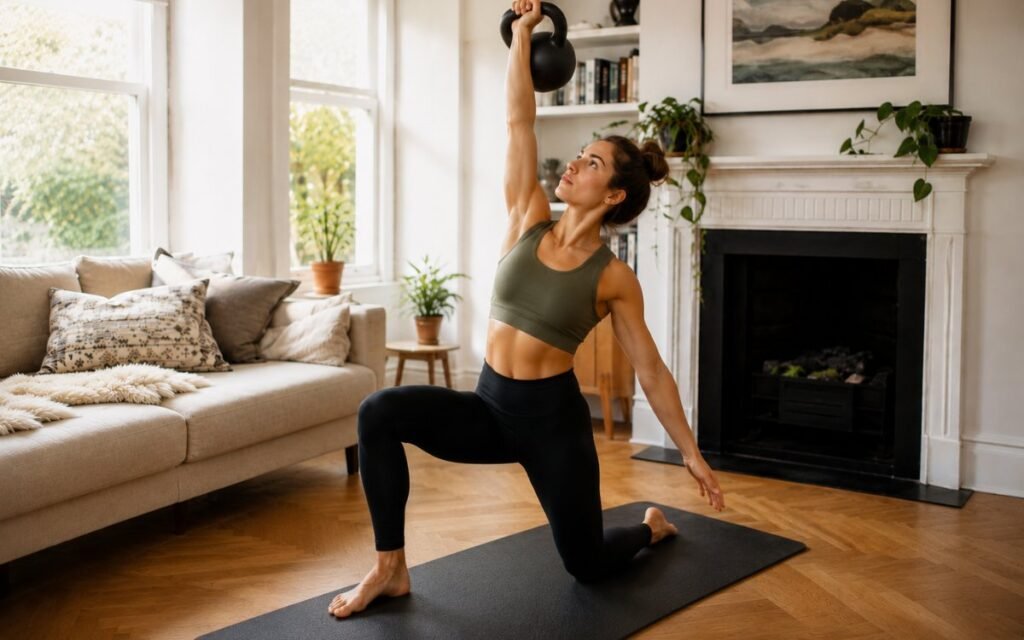
The Turkish get-up is the most complex movement in kettlebell training — and one of the most rewarding. It develops shoulder stability, hip mobility, and core strength simultaneously. Don’t rush to this one; come back to it after 6–8 weeks of foundational training.
How to do it (simplified):
- Lie on your back, kettlebell pressed to ceiling in right hand, right knee bent.
- Roll onto your left elbow, then left hand.
- Lift hips, sweep left leg back to a half-kneeling position.
- Stand fully upright with the bell overhead.
- Reverse the sequence to return to the floor.
Beginner tip: Practice the movement with no weight first — or with a shoe balanced on your fist — until the pattern feels natural. Then add a very light kettlebell.
Common mistake: Rushing between positions. Each position should be held for a moment — this is a skill exercise, not a conditioning one.
15. Kettlebell Snatch
Works: Full body power — glutes, hamstrings, shoulders, core, grip
The snatch is the most technically demanding kettlebell exercise. It moves the bell from between the legs to fully overhead in one fluid motion. Listed here as an advanced option — most beginners should wait 3–6 months of consistent training before attempting it.
How to do it (overview):
- Start like a single-arm swing — hike the bell back.
- Execute a powerful hip drive.
- As the bell rises, punch your hand through the handle so the bell flips over the back of your hand into an overhead position.
- Stand fully upright with arm locked out overhead.
Beginner tip: Perfect your single-arm swing and high pull before attempting the snatch. These movements teach the hip power and hand path needed.
Common mistake: Letting the bell crash over your hand instead of punching through it — this bruises the wrist and indicates timing issues. Start with a very light weight.
Beginner Kettlebell Workout Plan (3 Days Per Week)
Day 1 — Full Body Strength
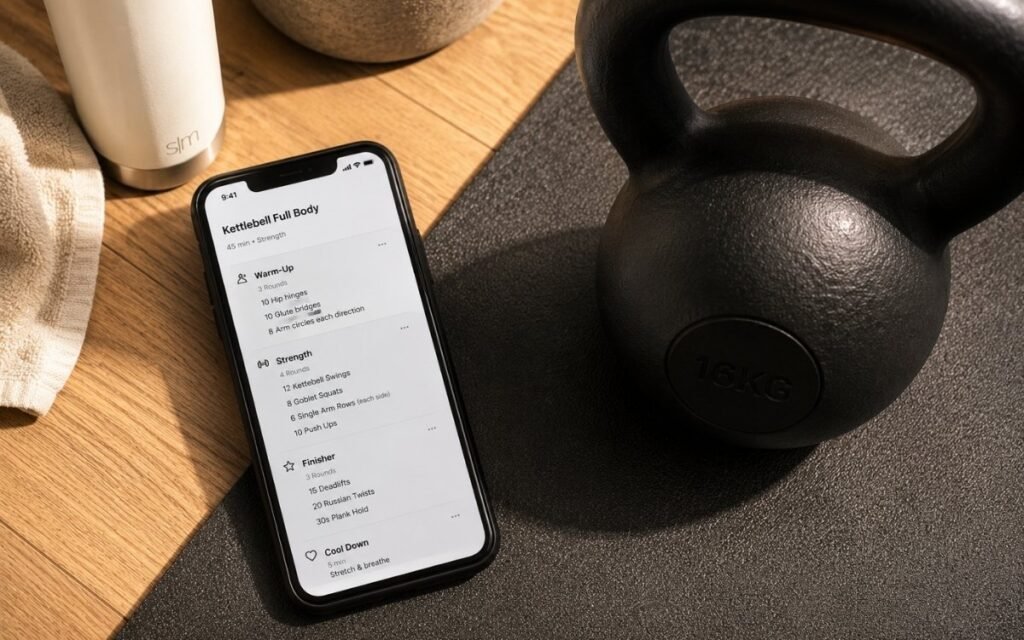
| Exercise | Sets | Reps | Rest |
|---|---|---|---|
| Kettlebell Deadlift | 3 | 10 | 60 sec |
| Goblet Squat | 3 | 10 | 60 sec |
| Kettlebell Row | 3 | 10/side | 60 sec |
| Kettlebell Press | 3 | 8/side | 60 sec |
| Farmer’s Carry | 3 | 30 sec | 60 sec |
Day 2 — Fat Burning and Conditioning
| Exercise | Sets | Reps/Duration | Rest |
|---|---|---|---|
| Two-Arm Swing | 4 | 15 | 45 sec |
| Kettlebell Lunge | 3 | 10/leg | 60 sec |
| Russian Twist | 3 | 10/side | 45 sec |
| Single-Arm Swing | 3 | 10/side | 60 sec |
Day 3 — Muscle Building
| Exercise | Sets | Reps | Rest |
|---|---|---|---|
| Goblet Squat | 4 | 12 | 75 sec |
| Floor Press | 3 | 10/side | 75 sec |
| Kettlebell Deadlift | 3 | 12 | 75 sec |
| Kettlebell Halo | 3 | 6/direction | 60 sec |
| Kettlebell Row | 3 | 12/side | 75 sec |
Weekly schedule: Day 1 on Monday, Day 2 on Wednesday, Day 3 on Friday. Rest or walk on other days.
Common Kettlebell Mistakes Beginners Make
Choosing Too Heavy Too Soon
The most universal beginner mistake. A heavier kettlebell feels like more progress — but it produces worse results by forcing form compensation. The right weight produces quality reps. Quality reps produce strength and muscle. Start lighter than your ego suggests.
Using Arms Instead of Hips
Applies primarily to the swing — but this error pattern shows up across most kettlebell movements. Your hips are the engine; your arms are the steering wheel. In the swing, the bell rises because your hips snap forward, not because your arms pull upward. When in doubt, think: less arms, more hips.
Training Every Day Without Recovery
Kettlebell training is demanding on the posterior chain, grip, and cardiovascular system simultaneously. Training without adequate recovery doesn’t accelerate progress — it prevents it. Three days per week with rest days between is not a compromise; it’s optimal for beginners.
Kettlebell Exercises by Goal
Best Kettlebell Exercises for Weight Loss
Focus on movements that keep your heart rate elevated while engaging large muscle groups:
- Swing — the king of kettlebell conditioning
- Snatch (when ready) — highest calorie burn per rep of any kettlebell exercise
- Farmer’s Carry — deceptively demanding on your cardiovascular system
Best Kettlebell Exercises for Muscle Building
Focus on slower, controlled movements with heavier loads:
- Goblet Squat — develops lower body mass effectively
- Kettlebell Press — shoulder and tricep development
- Kettlebell Row — upper back thickness and rear shoulder development
Best Kettlebell Exercises for Beginners (Start Here)
These three first, in this order:
- Kettlebell Deadlift — teaches the hip hinge
- Goblet Squat — teaches the squat pattern
- Two-Arm Swing — combines both patterns with power and conditioning
Master these three before adding anything else. Two to three weeks of focused practice on just these movements will make every subsequent exercise easier to learn.
Frequently Asked Questions
Can you build muscle with only kettlebell exercises? Yes — for beginners and intermediate exercisers, kettlebell training produces meaningful muscle and strength gains. The compound movements (swing, goblet squat, press, row) recruit large amounts of muscle mass and provide sufficient mechanical tension to drive adaptation. Advanced muscle building eventually benefits from heavier loads than most people use with kettlebells, but for most home training goals, kettlebells are completely sufficient.
Are kettlebells better than dumbbells? Neither is objectively better — they’re different tools suited to different movements. Kettlebells excel at ballistic, swinging movements (swing, clean, snatch) that dumbbells can’t replicate safely. Dumbbells excel at isolation exercises (bicep curl, lateral raise) where a fixed handle matters. For home trainers who want one tool, kettlebells offer more variety and the swing is a uniquely effective movement. For those who want the broadest exercise library, both together is the answer.
Is a 20-minute kettlebell workout enough? For beginners: yes, a focused 20-minute kettlebell session produces genuine training stimulus. Because kettlebell exercises combine strength and cardiovascular demand, a 20-minute session is roughly equivalent to a 35–40 minute traditional gym workout. The quality of the session matters more than the duration.
How many times per week should beginners train with kettlebells? Three days per week is the research-supported optimal frequency for beginners. This provides each muscle group with sufficient stimulus (each session is full-body) while allowing 48 hours of recovery between sessions. Training more frequently as a beginner typically reduces results by impairing recovery rather than accelerating adaptation.
What kettlebell exercise burns the most fat? The swing burns the most calories per minute of the foundational exercises — approximately 20 calories per minute at sustained effort, comparable to running. The snatch burns even more, but requires technique development before it becomes a conditioning tool. For beginners, swing-focused sessions provide the greatest fat-burning stimulus.
Start Simple, Stay Consistent
You don’t need all 15 exercises to get started. Start with three: the deadlift, the goblet squat, and the swing. Practice them until they feel natural. Add the row and press in week 3. Work through the full list progressively over 2–3 months.
The kettlebell is not a complicated tool. It’s a weight with a handle, used in movements your body already knows how to do. The complexity people project onto it is mostly the fitness industry overcomplicating things to sell courses and programs.
Pick it up. Start with the deadlift. Come back tomorrow and do it again.
For your complete home gym setup around the kettlebell: → Home Gym Setup on a Budget: What to Buy First (And What to Skip)
→ Best Adjustable Dumbbells for Home Workouts: Honest Reviews
To build the kettlebell into a complete fat loss program: → Workout at Home to Lose Weight: The Complete Beginner’s Plan
🏋️ Sportzillax Training Notes: The Science Behind This Guide
Getting stronger does not require the perfect gym, the newest equipment, or a complicated program.
It starts with understanding how your body moves — then repeating simple movements consistently enough for your body to adapt.
The recommendations in this guide are based on exercise science, strength training principles, and research on how kettlebell movements improve strength, conditioning, and overall fitness.
Here are some of the resources that helped shape this guide:
💪 Kettlebell Training & Energy Demand
Research by Farrar et al. and Lake & Lauder explored the physical demands of kettlebell exercises — including why movements like the kettlebell swing can challenge both your muscles and cardiovascular system at the same time.
🔥 Strength Training & Muscle Development
Studies on resistance training and muscle growth, including work from Brad Schoenfeld, help explain why progressive overload, proper technique, and consistency matter more than constantly changing exercises.
❤️ Exercise Frequency & Long-Term Health
Guidelines from the Centers for Disease Control and Prevention (CDC) and the American Council on Exercise (ACE) support regular strength training as part of a balanced, sustainable fitness routine.
Because the best workout is not the one that looks most impressive online.
It is the one you understand, repeat, and can keep doing years from now.