
Let’s be honest: the first time you saw someone using massage guns on the sidelines of an NBA game or at your local CrossFit box, it looked a bit… intense. It sounds like a power tool and moves like a jackhammer. But there’s a reason these devices have moved from elite training rooms into the gym bags of everyday weekend warriors.
When used correctly, massage guns are absolute game-changers for muscle tension and recovery. However, most people are using them all wrong. They “blast” their muscles until they bruise, thinking more pain equals more gain. In this comprehensive guide, we’re going to look at the science of percussive therapy and how to actually use these tools to feel better, not just sorer.
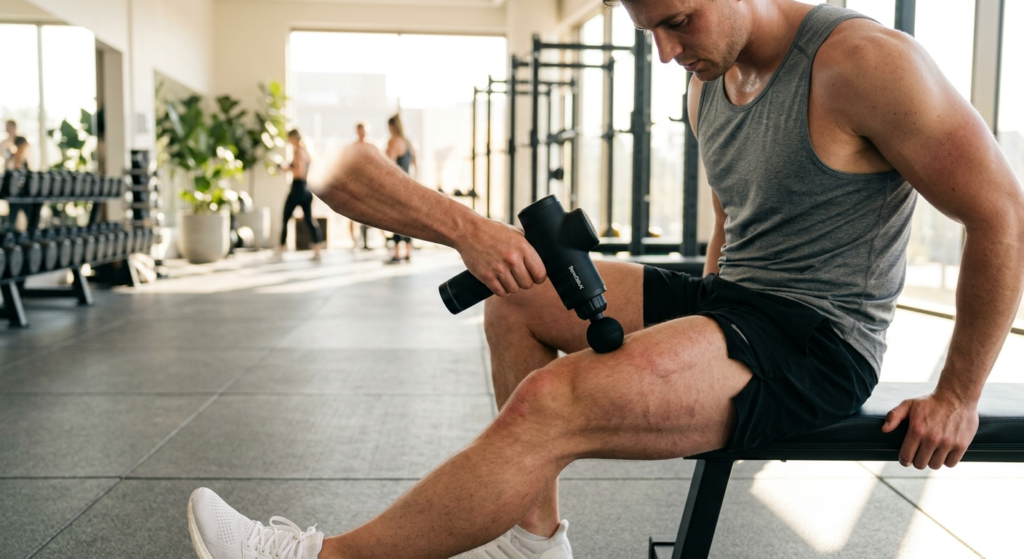
Percussive Therapy vs. Vibration: How Massage Guns Change Your Muscle Chemistry
Many users confuse a high-end massage gun with a cheap vibrating massager. The technical difference lies in Amplitude (stroke length). While standard vibration only oscillates at 1-2mm on the skin’s surface, a professional-grade massage gun features a 12mm to 16mm amplitude.
The Gate Control Theory
Why does it feel so good? It’s not magic; it’s neuroscience. By striking the muscle 30-40 times per second (1,800 – 2,400 RPM), the device stimulates the mechanoreceptors in your skin. According to the Gate Control Theory of Pain, these rapid touch signals “close the gate” in your spinal cord, blocking slower pain signals from reaching your brain.
The Blood Flow Boost
Infrared thermography tests indicate that just 2 minutes of targeted use can increase local skin temperature by 2.5°C and boost blood flow by up to 22%. This “flushing” effect is what moves metabolic waste, like lactate, out of the tissue significantly faster than passive rest.
Stop the Pain: How to Use Massage Guns Correctly (A Step-by-Step Protocol)
If you’ve read our 300-hour DOMS test results, you know our stance: stop “blasting” your muscles! Think of the massage gun as a “pacer,” not a “drill.”
1. The Pre-Workout “Ignition” (30 Seconds)
- Goal: Wake up the nervous system and increase Range of Motion (ROM).
- Setting: High speed, very low pressure.
- Action: Quickly glide the gun over major muscle groups. Do not stay on one spot for more than 5 seconds.
2. The Post-Workout “Flush” (2 Minutes per Group)
- Goal: Down-regulate the nervous system into “rest and digest” mode.
- Setting: Medium speed, moderate pressure.
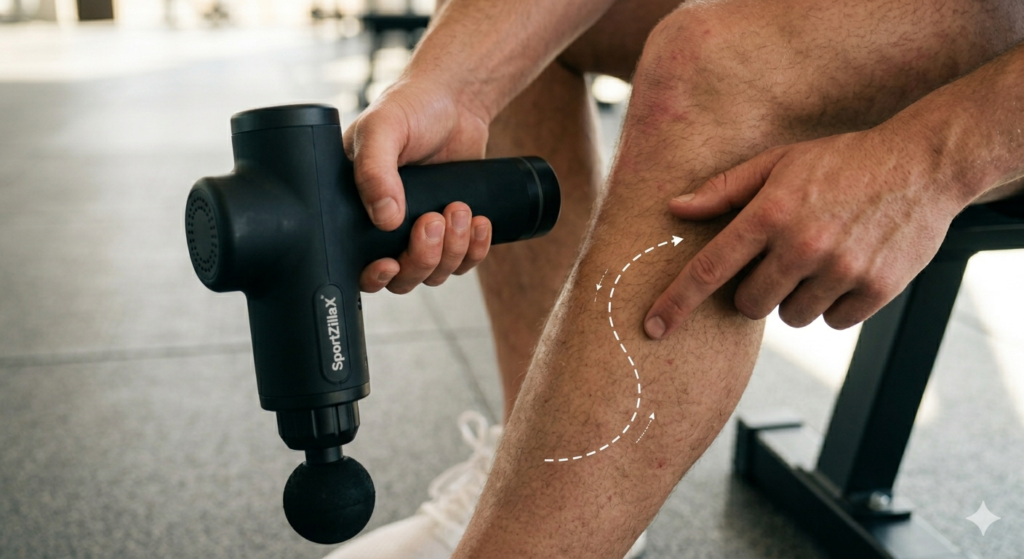
- The “Floating” Technique: Do not grip the handle white-knuckled. Hold it loosely and let the device “float” over the muscle belly. If the gun starts to chatter or bounce, you are pressing too hard or hitting a bone.
Selecting the Best Massage Guns: 3 Specs That Actually Matter
When shopping for massage guns, don’t get distracted by the number of attachments or fancy LCD screens. Focus on the “Holy Trinity” of specifications:
- Stall Force (The Torque): This is the amount of pressure you can apply before the motor stops. A beginner gun might stall at 20 lbs, while a professional unit handles 60 lbs. For thick muscles like quads and glutes, you need at least 40 lbs of stall force.
- Amplitude (The Depth): * 10mm: Best for light relaxation and office workers.
- 16mm: Essential for powerlifters and deep-tissue enthusiasts.
- Noise Level (The dB Trap): Anything over 65dB (the volume of a loud conversation) will make it impossible to use while watching TV. Look for “Brushless Motors” which typically hover around 45-55dB.
| Feature | Beginner/Casual User | Professional/Athlete |
| Amplitude | 8mm – 10mm | 12mm – 16mm |
| Stall Force | 20 – 30 lbs | 45 – 60 lbs |
| Noise Level | Ultra Quiet (<45dB) | Power Focused (55dB+) |
| Battery Life | 2-3 Hours | 5+ Hours (Swapable) |
The “No-Go” Zones: Safety First
Even the best massage guns can be dangerous if used in the wrong place. Avoid these “Vulnerability” areas:
- The Carotid Sinus: The sides of your neck. High-frequency percussion here can interfere with blood flow to the brain.
- Bony Prompts: Never hit the spine, kneecaps, or elbows directly. This can cause inflammation of the bone lining (periosteum).
- Nerve Plexuses: Avoid the armpits and the groin area where major nerves are close to the surface.
Massage Gun FAQ: Your Questions Answered
Q: Can I use a massage gun for a pulled muscle? A: No. If you have a Grade II or III strain (a tear), percussive therapy will worsen the injury by shearing the healing fibers. Wait at least 72 hours and consult a physical therapist.
Q: Does it actually prevent DOMS? A: Our 300-hour test suggests that while it doesn’t “delete” soreness, it significantly reduces the perception of pain and improves blood flow to speed up the repair process.
Q: How many times a day can I use it? A: Limit use to 2-3 times per day. Over-using massage guns can desensitize the skin and potentially lead to “muscle bruising.”
Conclusion: Find Your Flow with SportZillaX
At the end of the day, massage guns are incredible tools for anyone looking to stay mobile and pain-free. But remember: they are a supplement to, not a replacement for, good sleep, hydration, and proper stretching. Use them with intention, avoid the “blasting” temptation, and listen to your body.
Namaste and Happy Recovery! Do you have a favorite muscle group to target? Let us know in the comments below!