
In 2026, owning a smartwatch doesn’t make you an elite athlete; knowing what to do with the numbers does. Most lifters use their wearables to track calories, but the real power lies in biometric syncing. If your HRV is tanking and your “Readiness Score” is in the gutter, blindly hitting your quads with a massage gun might actually backfire. The secret to 2X faster muscle repair isn’t just more intensity—it’s about using a data-driven recovery blueprint to apply the right mechanical force at the exact moment your nervous system can handle it.
Beyond Vibrations: The Science of Precision Recovery
The old way of recovering was simple: if it hurts, massage it. The 2026 way is surgical. We are now using percussion tech as a targeted tool to influence the Autonomic Nervous System (ANS). When we talk about muscle repair speed, we aren’t just talking about blood flow; we are talking about shifting the body from a “sympathetic” (stressed) state to a “parasympathetic” (recovery) state.
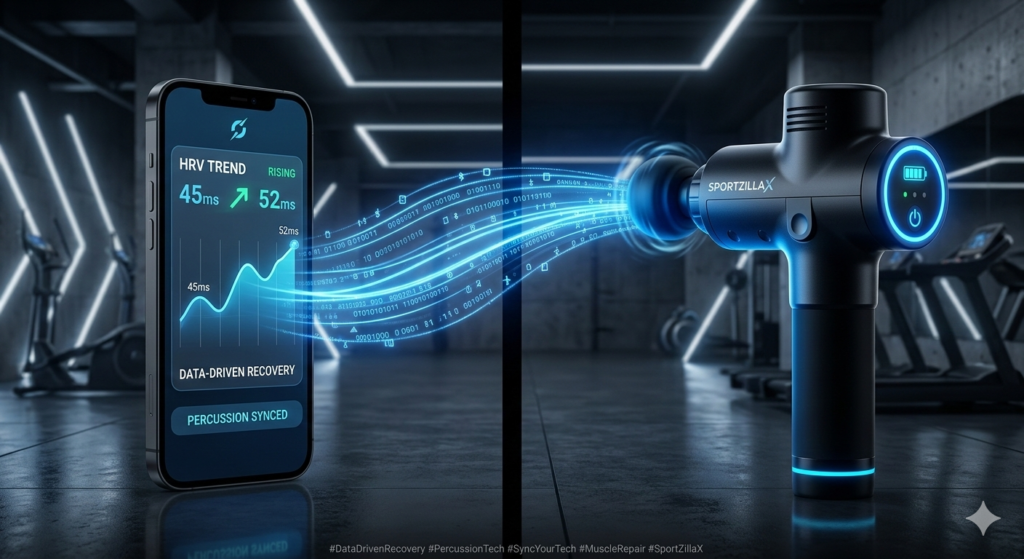
By syncing your wearable’s data—specifically your Heart Rate Variability (HRV) and skin temperature—you can determine the exact amplitude and stall force needed to flush metabolic waste without over-taxing your CNS.
Phase 1: Reading Your Body’s Daily Signals
Before you touch your recovery equipment, you need a diagnostic. Your wearable is your “check engine” light.
1. HRV (Heart Rate Variability)
If your HRV is 20% below your baseline, your nervous system is fried. In this state, high-intensity percussion can be perceived as a fresh “attack” by your brain. You need low-frequency, long-stroke therapy to soothe the fascia.
2. Muscle Strain & Temperature
Elevated local skin temperature often indicates acute inflammation. This is the only time you should back off. Use your biometric data to distinguish between “good” DOMS (Delayed Onset Muscle Soreness) and actual tissue damage.
Phase 2: The Syncing Protocol (The Blueprint)
To achieve 2X faster muscle repair, you must match the vibration frequency to your body’s current state. Follow this 2026 protocol:
| Data Signal | Body Status | Percussion Strategy | Duration |
| Low HRV (<40ms) | CNS Fatigue | 1750 PPM (Low) / Deep 16mm Stroke | 2 Mins/Group |
| High Strain Score | Local Fatigue | 2100 PPM (Med) / Targeted Pulse | 5 Mins/Group |
| High Readiness | Primed for Work | 2400 PPM (High) / Rapid Sweep | 30 Sec/Group |
According to the latest research in the Journal of Strength and Conditioning Research, percussive massage significantly reduces the global perception of soreness while increasing range of motion, provided the frequency is adjusted to the user’s fatigue level.
Why Your Cheap Gear is Capping Your Gains
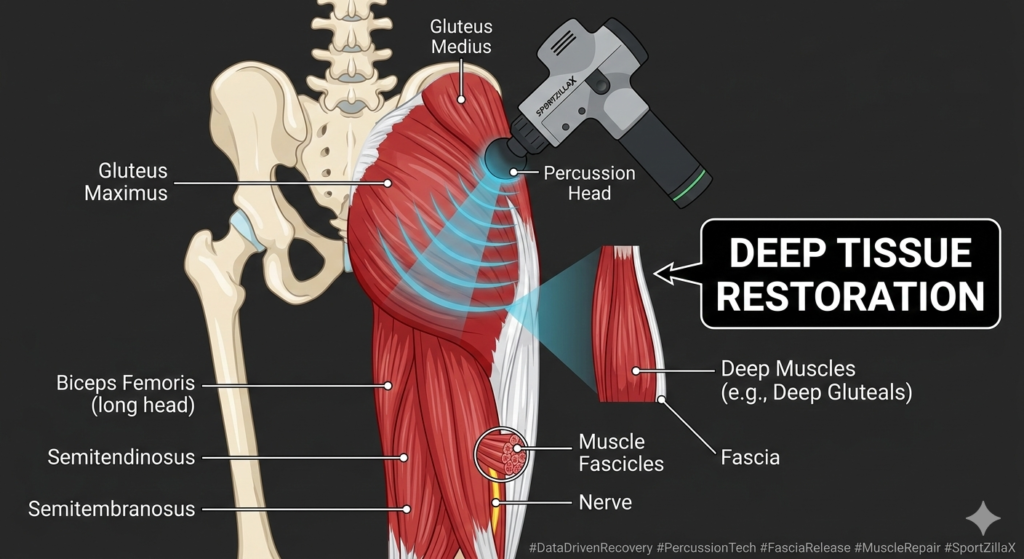
If you’re using a $30 massager from a generic marketplace, you aren’t doing percussion therapy; you’re just vibrating your skin. To trigger real muscle repair, you need a tool with a high Stall Force.
A “Stall Force” of at least 40 lbs is required for the device to keep moving when you press into the glutes or hamstrings. Cheaper motors will stop, meaning you never reach the deep fascia where the real recovery happens. At SportZillaX, we only recommend S-Tier gear that maintains its RPM regardless of the pressure applied.
FAQ: Precision Recovery Questions
Q: Can I use percussion therapy every day? A: Yes, but only if you follow the blueprint. On low-data days (High Stress), keep sessions short and frequencies low to avoid over-stimulating your nerves.
Q: Does syncing gear actually work for fat loss? A: Indirectly, yes. Faster recovery means you can hit high-intensity sessions more frequently without burnout, which is the primary driver for metabolic health.
The Bottom Line: Data Without Action is Waste
Your smartwatch is telling you a story every morning. If you aren’t using that story to guide your recovery equipment, you’re leaving 50% of your gains on the table. Bridge the gap. Sync your tech. Repair faster.
Ready to start your first 5-minute reset? Head over to our [Usage Guides] to watch our lead trainer demonstrate the HRV-Sync technique for elite-level recovery.