
Those dumbbells sitting in the corner of your room? This guide is for them.
You bought them with the best intentions. Maybe they got used a few times. Maybe they went straight from Amazon box to floor and stayed there. Either way, they’re waiting — and they have more potential than you’ve given them credit for.
Here’s the honest promise of this guide: 15 dumbbell exercises, organized by muscle group so you know exactly what each one does, with a beginner-friendly description of how to do each one correctly and what it should feel like when you’re doing it right. No bench required. No gym needed. No experience necessary.
We’ll also give you a complete 4-week dumbbell workout plan and straightforward guidance on what weight to start with — because “use a light weight” is the most useless advice in beginner fitness.
By the end of this, you’ll know exactly what to do with those dumbbells. Tonight, if you want.
Key Takeaways
- Research in the Journal of Strength and Conditioning Research confirms that dumbbell training produces equivalent muscle and strength gains to barbell training for beginners — the tool matters less than the effort and consistency
- Beginners should start with a weight they can lift for 10–12 reps with good form; if the last 3 reps don’t feel challenging, the weight is too light
- No bench is required for any exercise in this guide — all exercises use the floor, a chair, or standing position
- Compound exercises (movements working multiple muscle groups) produce greater hormonal response and calorie burn than isolation exercises — this guide prioritizes compounds
- The CDC recommends muscle-strengthening activity at least 2 days per week — this 4-week plan meets and exceeds that with 3 sessions per week
- Most beginners notice visible strength changes within 4–6 weeks of consistent training; body composition changes typically follow at 6–10 weeks
What Weight Dumbbells Should Beginners Use?
This is the question every beginner asks — and “use a light weight” is not an answer.
Here’s a practical framework:
The right weight is one where you can complete 10 reps with good form, but rep 12 feels genuinely hard. You should feel challenged but in control. If you can easily do 15 reps, go heavier. If you can’t complete 8 reps with good form, go lighter.
Starting point recommendations:
| Exercise type | Women (starting) | Men (starting) |
|---|---|---|
| Lower body (squats, lunges, deadlifts) | 10–15 lbs | 20–30 lbs |
| Upper body pushing (press, chest) | 8–12 lbs | 15–20 lbs |
| Upper body pulling (rows, curls) | 8–12 lbs | 12–20 lbs |
| Shoulders (lateral raise, front raise) | 5–8 lbs | 8–12 lbs |
These are starting points, not destinations. Every 2–3 weeks, ask yourself: can I complete all my reps without struggling on the last 3? If yes, increase weight by the smallest available increment.
If you’re looking for a versatile set that grows with you, our Best Adjustable Dumbbells for Home Workouts guide covers honest options from $150 to $500.
Sportzillax editor note: Most beginners go too light, especially women who’ve been told “tone up, don’t bulk.” A weight that doesn’t challenge you doesn’t produce adaptation. Choose a weight that’s uncomfortable by rep 12, not rep 20.
Upper Body Dumbbell Exercises for Beginners (5 Exercises)
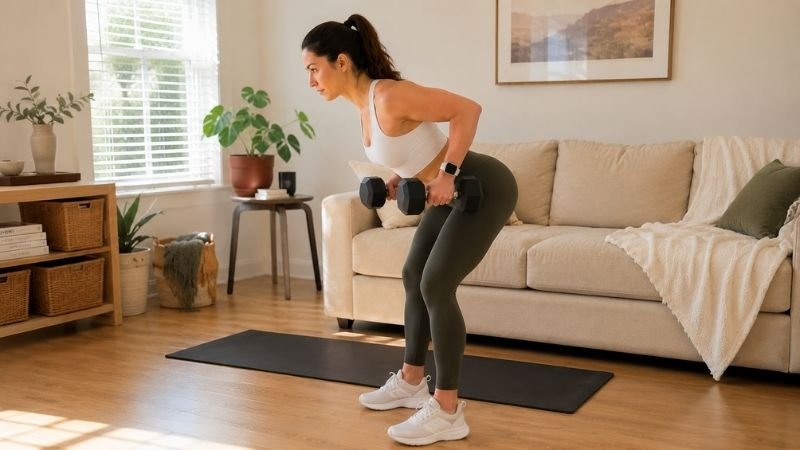
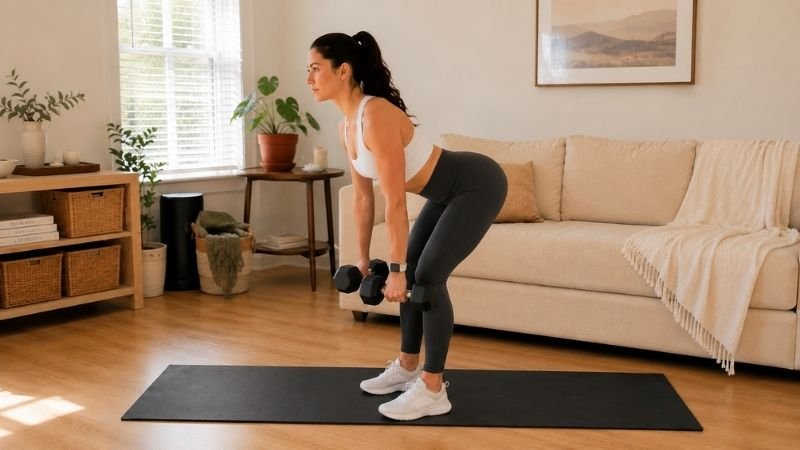
Exercise 1: Dumbbell Bent-Over Row Muscles: Mid-back, rear shoulders, biceps
Stand with feet hip-width apart, a dumbbell in each hand. Hinge forward at the hips until your torso is roughly parallel to the floor — think of pushing your hips back rather than bending forward. Let the dumbbells hang toward the floor. Pull both dumbbells up toward your hips, driving your elbows back. Squeeze your shoulder blades together at the top. Lower slowly.
Sets/Reps: 3 × 10–12 Rest: 60–75 seconds What it should feel like: The muscles between and beneath your shoulder blades should be working hard. If you feel it primarily in your biceps, you’re pulling with your arms instead of your back — focus on leading with your elbows.
Exercise 2: Dumbbell Floor Press Muscles: Chest, shoulders, triceps
Lie on your back on a yoga mat, knees bent, feet flat. Hold a dumbbell in each hand at chest level, elbows at about 45 degrees from your body. Press both dumbbells up until your arms are fully extended, then lower slowly until your elbows touch the floor. Pause briefly — don’t bounce — then press again.
Sets/Reps: 3 × 10–12 Rest: 60–75 seconds What it should feel like: A stretch and squeeze across your chest. The floor press is actually preferred over a bench press by many coaches because it naturally limits range of motion to a shoulder-safe position.
Exercise 3: Dumbbell Shoulder Press Muscles: Shoulders (front and middle heads), triceps
Sit on a sturdy chair or stand with feet hip-width apart. Hold a dumbbell in each hand at shoulder height, palms facing forward. Press both dumbbells overhead until your arms are fully extended. Lower slowly back to shoulder height.
Sets/Reps: 3 × 10–12 Rest: 60 seconds What it should feel like: The tops of your shoulders working hard as you press. Brace your core throughout — don’t let your lower back arch to compensate.
Exercise 4: Dumbbell Bicep Curl Muscles: Biceps, forearms
Stand with feet hip-width apart, a dumbbell in each hand, arms at sides, palms facing forward. Keeping your elbows pinned at your sides, curl both dumbbells up toward your shoulders. Squeeze at the top. Lower slowly — take 3 seconds on the way down.
Sets/Reps: 3 × 12–15 Rest: 60 seconds What it should feel like: The front of your upper arms should be burning by rep 12. The slow lowering phase is doing most of the muscle-building work.
Exercise 5: Dumbbell Tricep Kickback Muscles: Triceps (back of upper arm)
Hinge forward at the hips, a dumbbell in each hand. Bring your upper arms parallel to the floor, elbows bent to 90 degrees. Extend your forearms back until your arms are straight. Squeeze the back of your arms at full extension. Return slowly.
Sets/Reps: 3 × 12 Rest: 60 seconds What it should feel like: A distinct squeeze and burn in the back of your upper arms at full extension.
Lower Body Dumbbell Exercises for Beginners (5 Exercises)
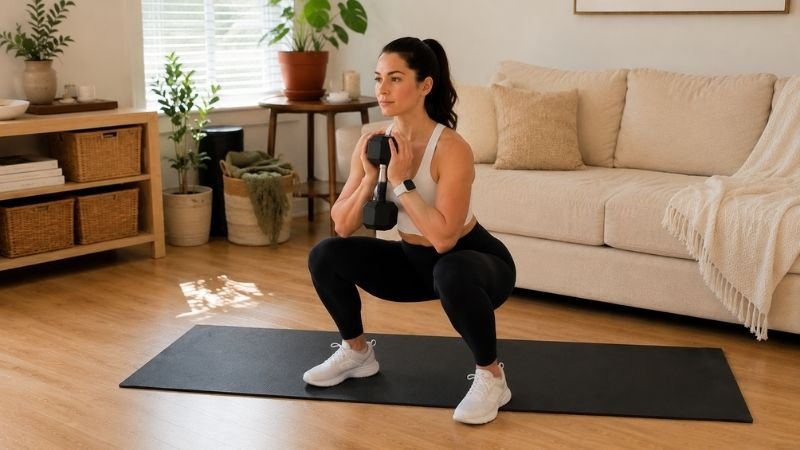
Exercise 6: Dumbbell Goblet Squat Muscles: Quads, glutes, hamstrings, core
Hold one dumbbell vertically at your chest with both hands cupped underneath. Feet shoulder-width apart, toes slightly turned out. Sit back and down into a squat — aim to get your thighs parallel to the floor or as low as comfortable. Drive through your heels to stand.
Sets/Reps: 3 × 12–15 Rest: 60–75 seconds What it should feel like: Your quads and glutes should be working hard by rep 10. If your heels are lifting, widen your stance slightly.
Exercise 7: Dumbbell Romanian Deadlift Muscles: Hamstrings, glutes, lower back
Stand with feet hip-width apart, a dumbbell in each hand at your thighs. Hinge at your hips — push your hips back as you lower the dumbbells down your legs, keeping your back flat. Lower until you feel a stretch in the back of your thighs, typically mid-shin. Drive your hips forward to return to standing.
Sets/Reps: 3 × 10–12 Rest: 75 seconds What it should feel like: A deep stretch and pull in the back of your thighs (hamstrings). If you feel it in your lower back instead, your back is rounding — reduce weight and focus on the hip hinge pattern.
Exercise 8: Dumbbell Reverse Lunge Muscles: Quads, glutes, hamstrings, core stability
Stand tall with a dumbbell in each hand. Step one foot back, lower your back knee toward the floor, then return to standing. Alternate legs. The reverse lunge is significantly easier on the knees than a forward lunge — it’s the right starting point for beginners.
Sets/Reps: 3 × 10 per leg Rest: 75 seconds What it should feel like: The front thigh (quad) and glute of the front leg working hard. If your front knee is traveling far over your toes, take a slightly larger step back.
Exercise 9: Dumbbell Sumo Squat Muscles: Inner thighs, glutes, quads
Stand with feet wider than shoulder-width, toes pointing out at 45 degrees. Hold one heavy dumbbell with both hands hanging between your legs. Squat down, keeping your knees tracking over your toes. Drive through your heels to stand.
Sets/Reps: 3 × 12–15 Rest: 60 seconds What it should feel like: Your inner thighs and glutes working — a different sensation from the goblet squat, which is more quad-dominant.
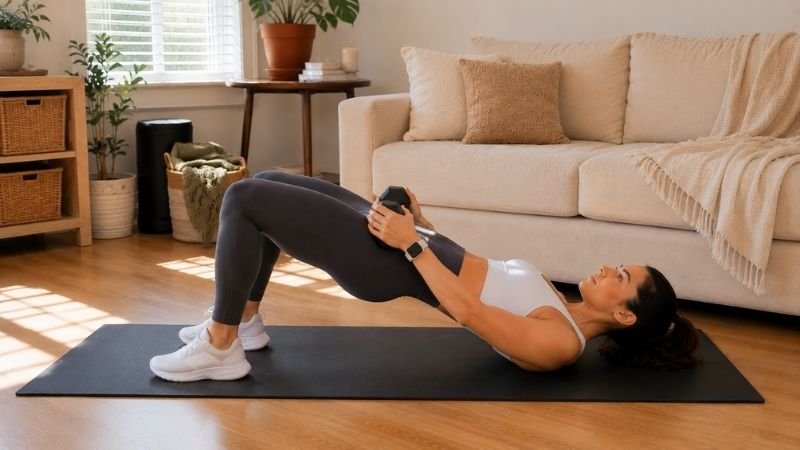
Exercise 10: Dumbbell Glute Bridge Muscles: Glutes, hamstrings, core
Lie on your back, knees bent, feet flat. Place a dumbbell on your hips and hold it with both hands. Drive your hips toward the ceiling, squeezing your glutes hard at the top. Hold 1–2 seconds. Lower slowly.
Sets/Reps: 3 × 15 Rest: 60 seconds What it should feel like: Your glutes should be the primary muscles working — not your lower back. If you feel this in your lower back, reduce the weight and focus on squeezing your glutes before lifting.
Full Body Dumbbell Exercises for Beginners (3 Exercises)
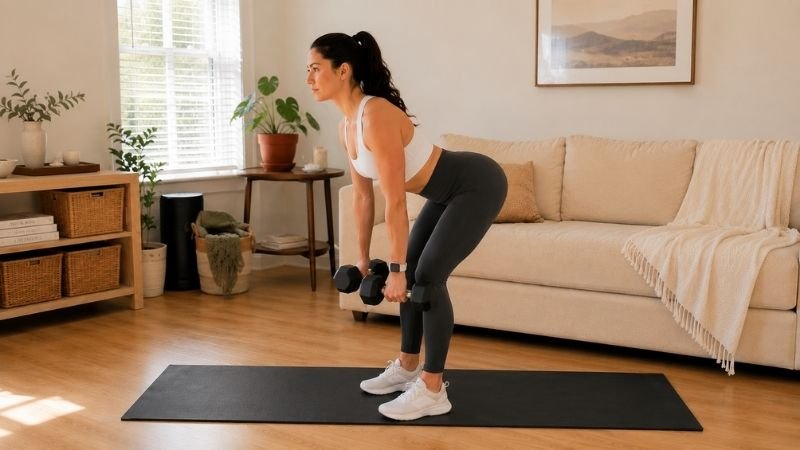
Exercise 11: Dumbbell Deadlift Muscles: Hamstrings, glutes, back, core — essentially everything
Stand with feet hip-width apart, dumbbells on the floor in front of you. Hinge and bend your knees to grip the dumbbells. Keep your chest up and back flat as you drive through your heels to stand, bringing the dumbbells up your legs. Lower with control.
Sets/Reps: 3 × 10 Rest: 90 seconds What it should feel like: Your entire posterior chain (back of body) working together. This is one of the most functional exercises available — it directly mimics picking things up from the floor.
Exercise 12: Dumbbell Push-Up Row Muscles: Chest, back, core, shoulders — full body stability
Start in a push-up position with a dumbbell in each hand. Perform one push-up, then row one dumbbell to your hip while balancing on the other. Lower it, do another push-up, row the other side.
Sets/Reps: 3 × 6 per side Rest: 90 seconds Modification: Do the push-up portion on your knees, then stand the dumbbells up and do the rows separately if the combined movement is too challenging.
Exercise 13: Dumbbell Farmer’s Carry Muscles: Core stability, grip, shoulders, legs — whole body
Hold a dumbbell in each hand, arms at your sides. Stand tall, shoulders back, core braced. Walk 10–15 steps forward, turn, walk back. This sounds almost too simple — it’s not. Heavy farmer carries are genuinely one of the most effective full-body strength exercises available.
Sets/Duration: 3 × 30 seconds walking Rest: 60 seconds
Core Dumbbell Exercises for Beginners (2 Exercises)
Exercise 14: Dumbbell Dead Bug Muscles: Deep core, transverse abdominis
Lie on your back, hold one light dumbbell in both hands pointing toward the ceiling. Knees at 90 degrees (tabletop). Slowly lower your arms overhead while extending one leg toward the floor, keeping your lower back pressed down. Return and alternate.
Sets/Reps: 3 × 8 per side Rest: 60 seconds
Exercise 15: Dumbbell Russian Twist Muscles: Obliques, core rotators
Sit on the floor, lean back slightly to create a V-shape. Hold one dumbbell with both hands. Rotate your torso to the right, tapping the dumbbell toward the floor. Return to center and rotate left.
Sets/Reps: 3 × 10 per side Rest: 60 seconds Note: Keep your lower back from rounding. If you feel strain in your lower back, reduce the weight or eliminate the weight entirely until your core is stronger.
Your 4-Week Beginner Dumbbell Workout Plan
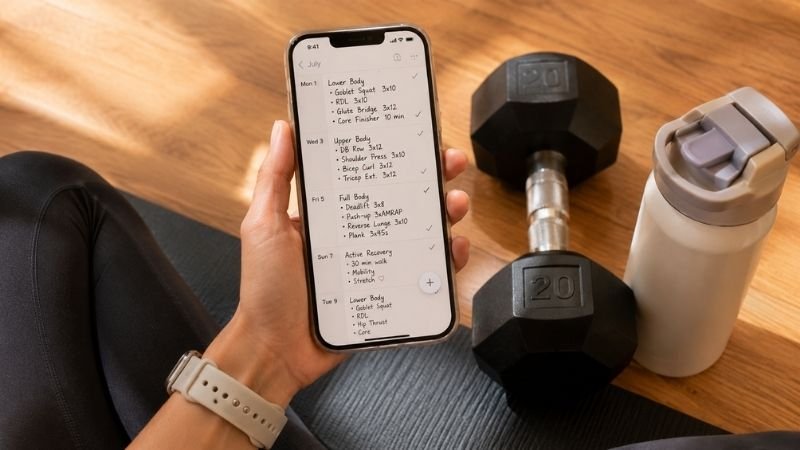
Here’s how to put these 15 exercises into a structured program.
Training frequency: 3 days per week, non-consecutive (e.g., Monday/Wednesday/Friday) Session duration: 30–40 minutes
Week 1–2 (Foundation) — 3 sessions per week
Session A:
- Goblet Squat — 3×12
- Dumbbell Floor Press — 3×10
- Dumbbell Bent-Over Row — 3×10
- Glute Bridge — 3×15
- Bicep Curl — 3×12
Session B:
- Romanian Deadlift — 3×10
- Shoulder Press — 3×10
- Reverse Lunge — 3×10 per leg
- Tricep Kickback — 3×12
- Dead Bug — 3×8 per side
Alternate Session A and B across your 3 training days.
Week 3–4 (Build) — 3 sessions per week
Add 2 reps to each exercise compared to weeks 1–2. Where possible, increase weight by the smallest available increment. Add:
Session C (added in week 3):
- Dumbbell Deadlift — 3×10
- Sumo Squat — 3×12
- Push-Up Row — 3×6 per side
- Farmer’s Carry — 3×30 sec
- Russian Twist — 3×10 per side
Rotate through all three sessions across your training days.
Dumbbell Exercises for Women: What You Should Know
The exercises in this guide are equally effective for women and men — the fundamental movements don’t change based on gender. But a few things are worth addressing directly.
You won’t bulk up from these exercises. Building significant muscle mass requires years of progressive heavy training, very high calorie intake, and specific hormonal conditions most women don’t have naturally. Consistent dumbbell training produces improved muscle tone, better posture, higher metabolic rate, and functional strength — not a bulky appearance.
Lower body exercises matter most for women’s goals. The exercises that produce the most visible body composition changes for women are goblet squats, Romanian deadlifts, reverse lunges, and glute bridges — the exercises targeting your glutes and legs. Don’t skip them in favor of arm exercises.
Protein intake matters. To support muscle adaptation from dumbbell training, aim for 0.7–1g of protein per pound of body weight daily. Without adequate protein, your muscles can’t fully utilize the training stimulus.
Common Mistakes Beginners Make with Dumbbell Exercises
Going too light. The most universal mistake. A dumbbell that doesn’t challenge you doesn’t produce adaptation. If you can complete 15 reps without effort, you need a heavier dumbbell.
Rushing through reps. Fast, momentum-driven reps reduce muscle activation and increase injury risk. Aim for 2 seconds up, 3 seconds down. Slower lowering phases produce more muscle stimulus per rep.
Only training upper body. Many beginners — especially women — focus on arms and avoid leg work. Your legs and glutes are the largest muscle groups in your body and produce the greatest metabolic benefit. Train them at least as frequently as your upper body.
Skipping rest days. Muscles grow during recovery, not during training. Three sessions per week with rest days between is optimal for beginners. Training the same muscles daily slows progress and increases injury risk.
When You Only Have 10 Minutes
Pick three exercises — one lower body, one upper body push or pull, one core. Do 3 sets of 10 each.
Example quick session:
- Goblet Squat — 3×10
- Floor Press — 3×10
- Dead Bug — 3×8 per side
Ten focused minutes. It maintains the habit. It deposits into your progress. It counts.
Warning Signs to Watch
Stop and consult a healthcare provider if you experience:
- Sharp or shooting joint pain (not muscle burn) during any exercise
- Wrist or shoulder pain that persists beyond 48 hours
- Lower back pain that worsens with hip hinge exercises (Romanian deadlift, deadlift)
- Dizziness or shortness of breath disproportionate to effort
Muscle soreness in the 24–48 hours after new exercises is completely normal. Sharp joint pain is not — it’s a signal to stop and assess.
Frequently Asked Questions
What are the best dumbbell exercises for beginners? For building foundational strength, the goblet squat, dumbbell Romanian deadlift, floor press, bent-over row, and glute bridge cover the five fundamental movement patterns (squat, hinge, push, pull, carry) and are appropriate for complete beginners. These five exercises alone are sufficient for a complete beginner strength program.
How heavy should dumbbells be for beginners? For lower body exercises: women start at 10–15 lbs, men at 20–30 lbs. For upper body: women at 8–12 lbs, men at 12–20 lbs. The right weight is one where the last 3 reps of each set feel genuinely challenging with good form. See our How Heavy Should Dumbbells Be guide for more detail.
Can I do dumbbell exercises for beginners at home without a bench? Yes — every exercise in this guide is designed to be done without a bench. The floor press replaces the bench press, glute bridges are done on the floor, and all other exercises are standing or floor-based. A yoga mat is the only surface you need.
How many dumbbell exercises should a beginner do per session? 5–6 exercises per session is ideal for beginners — enough to train your full body without excessive volume that extends recovery time. As fitness improves over 6–8 weeks, you can increase to 7–8 exercises per session.
Will dumbbell exercises help me lose weight? Dumbbell exercises build muscle, and muscle raises your resting metabolic rate — meaning you burn more calories even when not exercising. Combined with a modest calorie deficit, consistent dumbbell training is an effective component of fat loss. The exercises themselves burn 150–250 calories per 30-minute session, but the longer-term metabolic benefit of muscle building is the more significant contribution.
Pick Up Those Dumbbells Tonight
You now have 15 exercises, a 4-week plan, guidance on what weight to use, and a clear picture of what to expect. The only thing left is to actually start.
Tonight: do the Week 1 Session A workout. Five exercises, three sets each, about 25 minutes. That’s it.
When you’ve completed 4 weeks and you’re ready for the next level: → Full Body Dumbbell Workout at Home: The Complete Beginner’s 3-Day Plan
To understand how to keep making progress beyond week 4: → What Is Progressive Overload? The Simple Rule That Makes Home Workouts Actually Work
If you’re thinking about adding a second pair or upgrading to adjustable dumbbells: → Best Adjustable Dumbbells for Home Workouts (2026): Honest Reviews for Every Budget
References
- Schoenfeld, B.J., et al. (2020). Resistance Training Volume Enhances Muscle Hypertrophy but Not Strength in Trained Men. Medicine & Science in Sports & Exercise.
- Calatayud, J., et al. (2015). Comparative muscle activity of selected strength exercises for the upper body. Journal of Human Kinetics.
- Centers for Disease Control and Prevention (CDC). Physical Activity Guidelines for Americans. https://www.cdc.gov/physicalactivity/basics/adults/index.htm
- American College of Sports Medicine (ACSM). Resistance Training for Health and Fitness. Position Stand, 2009.
- Beyond Type 1. At-Home Workout: 15-Minute Dumbbell Routine for Beginners. https://beyondtype1.org/easy-dumbbell-workout-beginners/