
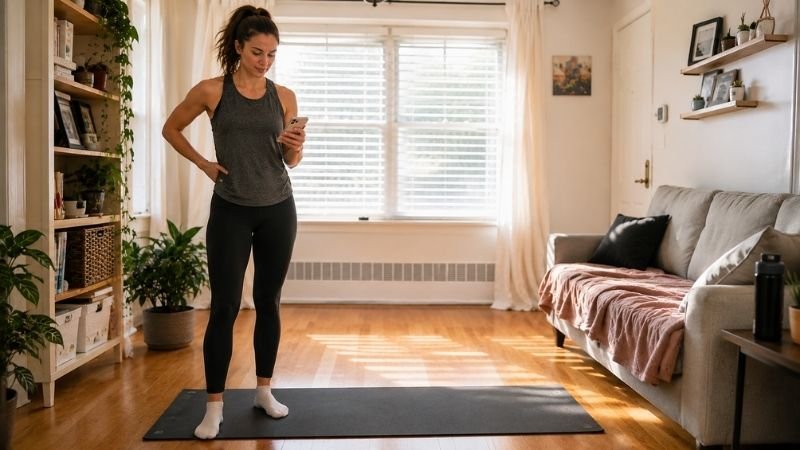
The hardest part of starting a workout plan isn’t the first workout. It’s the moment before — when you’re staring at a blank calendar wondering where to begin, what to do, how many times a week, and whether this time will actually stick.
Most beginner workout guides don’t help with that part. They hand you a list of exercises and leave you to figure out the rest. That’s why most beginner plans fail within two weeks — not because the exercises are wrong, but because the structure wasn’t clear enough to survive a busy Tuesday when everything else is already competing for your time.
This guide is different. You’ll get a complete, day-by-day beginner workout plan for 4 weeks — every workout mapped out, every exercise explained, every rest day accounted for. You don’t need a gym. You don’t need equipment (though we’ll show you how to add dumbbells if you have them). You need 20–30 minutes, three days a week, and a living room floor.
That’s it. Let’s build something you can actually stick to.
Key Takeaways
- The optimal training frequency for beginners is 3 days per week — research shows this provides sufficient stimulus for strength adaptation while allowing adequate recovery between sessions
- Beginner workout sessions should last 20–30 minutes, not 60+ — longer sessions don’t produce better results for those new to training and significantly reduce adherence
- The CDC recommends 150 minutes of moderate activity per week plus muscle-strengthening on 2+ days — this 4-week plan meets and exceeds both guidelines
- Consistency over intensity: a 20-minute workout you actually complete beats a 60-minute workout you skip every time
- Most beginners notice meaningful improvements in strength and endurance within 3–4 weeks — visible body composition changes take 6–8 weeks of consistent effort
- Rest days are not optional — they’re when your muscles actually strengthen; training every day as a beginner consistently leads to burnout or injury within 2–3 weeks
Before You Start: The One Decision That Changes Everything
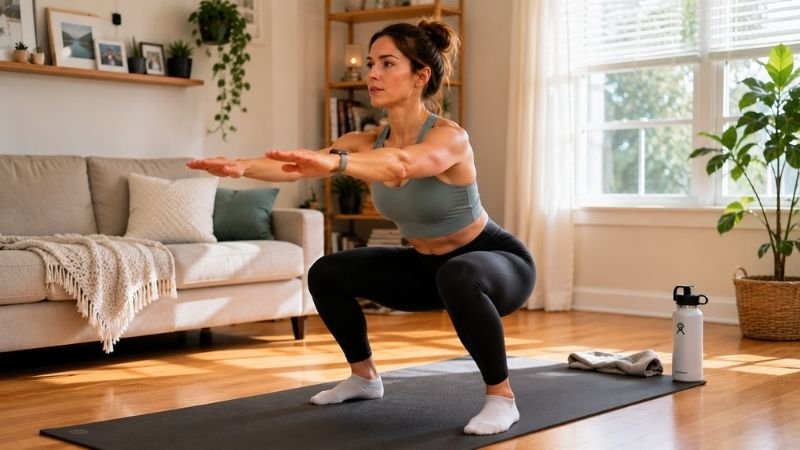
Most beginner plans overwhelm you with options. This one doesn’t. You make one decision before you begin:
Do you have dumbbells (or resistance bands) at home?
Yes → Use Plan A (bodyweight + light weights, in the plan below) No → Use Plan B (100% bodyweight, also in the plan below)
Both plans follow the exact same 4-week schedule, same days, same structure. The only difference is whether you’re adding resistance to certain exercises. You can start with Plan B and switch to Plan A any time.
That’s the only choice you need to make right now.
Why 3 Days a Week Is the Right Starting Point
There’s a common misconception that more training days = faster results. For beginners, this is almost always wrong.
When you’re new to strength training, your muscles experience significant micro-damage from even moderate exercise. They need 48 hours to repair and strengthen before being stressed again. Training on consecutive days without recovery leads to a phenomenon called overreaching — cumulative fatigue that stalls progress and increases injury risk.
Three days per week, with rest days in between, is the training frequency most consistently supported by research for beginner strength gains. A 2025 study confirmed that distributing training volume across multiple shorter sessions reduces perceived difficulty and improves adherence compared to fewer, longer sessions.
The schedule we’ll use: Monday / Wednesday / Friday or Tuesday / Thursday / Saturday — whichever fits your life. What matters is the rest day between sessions, not which specific days you choose.
Sportzillax editor note: If three days feels like too much right now, start with two. Tuesday and Friday works perfectly. A plan you actually do twice a week beats a plan you abandon after day three.
Your 4-Week Beginner Workout Plan (Day by Day)
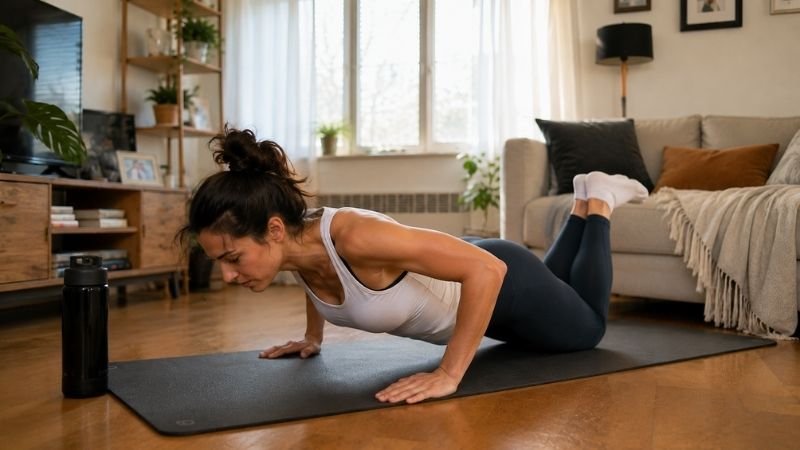
Every workout follows this structure:
- Warm-up: 3–5 minutes
- Main workout: 15–20 minutes
- Cool-down: 2–3 minutes
Total time: 20–28 minutes per session.
The Warm-Up (Same Every Session — 3 Minutes)
Do this before every workout, every time. It’s not optional.
- March in place — 45 seconds (lift knees to hip height, pump arms)
- Arm circles — 20 seconds forward, 20 seconds backward
- Hip circles — 20 seconds each direction
- Slow bodyweight squats — 8 reps (focus on form, not speed)
- Inchworms — 4 reps (hinge forward, walk hands to plank, hold 1 second, walk back)
WEEK 1 — Build the Foundation
Goal: Learn the movement patterns. Don’t focus on weight or speed — focus on doing each exercise correctly.
Day 1 (Monday or Tuesday)
| Exercise | Sets | Reps | Rest |
|---|---|---|---|
| Bodyweight Squat | 2 | 10 | 60 sec |
| Modified Push-Up (knees) | 2 | 8 | 60 sec |
| Glute Bridge | 2 | 12 | 60 sec |
| Dead Bug | 2 | 6 per side | 60 sec |
Plan A additions: Hold a light dumbbell at chest for squats (goblet squat). Add a dumbbell to glute bridges.
Day 2 (Wednesday or Thursday) — Rest or Walk Light 20–30 minute walk. No structured workout.
Day 3 (Friday or Saturday)
| Exercise | Sets | Reps | Rest |
|---|---|---|---|
| Reverse Lunge | 2 | 8 per leg | 60 sec |
| Modified Push-Up (knees) | 2 | 8 | 60 sec |
| Bird Dog | 2 | 8 per side | 60 sec |
| Glute Bridge | 2 | 12 | 60 sec |
Day 4 (Sunday) — Full Rest
Day 5 (Monday or Tuesday) — Week 1, Session 3
| Exercise | Sets | Reps | Rest |
|---|---|---|---|
| Bodyweight Squat | 2 | 12 | 60 sec |
| Modified Push-Up (knees) | 2 | 10 | 60 sec |
| Reverse Lunge | 2 | 8 per leg | 60 sec |
| Dead Bug | 2 | 8 per side | 60 sec |
How Week 1 should feel: Manageable. You should be slightly challenged but not exhausted. If you feel destroyed after Day 1, you went too hard — reduce reps next time.
WEEK 2 — Add a Little More
Goal: Increase reps slightly. Notice what’s getting easier. Push through — Week 2 is statistically where most beginners quit, and the only reason is that the novelty has worn off and the habit isn’t formed yet. Keep going.
Session 1
| Exercise | Sets | Reps | Rest |
|---|---|---|---|
| Bodyweight Squat | 3 | 10 | 60 sec |
| Modified Push-Up | 3 | 8 | 60 sec |
| Glute Bridge | 3 | 12 | 60 sec |
| Bird Dog | 2 | 8 per side | 60 sec |
Session 2
| Exercise | Sets | Reps | Rest |
|---|---|---|---|
| Reverse Lunge | 3 | 10 per leg | 60 sec |
| Modified Push-Up | 3 | 10 | 60 sec |
| Dead Bug | 3 | 8 per side | 60 sec |
| Glute Bridge | 3 | 15 | 60 sec |
Session 3
| Exercise | Sets | Reps | Rest |
|---|---|---|---|
| Bodyweight Squat | 3 | 12 | 60 sec |
| Push-Up (try 2–3 full, rest on knees) | 3 | 8 | 60 sec |
| Reverse Lunge | 3 | 10 per leg | 60 sec |
| Bird Dog | 3 | 8 per side | 60 sec |
Plan A: Week 2, add dumbbells to rows. Sit on the edge of a chair, hold a dumbbell in each hand, hinge slightly forward, pull elbows back (bent-over row). 3×10.
WEEK 3 — Build Momentum
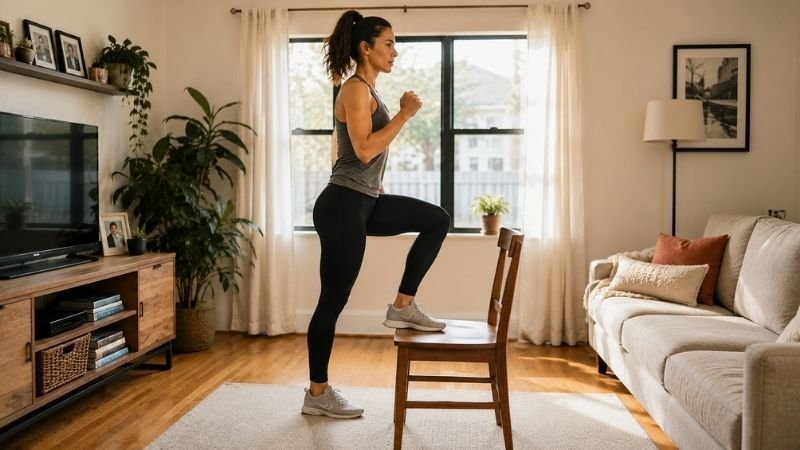
Goal: You’re three weeks in. Your body has adapted significantly from Week 1. The exercises that were hard are now your warm-up. Time to add a new challenge.
New exercises introduced this week:
Step-Up (using a sturdy chair or low step): Stand in front of the chair, step one foot up, drive through that heel to stand fully on the chair, step back down. 3×10 per leg.
Plank (from knees or feet): Hold a straight body position for 20–30 seconds. 3 holds.
Session 1
| Exercise | Sets | Reps | Rest |
|---|---|---|---|
| Goblet Squat (or Bodyweight Squat) | 3 | 12 | 60 sec |
| Push-Up (try full, drop to knees when needed) | 3 | 8–10 | 60 sec |
| Step-Up | 3 | 10 per leg | 60 sec |
| Plank Hold | 3 | 20–25 sec | 45 sec |
Session 2
| Exercise | Sets | Reps | Rest |
|---|---|---|---|
| Reverse Lunge | 3 | 12 per leg | 60 sec |
| Dumbbell Row (or Bent-Over Row) | 3 | 10 per side | 60 sec |
| Glute Bridge | 3 | 15 | 45 sec |
| Dead Bug | 3 | 10 per side | 45 sec |
Session 3
| Exercise | Sets | Reps | Rest |
|---|---|---|---|
| Step-Up | 3 | 12 per leg | 60 sec |
| Push-Up | 3 | 10 | 60 sec |
| Goblet Squat | 3 | 15 | 60 sec |
| Plank Hold | 3 | 25–30 sec | 45 sec |
WEEK 4 — Finish Strong
Goal: Complete the plan. Notice how different this week feels from Week 1. Reduce rest time by 10–15 seconds compared to Week 1. Same exercises, slightly less recovery between sets — that’s progressive overload happening automatically.
Session 1
| Exercise | Sets | Reps | Rest |
|---|---|---|---|
| Goblet Squat | 3 | 15 | 45 sec |
| Push-Up (full if possible) | 3 | 10–12 | 45 sec |
| Step-Up | 3 | 12 per leg | 45 sec |
| Plank Hold | 3 | 30 sec | 45 sec |
Session 2
| Exercise | Sets | Reps | Rest |
|---|---|---|---|
| Reverse Lunge | 3 | 12 per leg | 45 sec |
| Dumbbell Row | 3 | 12 per side | 45 sec |
| Glute Bridge | 3 | 15 | 45 sec |
| Bird Dog | 3 | 10 per side | 45 sec |
Session 3
| Exercise | Sets | Reps | Rest |
|---|---|---|---|
| Goblet Squat | 3 | 15 | 45 sec |
| Push-Up | 3 | 12 | 45 sec |
| Step-Up | 3 | 12 per leg | 45 sec |
| Plank Hold | 3 | 30–35 sec | 45 sec |
The Cool-Down (Same Every Session — 2 Minutes)
- Standing forward fold — 30 seconds
- Standing quad stretch — 20 seconds each leg
- Chest opener (clasp hands behind back, squeeze shoulder blades) — 20 seconds
- Seated spinal twist — 20 seconds each side
Beginner Workout Plan for Women: What’s Different (And What Isn’t)
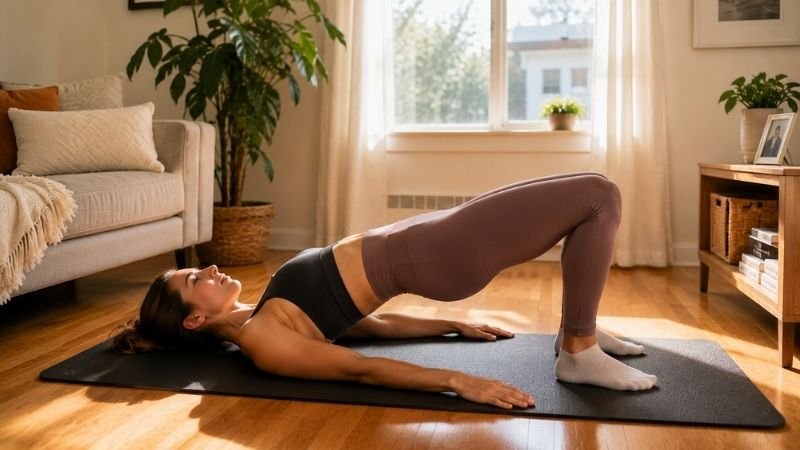
The exercises in this plan work equally well for women and men — the fundamental movement patterns (squat, hinge, push, pull, core) are universal. But there are a few things worth addressing specifically for women new to strength training.
You will not bulk up. This is the single most persistent myth in women’s fitness, and it stops millions of women from lifting weights. Building significant muscle mass requires years of progressive heavy training, very high calorie intake, and specific hormonal conditions that most women don’t have naturally. What this plan produces is increased muscle tone, improved posture, a higher resting metabolic rate, and more functional strength — not a physique that looks “too muscular.”
The exercises that will change your body most are probably the ones you’re most tempted to skip. Squats, lunges, and glute bridges target the glutes and legs — the largest muscle groups in your body, and the ones that produce the most metabolic benefit and visible change. Don’t skip leg day.
Your energy will fluctuate with your menstrual cycle — and that’s normal. If Week 3 falls during your period and everything feels harder, that’s not a fitness problem. It’s physiology. Reduce reps or rest more. Come back next session.
Beginner Workout Plan for Weight Loss: Setting Realistic Expectations
This plan will support fat loss — but it’s worth being clear about how.
Strength training builds muscle, and muscle burns more calories at rest than fat does. Over weeks and months, this raises your resting metabolic rate, making fat loss more sustainable long-term. The workouts themselves burn 100–200 calories per session — meaningful, but not the primary mechanism.
The primary driver of fat loss is a calorie deficit — consuming slightly less than your body needs. This plan, combined with moderate attention to what you’re eating (not a crash diet — just reasonable portions and adequate protein), will produce visible results within 6–8 weeks.
Realistic expectations:
- Weeks 1–2: You’ll feel sore. You’ll feel stronger. The scale may not move.
- Weeks 3–4: Clothes may start fitting differently. Energy typically improves.
- Weeks 5–8: Visible changes in muscle tone and body composition begin to show for most people who are consistent.
If fat loss is your primary goal, adding 3 days of home cardio (walking, low-impact circuits) to your 3 strength days accelerates results significantly without adding gym time.
What to Do If You Miss a Day (The Rule That Keeps Most People Going)
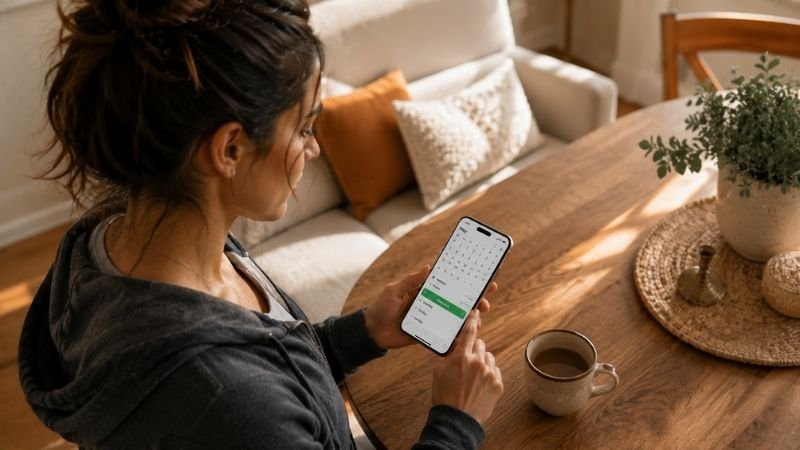
This matters more than the workout plan itself.
The single most common reason people abandon a beginner workout plan isn’t injury or lack of motivation. It’s missing one day, feeling guilty, deciding they’ve “fallen off track,” and stopping entirely.
Here’s the rule that prevents this: A missed workout is not a failed plan. It’s a rescheduled workout.
If you miss Monday, do it Tuesday. If you miss Tuesday too, do it Wednesday. If you miss the entire week, start the next week where you left off — don’t restart from Week 1 as punishment. Life happens. One missed week in a month of otherwise consistent training is still three weeks of consistent training, which is genuinely meaningful progress.
The only version of this plan that fails is the one you abandon completely. Everything else is just adjustments.
When You’ve Finished Week 4 — What Comes Next
Completing 4 weeks of consistent training is a genuine achievement. Your body has changed — you’re stronger, your movement patterns are more efficient, your recovery is faster. Now what?
Option 1 — Repeat the plan with heavier weights. Go through the same 4 weeks using heavier dumbbells (or adding dumbbells if you did Plan B). The familiarity of the exercises lets you focus entirely on progressive overload.
Option 2 — Move to a structured 3-day dumbbell split. Our Full Body Dumbbell Workout gives you the next step — a more advanced 3-day program with greater exercise variety and heavier loads.
Option 3 — Add cardio. Layer in 2–3 home cardio sessions per week alongside your strength training for a more complete fitness approach.
Warning Signs to Watch For
Most beginner workout soreness is normal — you should expect muscle soreness (DOMS) in the 24–48 hours after new exercises. This is distinct from injury.
Consult a doctor or stop training if you experience:
- Sharp or shooting pain during an exercise (not muscle burn — actual pain)
- Joint swelling that doesn’t resolve within 24–48 hours
- Chest pain, dizziness, or severe shortness of breath during low-intensity movement
- Symptoms that consistently worsen with exercise rather than improving with recovery
When in doubt, rest an extra day. One extra rest day costs you nothing. Pushing through an injury costs you weeks.
Frequently Asked Questions
How many days a week should a complete beginner work out? Three days per week is the research-supported sweet spot for beginners. It provides enough training stimulus for strength adaptation while allowing 48 hours of recovery between sessions. More than 4 days per week as a beginner consistently leads to burnout or injury before the habit is established.
How long should a beginner workout be? 20–30 minutes is ideal for beginners. Longer workouts don’t produce proportionally better results and significantly reduce adherence — the gym session you actually complete consistently beats the perfect 60-minute plan you keep skipping. As fitness improves after 6–8 weeks, you can naturally extend sessions.
Can I do this beginner workout plan without any equipment? Yes — Plan B in this guide is 100% bodyweight. No dumbbells, no resistance bands, nothing beyond a yoga mat (optional). All exercises use your body weight as resistance. You can add equipment later as you progress.
What should I eat when starting a workout plan? Focus on two things: adequate protein (0.7–1g per pound of body weight daily to support muscle repair) and not dramatically reducing calories in your first month of training. Your body is adapting to a new demand — underfueling this process stalls results and increases fatigue. Eat regular meals with protein at each one, stay hydrated, and adjust calories gradually if weight loss is a secondary goal.
I’ve tried workout plans before and always quit by week two. How is this different? Week two is genuinely the hardest week of any new exercise habit — the novelty has worn off and the habit isn’t formed yet. Knowing this in advance is your advantage. Put Week 2 sessions in your calendar now, treat them like appointments, and lower the bar: a 20-minute workout that feels too easy still counts. Showing up in Week 2 is the most important thing you’ll do in this entire plan.
Start Today — Not Monday
There’s a version of you that’s been planning to start a workout plan for a while. That version keeps pushing the start date forward. Monday. After the holidays. When things calm down.
Things rarely calm down. Monday has a way of becoming next Monday.
The actual first step isn’t the workout. It’s clearing a space in your living room, deciding which three days this week you’ll train, and adding them to your calendar. Do that now. The workout can start in five minutes.
Week 4 is coming whether you start today or not. The only question is whether you’ll be four weeks stronger when it gets here.
When you’ve completed this plan and you’re ready for the next step: → Full Body Dumbbell Workout at Home: The Complete Beginner’s 3-Day Plan
→ What Is Progressive Overload? The Simple Rule That Makes Home Workouts Actually Work
→ Cardio at Home: The Best No-Equipment Workouts for Beginners
References
- American College of Sports Medicine (ACSM). Progression Models in Resistance Training for Healthy Adults. Medicine & Science in Sports & Exercise, 2009.
- Centers for Disease Control and Prevention (CDC). Physical Activity Guidelines for Americans. https://www.cdc.gov/physicalactivity/basics/adults/index.htm
- Ralston, G.W., et al. (2017). The Effect of Weekly Set Volume on Strength Gain: A Meta-Analysis. Sports Medicine.
- Schoenfeld, B.J., et al. (2016). Effects of Resistance Training Frequency on Measures of Muscle Hypertrophy: A Systematic Review and Meta-Analysis. Sports Medicine.
- Clear, J. (2018). Atomic Habits. Avery Publishing. (habit formation research application)